Lifelode – A Domestic Fantasy to Chew On

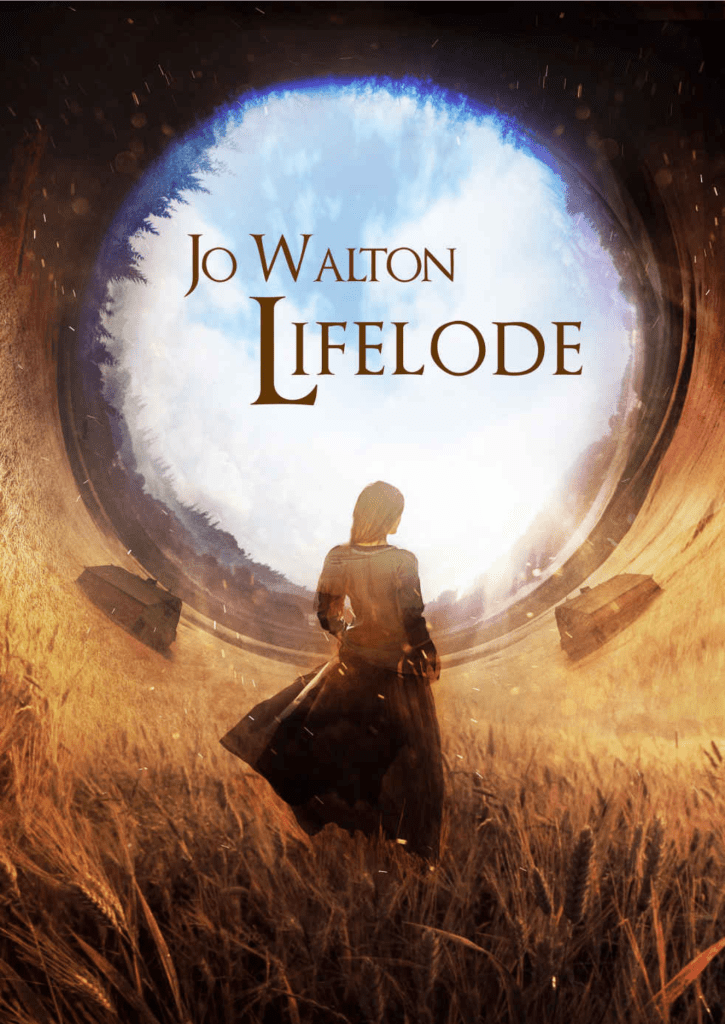
I am so happy that I read Lifelode. It isn’t a perfect book, but I love how it defies easy comparisons and pushed boundaries of fantasy in the 2000s structurally and thematically. It’s got delightfully weird worldbuilding and, if pressed, would use One Hundred Years of Solitude as the closest comparison I’ve read (though even that isn’t right). More selfishly, it’s also probably one of the best books I’ve read for a book club, simply because I think Lifelode makes so many bold choices that will spark interesting discussion. Certainly my views here on how Walton handled theme don’t seem to be universally shared amongst those who, like me, ended up reading far ahead for our midway discussion. Lifelode isn’t necessarily a dense book, but there’s a lot of interesting choices here which set a great foundation for discussion whether you loved or hated the directions the story took. 

The Premise:
Applekirk is a rural farming town run by a lord and his family, who live in a large manor. Taveth is one of the four adults of the marriage, committed to maintaining the house. One of her husbands is Lord, another manages the sheep and farms. Meanwhile Chayra, the other wife of the house, has found joy in throwing pots. Their lives are thrown out of routine with the arrival of a flirtatious travelling scholar, a meanspirited ancestor to one of Taveth’s husbands, and a priestess of the goddess of marriage who has been sent to bring said ancestor to the goddess’ justice. Just as important, however, is the harvest and all preparations it requires. 

Read if Looking For: books without easy comparisons, celebration of traditionally feminine work, Gods as hiveminds, reimagined family structures

Avoid if you Dislike: pastoral settings, relationship drama, complex family trees, peas, petty characters

Continue reading “Lifelode – A Domestic Fantasy to Chew On”

Children of Time

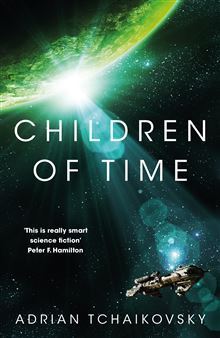
I meant to read this book ages ago, but my dad (who never reads) picked it up off my bookshelf while visiting and took it back to Kansas. I finally resigned myself to not getting it back and grabbed another from a used bookstore. I’ve only read one other book from Tchaikovsky, and this confirmed that I like his books a lot, but they’re probably only for when I’m in the mood for something on the more breezy/readable end of things. 

The Premise:
A planet was terraformed, meant to be home to monkeys infested with an evolutionary super-virus to help them prepare a civilization for humans to inherit. Things went wrong, and invertebrates ended up with the virus instead. We follow two societies across thousands of years: the spiders who raise from a simple hunter/gatherer society into spacefaring astronauts, and a spaceship carrying what may be the last of humanity, seeking one of the homeworlds. They will only briefly interact in this book, as their storylines largely remain separate but for a few discrete moments in time. 

Read if Looking For: so many spiders, batshit crazy worldbuilding, spaceship politics

Avoid if Looking For: inhuman narration, stories focusing on first contact, messy thematic work

Continue reading “Children of Time”

Tongues

It has taken me much longer to write this review than is normal. It’s tough to figure out how to talk about this book, or why I enjoyed it so much. I found this to be a bit like trying to point out a bird in the forest. The problem lay not with getting a friend to find the bird on the tree, but rather trying to get them looking at the right tree in the first place. Too zoomed in on specifics and a review loses any sense of cohesion, but too zoomed out and you have nothing interesting to say. There’s a lot to say about Tongues. Even when I end up disliking the choices an author makes in stories like this, I appreciate the gradual blurring of lines between Literary Fiction and Genre Fantasy. Thankfully though, I ended up liking Tongues a lot.

The Premise
This is a book that takes a bunch of elements from Greek myth (or, our cultural ideas about Greek Myth smashed into something eldritch and ancient) and fast-forwards the see how they’re interacting with the modern world. Prometheus befriends the Eagle who eats his liver each day. A teenager with a teddy bear on his back wanders through the war-torn landscape of Afghanistan. A girl is tasked by eldritch creatures to kill a god. A mysterious cult is gaining prominence in the region.

Read if Looking For:
– something weird
-something disturbing
– something baroque

Avoid if Looking For:
– something quick
-something sweet
– something simple

Continue reading “Tongues”

The Divine Cities Trilogy

Robert Jackson Bennett is currently getting laude for his Shadow of the Leviathan series (which are quite good on the whole). However, I think his Divine Cities Trilogy is by far the superior work, even if it’s taken me about four years to read the entire thing (I wrote in my review of book 2 that the finale would be ‘a priority for 2024’ yet I’m only getting around to it in 2026). These books are unlike anything I’ve read. The prose is straightforward enough, Bennett’s thematic work is ambitious and so very different from the examinations of imperialism we see in the 2020s, including his current series. It’s the type of mind bending and ambitious fantasy I love to read, and it safely sits as some of my favorite books in the genre. 

Read if Looking For: spycraft/action hybrids, competent protagonists, weird gods, thorny questions without easy answers

Avoid if Looking For: direct sequels, purely happy endings, John le Carre style bureaucracy spycraft, straightforward morality

Continue reading “The Divine Cities Trilogy”

The Chromatic Fantasy

I’m all about unapologetically queer books, and The Chromatic Fantasy definitely fits that brief.  This book isn’t a tour-de-force on the trans experience, but it’s an extremely fun romp a book with great art that didn’t disappoint in the slightest. I need to wait a week or two to see if this has the emotional staying power to crack my top 10 of the year, but I think it’s got a pretty good shot. 

The Premise
Jules hates being a nun, in no small part because he’s not a woman. To escape, he makes a deal with the Devil, gaining immortality and becoming a thief, swordsman, and general troublemaker. When he meets his match a fellow scoundrel, the two figure out what a life together might look like. Turns out, this life mostly looks very, very chaotic. Looming over Jules’ new life though, is the Devil constantly pushing Jules into isolation, depression, and doubt.

Read if Looking For: tricksters and thieves, anachronism and whimsy, more color than a chameleon at a rave

Avoid if Looking For: fully coherent plots, historical accuracy (or even consistency in the intensity of historical inaccuracies), memorable villains, books without nudity

Continue reading “The Chromatic Fantasy”

The Route of Ice and Salt

A Mexican horror novel following a ship captain of a ship transporting vampires, playing off elements of Dracula (which I haven’t read). It’s an excellent translation, and a dip into the more Literary side of horror than I normally go for. This was a good reminder of why I was a bad English major in college, and why genre fiction is my happy place over Literature. However, I’m glad I read this, and I think it’s much better at engaging with vampires’ historic associations with queerness in interesting ways than most other queer vampire books I’ve read.

The Premise
The captain of the Demeter has been hired to take fifty boxes of dirt to England. The captain spends the trip in a haze, torn between his constant desire for the companionship of men and his responsibilities as captain of the ship. And he dreams. Oh does he dream, and his dreams grow ever darker as strange things begin to take place on the Demeter, shifting what should have been an easy and profitable journey into a thing from nightmares.

Read if Looking For: intense focus on internal monologue, dream sequences, horror of the unseen, prose like liquid silk

Avoid if Looking For: direct plot or prose, ethical gays, paranormal romance elements, cute rats, protagonists who don’t sexually harass people, vampires with major speaking roles

Continue reading “The Route of Ice and Salt”

A Drop of Corruption (Shadow of the Leviathan #2)

The Tainted Cup was one of my favorite reads of last year, and I knew that this book was going to be on my 2025 reading list. Robert Jackson Bennet is a fantastic author who has an ability to write across a wide range of styles. Though billed as traditional murder mysteries, I actually think of this series, I actually think this series lives in a hybrid between mystery, thriller, and fantasy. Overall, I liked book 1 more, but this was still a fantastic read, and I’ll happily keep gobbling them up as they come out!

For my review of book 1, see The Tainted Cup.

The Premise:
In this installment of Din & Ana’s adventures, they travel to Yarrow, a part of the world not (yet) part of the Empire, but which hosts the Leviathan dissection and processing facility known as The Shroud. When a member of the delegation supervising negotiations with the Yarrow government about joining the Empire turns up dead, Ana is called in to solve the case. 

Honestly, if you liked book 1, you’ll probably feel similarly about book 2. If you didn’t, I doubt this will solve any issues you had.

Read if Looking For: a murder mystery/thriller in a biopunk world filled with obscure and arcane grafts that modify humans into something more.

Continue reading “A Drop of Corruption (Shadow of the Leviathan #2)”

Perdido Street Station

This is a book that’s been sitting on my ‘priority read’ bookshelf for about three years now. New Weird is a genre I’d been interested in, and Miéville’s reputation as an author who is concerned with his books as political objects pushing against the autoritarian status quo of fantasy really appeals to me. However, I’m finding that extremely large books put me off more than they used to, and I kept pushing it off until I was in the right mood. I left the book with mixed feelings. In some parts I felt in awe of what Miéville was accomplishing, and elsewhere I was disappointed in the choices he made to the point where I considered stepping away for a week or two. I have the feeling that I’ll be thinking about this book for a while, as it seems the type of story to sit with you.

The Premise
New Crobuzon is a dirty, grimy city. It’s filled with trash, corruption, and enough police brutality to make Vladmir Putin proud. It’s also home to humans, cactus-people, women with scarabs for heads, avian humanoids, literal demons, hands that can posess people, a whole caste with intensive plastic surgery forcibly grafting on mechanic or animal parts onto their bodies, among other things. This story mostly follows a dating couple: Isaac (a scientist) and Lin (an artist). Isaac gets recruited by a bird man without wings to get him to fly again, and Lin is recruited by a crime boss to create a masterpiece sculpture. Events spiral out of control, bizarrely leading to eldritch abominations let loose across the sprawling metropolis.

Read if You Like: unhinged worldbuilding, examinations of power and culture, eldritch horrors, characters without happy endings, books to chew on

Avoid if Looking For: fast paced stories, consistent female characterization, happy and mindless books

Continue reading “Perdido Street Station”

The Seven Moons of Maali Almeida

Sometimes, incredible books fall in your lap for no seeming reason (and by no seeming reason, I really mean Audible’s algorithim has learned that I like books about gay men). It’s certainly not my normal fare: I don’t read a ton of magical realism, and even less that pushes more on the literary end of things than the genre fiction side of that subgenre. Yet I’m so incredibly thankful I indulged the whim to dive into this book. It isn’t perfect, and likely won’t crack my favorite reads of the year, but it’s going to stick with me for a long time.

The Premise:
Maali is dead, stuck in a queue to find his way to the next life. He doesn’t know how he died, but he knows that he has unfinished business in the land of the living. He’s a war photographer in 1990 Sri Lanka, a gambler who loses more money than he makes, and a slut who has trouble remaining monogamous to the boyfriend he really does dearly love. He learns he has seven days before he is stuck forever in the in-between, and promptly sets off to try and get his partner and best friend to find his photographs, which have the power to topple a government.

Read if You Like: Magical Realism, ghosts, critiques of colonialism, dry humor

Avoid if You Dislike: tight plotting, morally upright characters, books lacking answers hard questions they bring attention to

Continue reading “The Seven Moons of Maali Almeida”

Toward Eternity

It’s been a while since I read a book whose back cover so poorly represents what is in the book itself. Anton Hur was done dirty by his publisher on this one, because the premise for the book is much more interesting than what’s shared. I expected a story about how society is adapting to technology that turns people immortal, with a focus on a patient/researcher and his poetry AI bot. While all that is indeed there, this story is actually a millennia spanning reflection on what it means to be a person, a unique individual, and how choices can echo across time. It has at least seven different POV characters who almost never repeat past a single chapter. A much more ambitious novel than it appears; it reminded me a lot of The Vanished Birds by Simon Jimenez, which is about as high of praise as I can possibly give.

The Premise:
Okay, let’s try to do a better job than the publishers. This book starts in a near-future world where emerging research shows nanomachines can turn you immortal and cure pretty much any ailment. Dr. Beeko runs this lab with Yonghun (who has undergone the research) and who has disappeared mysteriously. One of the only witnesses is Panit, Yonghun’s AI poetry-analysis machine who has been collecting dust for years. From this setup, we start exploring these events from these character’s points of view, then shifting to other patient’s experiences with nanotherapy, before jumping forward in time to explore a new version of the world where we see how these nanobots have shifted the world again … and again … and again. To give some sense of scope, the book is split into five sections: near future, future, distant future, very distant future, and eternity, and the choices of the original cast filter down into later storylines, they aren’t lead characters continuously throughout the novel.

Read if Looking For: books spanning millennia, philosophical musings, epistolary novels

Avoid if Looking For: straightforward stories, single POVs, everything explained in the end

Continue reading “Toward Eternity”