
I have been dying to read this book for ages. Eldritch bugs + magic perfume + creepy operas = one hell of an idea for a book, and every review I’ve seen has said it lives up to its premise. I got lost wandering the streets of Hiron Ennes’ imagination. It is a decadent new entry in the New Weird genre, and it feels extremely apt for a world that sees the potential for the first human being to become a trillionaire. This book is a masterpiece, and I really wish I hadn’t read it near the end of the school year as my brain is struggling to remember which hallway the copy room is in.
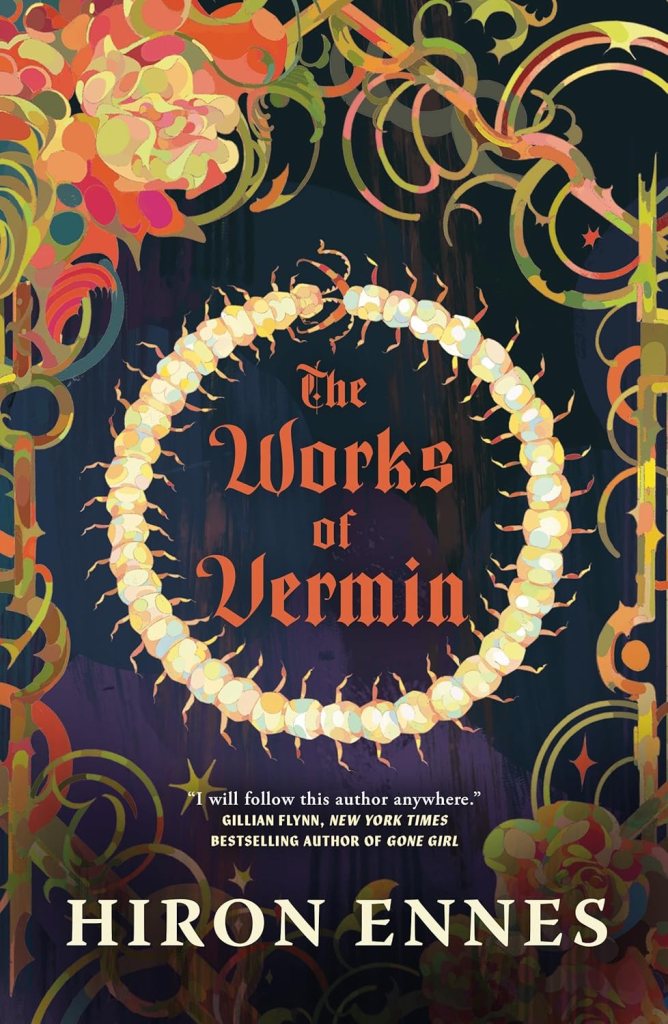
The Premise:
Guy is a vermin exterminator in the undercity, struggling to support himself and his younger sister. Aster is the chief perfumer for the violent Grand Marshal, who wears the skulls of those who would kill him as helmets. An insect with a taste for fine art has begun feeding in the city, and political unrest has begun to stir.
Read If Looking For: violent revolutions, weird worldbuilding, the dangers of capitalism, so many operas, big ass bugs
Avoid If Looking For: windowpane prose, clear explanations of how things work, dramatic fight scenes
Comparable Media: Perdido Street Station, Ambergreis, The Divine Cities
What Worked for Me:
The worldbuilding in works of vermin is simply delicious. Yes the city is a stump, and yes this leads to all sorts of delightful details (each root is its own neighborhood!). However, Ennes’ worldbuilding holds the special quality of making you feel that astounding things are, in fact, completely unremarkable. Tiliard is full of hallucinogenic insects, bugs that consume your ability to cook quality meals, and millipedes that consume art itself. Technology runs on sugar and sap. The upper class weaponizes perfume, mixing scents that stray into the realm of magic. The murder of actors as part of an operatic performance is utterly unremarkable, even though this death is administered through a poison that causes muscles to bloom like a flower. To the denizens of Tiiard however, this is unremarkable. The city is bizarre and disturbing and vibrant. Most of all, however, it feels like the characters walking the streets belong there, unaware of how strange their world is.
Thematically, I loved Ennes’ insistence that capitalism, art, politics, and war cannot be isolated. They go beyond claiming these elements impact one another, instead asserting that they are, fundamentally, the same thing. A military raid’s novel (and intensely disturbing) tactics and new visual artistic styles are both simply an indication of a regime change from one era to another (Revivalism being the most relevant movement for most of the book). Predatory loan sharks cannot be disentangled from operas which profit from the on-stage execution of ‘traitors’ who dared to paint outside the bounds of established technique. The destruction of a building is an artistic masterpiece. Whether Ennes would apply this thought process to our world is beyond my knowledge. It certainly rings true for me however; we live in a world where art, politics, war, and business is being rapidly reshaped by AI (and reactions to AI). And in both worlds, the people who benefit most are those who were already filthy rich before the regime change began.
Structurally, Ennes’ choice to balance two separate storylines was a great choice. We see both the most opulent and seediest parts of society at once. The rich perfumier and the downtrodden exterminator climbing out of debt is a really great pair – though the book continues to expand those I’d consider ‘main’ characters as it continues. They shuffle back and forth expertly, pushing storylines that thematically mirror each other even as they inevitably converge. Ennes plays a few tricks with this format. While I didn’t see the exact specifics they were going for, I found the shape of the ‘twists’ pretty obvious. I didn’t mind it though, and I think some people will love a reread with the context that the ending of the book provides to the opening. Thematically though, this book felt a lot like when The Hunger Games would comment on the absurdity of Capitol fashion. However, the whole book is examining that slice of culture (and the exploitation it’s based on) instead of using it as a fun-but-inconsequential worldbuilding detail. Guy in particular straddles these two worlds. Yes, he’s a bottom level exterminator with a short life expectancy. He also spent his childhood ushering at the opera, sneaking looks at performances with earplugs removed, consuming the art illegally. He is the glue that holds the story together, including his unconditional devotion to keeping his sister safe from the life he’s trapped in.
What Didn’t Work For Me:
This is, I think, purely a me problem. It was a bit wordy for my current mood. The descriptions in Works of Vermin trend towards the baroque and abstract. Ennes paints a scene with metaphor and ambiguity as much as they do sensory details. This was objectively the correct choice for this novel. A book that dwells so much on the absurdity and indulgence of rich-people art should be a little bit flowery. At the end of the school year though, I think I’d have preferred something a little bit simpler. Works of Vermin doesn’t quite demand your attention, but neither does it allow you to turn off your brain to enjoy the ride. Again, I think Ennes made all the right choices. I just wasn’t in a place to receive those choices quite as much as I’d have liked.
Conclusion: A deliciously original story with lots to say


Thank you for your review because I don’t think I would be able to read this book myself (big bugs, no thank you!).
LikeLiked by 1 person
That’s me with surgery/anatomy scenes! I’ve read some body horror (and will keep trying it), but it isn’t uncommon for me to flip a page or two ahead to see if descriptions have passed.
LikeLiked by 1 person
I guess everyone has something they know they’re better off skipping over.
LikeLike