
The best book I read last year was How to Survive this Fairytale by SM Hallow. It was by a new indie publishing house, so I decided to pick up a few other of their titles. Unfortunately, Hedone Books has gone under, because I very much would have been interested in more of books they put out. Currently, you can only read The Flesh of the Sea via Audible; I was lucky enough to have purchased my physical copy before the publisher went under. This won’t be my favorite read of the year (or even this project), but it was very enjoyable. It’s a quick read – even in the context of novellas – and I think it would be a fairly good palette cleanser, especially when paired with other weird-nautical series like Tide child.
The Premise:
Wilford is a natural scientist who, after getting rejected by the Royal Society in London, ends up on a really weird pirate ship. He sends letters of his misadventures to a fellow naturalist, Jean Baptiste, whom he had been avoiding after a drunken kiss. On his travels, Wilford encounters all sorts of disturbing and disgusting creatures, befriends his crewmates, and generally tries to prove his worth to himself, Jean Baptiste, and the Society. Meanwhile, Jean Baptiste’s journal shows his life feels empty without Wilford in it, and he gets very upset about an overprotective pirate who has been making moves on Wilford.
Read If Looking For: weird travelogues, disaster academics, yearning and pining, epistolary novels, quirky pirate crews
Avoid If Looking For: intense horror and gore, bespoke prose, Romantasy
Comparable Media: Tide Child, Memoirs of Lady Trent, Someone to Build a Nest In
But is it Horror?
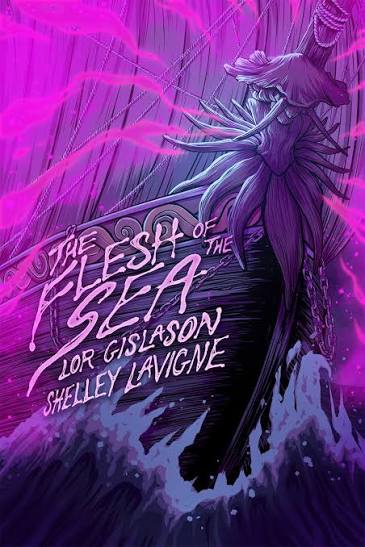
I came in expecting a really intense Eldritch Horror experience, which the cover and the story’s blurb seem to push towards. It didn’t quite hit that brief for me. I consider myself a fairly squeamish person, but I never felt grossed out by this book, even when it felt like I probably should be. One of the very first things Wilfred faces are worms that burrow into human flesh, and it gets more gruesome from there. However, I just never felt like Lavigne and Gislason quite captured imagery and sensory details the way that I needed for the horror in this book to shine through like I wanted. Maybe this is a mismatched expectation, but I wanted to have to walk away from this book and give myself breaks to avoid getting overwhelmed. This felt a lot more mellow, and I don’t think the prose reflected the grotesqueries of the journey. The story has the prose style common in many cozy fantasy books these days, paired with the plot of a straightforward horror novel.
This dichotomy arises, I think, because our protagonist Wilford himself has no sense of safety or care when it comes to these creatures. In fact, he advocates several times to keep monster specimens alive (or even dead) so he can study them. He’s got overflowing curiosity and a bounce in his step even in the weirdest of times. This came through clearly from his narrative voice and was reinforced with Jean Baptiste’s own accounts of Wilford. So perhaps my feelings about the horror levels in this book make sense when thinking about this as a series of letters written by someone who does not himself feel that intense revulsion.
To avoid spoilers, I won’t talk too much about the different creatures we see, but I appreciated the variety and originality of what was presented. Other than the wasps, nothing felt quite like anything I’d seen before, and even familiar concepts came with a twist or subversion that kept them from feeling too familiar. This book had one of my favorite interpretations of Sirens out there, and they bear almost no resemblance to the monsters of Greek Myth. I think the way to know whether The Flesh of the Sea is for you is to think about whether you’d like to read Alfred Russel Wallace’s travelog if he were in something Lovecraft-adjacent and in love with Darwin. You’ll see some wonderful, gross, and bizarre critters (and parasites) and get some funbanter.
From a prose standpoint, this book seems to fit into Sanderson-style writing. It was direct and simple, clear with descriptions and easy to parse. Subtext is fairly obvious, and the episodic nature of the chapters (each letter is usually a complete encounter with a single species), make this an easy story to float in and out of. The characters are fairly archetypical and open about their thoughts (it’s a letter/journal after all), with interesting details to latch onto and spur your imagination. It’s a very approachable horror book, low commitment even for a 130 pages. However, it doesn’t achieve anything significant enough to warrant me nominating it for awards, though I’ve generally found myself disappointed with most nominees outside the Le Guin Award. The Flesh of The Sea is a great workhorse book, but not revolutionary.
Conclusion: A delight, but missing a ‘wow’ factor that should have been easy to come by with this premise

