
Like so many people, I am an ardent Dungeon Crawler Carl fan. I hopped on the bandwagon just as it was taking off, and I’ve been overjoyed that it has prompted publishers to take a hard look at supporting more self-published authors. This is Book 8 in the series, which means you should probably skip this if you’re trying to figure out if the series is good for you (a shortish review of book 1 can be found here).
The Premise:
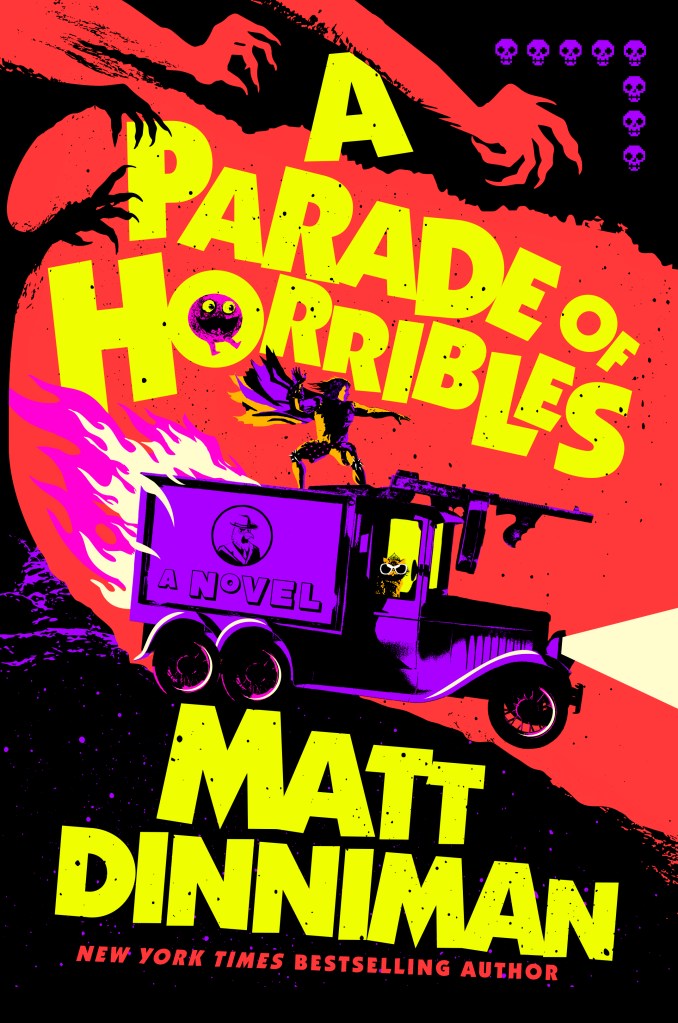
This book follows Carl and Donut as they traverse the 10th and 11th floors – though floor 10 takes up most of the page count. Floor 10 is styled as races, where crawlers must make a variety of unwieldy vehicles and mounts function in increasingly zany environments. As it becomes clear this floor is designed to pit crawlers against each other, the team hunts for various ways to help their fellow humans escape the dungeon through increasingly esoteric loopholes. Meanwhile, the Dungeon AI is growing in power, threatening the very universe itself.
Read If Looking For: More Dungeon Crawler Carl, increasingly unstable Artificial Intelligence, crawlers getting whittled down to near nothing
Avoid If Looking For: new achievements, leaderboard updates, lootbox openings
Comparable Media: Mad Max, Fast and Furious
What Didn’t Work For Me:
This book was probably my least favorite DCC story so far. There were some banger moments – mostly near the end – but I think Dinnaman is struggling with the transition in what the story is demanding of its author and characters. I felt these growing pains in Book 7, but they got really exacerbated here. Carl and Donut are growing too powerful for standard fights to matter, which saps a lot of tension out of regular crawl shenanigans. Unless a Deity is involved, I just don’t believe that the battle has realistic stakes. In This Inevitable Ruin, Dinnaman balanced this lack of tension by shifting the focus to large-scale warfare that individual characters couldn’t ‘fix’ and a deeper dive into how trauma has changed the crawlers on a fundamental level.
This book lost both of those elements. Carl and Donut felt very similar to the way they were in books 2-3 without any clear portrait of why they suddenly had fewer emotional struggles. We returned to a more classic dungeon crawl structure, but I felt like we were just going through to motions for the first 200 pages. We even missed many of the more interesting interplanar political elements from the early floors. Agatha is nowhere to be found after being a major player in Book 7. Mordecai is nearly nonexistent in this book. We do get one interview, but it just didn’t feel the same as before. Without all these little additions I was used to, the traditional Crawl elements felt hollow and shallow. I think I’d have felt more unimpressed with early books had Dinnaman not included the TV elements to this series. I never quite realized how much they added to the magic of the series.
Plot-wise, the book got stuck in an awkward cycle. The race structure led to a strong adventure/downtime loop that felt much more forced than earlier books. We got some quests that could’ve been interesting, but Dinnaman kept trying to integrate those quests into the racing instead of handling them during downtime. This felt awkward because it didn’t make sense – or reflect Carl’s normal approach to these story beats – but also made me feel constantly jarred by the sudden shifts between peace and violence. We’ve always had safe room shenanigans and moments of peace to break up the intensity, but I didn’t like the arbitrary nature of them in this book.
What Worked for Me:
Even if I hated the entire book, I’d probably commit to finishing the series. I’m far enough in and love enough of the story for it to be worth finishing out. Thankfully, the last 15-20% of the book was a big improvement. We saw some classic Dungeon Crawler Carl shenanigans, some really wonderful fight scenes, payoff for plotlines several books in the making, and a resolution that has me hungry for the sequel already. I wish the whole book had this energy, to be honest.
As a smaller aside, we got our first actual queer rep in the series! I’ve loved how Dinnaman has done a great job of avoiding misogynistic tropes common in progression fantasy and litrpg, and the lack of queer content (aside from the dungeon critters who want to have sex with literally anything) has made me a bit sad. It’s not major, and it’s just as stupid as a lot of things in Dungeon Crawler Carl, but I’m glad it finally happened. Hooray for small wins!
Conclusion: Overall, I found this book disappointing compared to its predecessors, but I still love the series.


One thought on “A Parade of Horribles – Dungeon Crawler Carl #8”