
Every year there’s a book. A book that blows my mind and makes me want to scream from the rooftops how much I love it. Typically, this book is a little more niche, with choices that keep the story from appealing to the broad audience needed for breakout hits. I’ve championed Welcome to Forever by Nathan Tavares and How to Survive this Fairytale by SM Hallow, and now its time for me to tackle The Iron Below Remembers. This book examines how history gets layered and built, revels in queer sexuality, and uses a superhero framework to focus on the intensely personal. Characterization is consistent and exciting, and our characters aren’t stand-ins for the reader’s hopes and dreams. It’s kind of a perfect mix for me, though there are a few elements that I think will put off the general reader. Certainly it’s a strong contender for book of the year (the only current competition is The God Eaters by Jessee Hajicek). I’m mostly just disappointed I didn’t pick it up sooner.
Elevator Pitch:
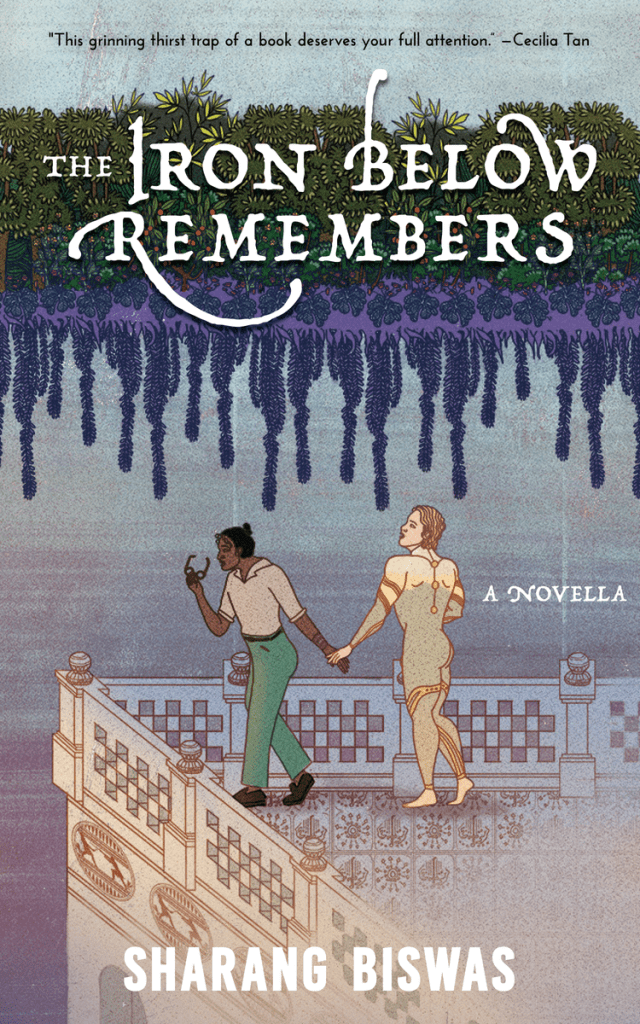
Professor Yadav’s specialty is ancient history, specifically the Karthik Empire, a South Asian colonizing force whose lasting impact is comparable to our world’s British Empire. His boyfriend is Ezra/Savior, a beloved superhero with golden retriever energy. When one of Savior’s battles uncovers a pristine artifact of sorcery – whose use and knowledge has been lost to time – Yadav’s connections see him as one of the primary researchers studying it. As his academic star rises, relationship dynamics shift. Woven through their journey are Yadav’s academic musings on the Karthik Empire.
Read If You Like: superhero settings from the perspective of a normie, fictional academia, relationships as something requiring work and investment
Avoid If You Dislike: abundant talk about sex (but very little actual sex happening), anecdotes that don’t connect with the main plot, footnotes, superhero settings without many superhero plot beats
What Worked for Me
It’s impossible to talk about this novella without digging into its history. While the story is set in London, this is a world where Europe got colonized, not the other way around. The ripple effects of this are often subtle, such as cultural touchstones that go unexplained by characters but which required me to look up details if I wanted proper context. Other times it was explicit, such as Yadav discussing the stereotypes of how Anglo-Saxans are obsessed with making things, and thus are lazy with their comparative lack of drive for the higher level intellectual pursuits; every sitcom has a token white character to fill out that role. The history itself gets fleshed out more thoroughly than I had anticipated. Yadav goes back and forth between his ‘modern’ story and various historical lectures about the world, often wholly unrelated to the things happening in his life. Sometimes these are quite broad in scope, such as discussing broad eras of history or popular mythological figures. Other times they are specific, such as how one of the best sources for ancient language is a text lauding a hospital’s efficiencies – and taking potshots at another – because it got used as a calligraphy exercise by kids. This is quite accurate to how many portions of academia gain knowledge about ancient cultures. Our knowledge is limited to the sources and artifacts that can survive, and it’s quite common for them to be vague enough to allow for many competing theories and evolving understandings. The novella isn’t written in a dense academic style; Yadav’s tangents on the history of the world feel like they are geared for general readership of his world, much like the average reader might pick up a popular nonfiction text on Ancient Greece before going to watch The Odyssey this summer. I thought this was a really smart choice, because it paired so jarringly with superhero storylines; the smashing together of something ancient with something modern was enjoyable. Honestly, I’d have taken even more bits of history in this novella if I could get them.
The superhero/modern side of the story is also a delight. Biswas is not the first to write in superhero settings from the perspective of someone without powers, but I thought it worked great here. We get exactly one traditional superhero story moment – attack by a villain – and even that was mostly a launch point for other plot and character arcs. Instead, he uses the superhero format to explore other deeply personal topics. It’s an interesting point of tension between Yadav and Ezra: they both feel inadequate for the other. Yadav can’t understand why a literal superhero would be interested in a stuffy academic, and Ezra perseverates on his lack of a college education and how smart Yadav is compared to how he sees himself. This dynamic isn’t uncommon in Romance books, but Biswas is so good at crafting convincing characters and their internal lives, it never felt rote.
As Yadav’s career rises, new pressures on his time and public image place strain on their relationship. Yadav gets wrapped up in his own research and rising star, having less time to focus on Ezra. Ezra isn’t used to this, and uses his superhero credentials to ‘help’ in a way that further ostracizes Yadav from his fellow academics because Ezra doesn’t understand the workplace dynamics of academia. Both of them make stupid choices, largely born out of their own fears and insecurities. I know a romantic connection is written well based on my emotions during the pain points. If an author has done their job right, I get viscerally uncomfortable, hoping to skip ahead to the part where the couple is back on track again. The Iron Below Remembers goes a step further, making me wonder if the ending itself will be a happy one. Neon Hemlock is a publishing house that isn’t afraid of a complicated and unconventional ending, and I won’t spoil here what path Biswas chose to take the story. However, he did a great job of introducing us to an established and loving couple, only to throw tension and conflict at them that feels brutally realistic, despite it all relating to superheroes and fantasy archaeology. The academia scratched a worldbuilding itch, but Yadav’s academic adventures do not form the emotional core of the book. I really hope Biswas tackles another story soon – though his work in the tabletop roleplaying community is great as well, his work on Brindlewood Bay is especially fun for anyone wanting to play elderly grannies solving eldritch crimes – because I was a mess hoping that Ezra and Yadav would have a happy ending. I would happily buy whatever his next book happens to be, just on the strengths of The Iron Below Remembers.
What Didn’t Work for Me
What I share here was not a negative for me, but I think it probably will be for many. The Iron Below Remembers is not subtle or shy about its sexuality. While we don’t ever get any actual on screen sex, but the novella is replete with mentions of it. Yadav’s footnotes frequently mention his and Savior’s intimate lives, and the two are in an open relationship with adventurous attitudes towards sex. Mentions pop up moderately frequently in the historical sections of the text as well, pointing out that history was just as – if not more – carnal than today’s society, something stuffy academics might be uncomfortable discussing. Goodness knows lots of mainstream history likes to ignore sex and sexuality beyond Benjamin Franklin’s supposed syphilis. To me, these elements didn’t overwhelm this novella. Yadav is actually a lot like me, the type of person who feels comfortable talking about sex as a normal part of life. These anecdotes are consistent with Yadav’s character. This is a type of queerness that rarely gets acknowledged in speculative fiction. I also know that others will pick up this book and bounce off it hard because, for them, the mentions of sexuality overshadow all the other interesting bits happening in the novella.
Conclusion: strong characters, interesting form, great marriage of storytelling styles that aren’t typically paired. Perfection


3 thoughts on “Novella Readathon #18: The Iron Below Remembers”