
As one of the Greats of the genre, I don’t know that I’ll have anything to say about The Lathe of Heaven that hasn’t been said before. I haven’t read a ton of her longform writing, and that’s a crying shame. Honestly, I don’t even think I would have picked this up had 1970s not been on the bingo card this year; it’s been a good kick in the pants that I really need to continue reading older works.
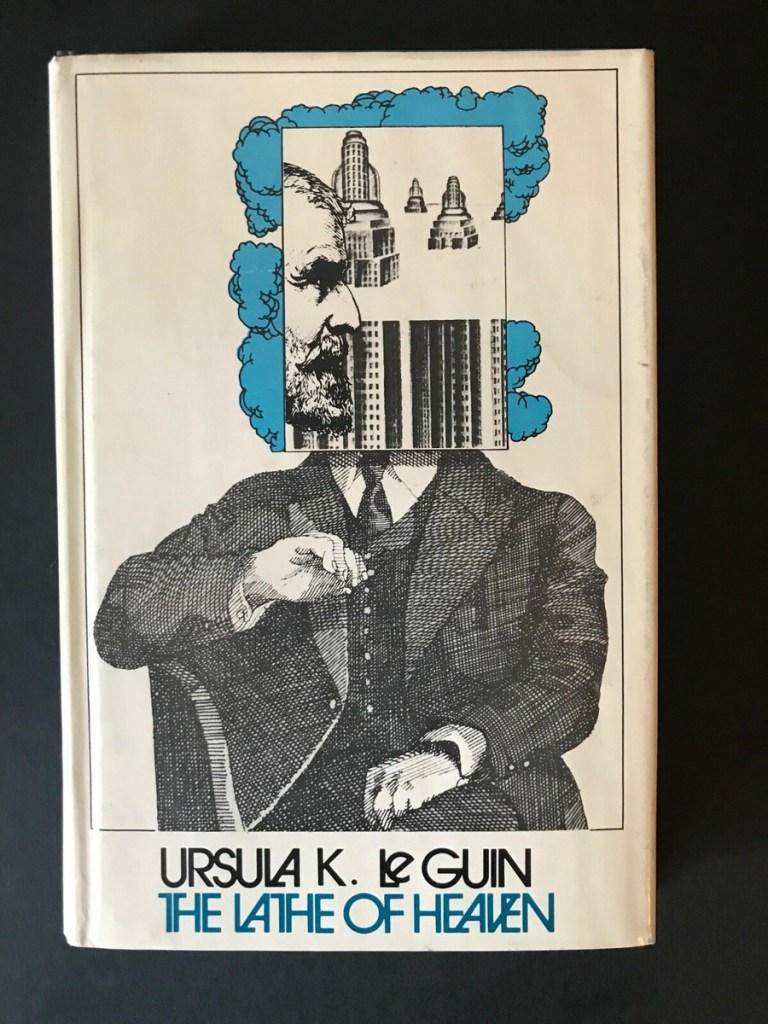
The Premise:
George Orr lives in a world with many problems. War in the Middle East, relentless climate change, and his fear of dreaming. You see, Orr’s dreams have the potential to change reality, rewriting history in radical and extreme ways. He gets caught stealing medications to prevent himself from dreaming, only to find himself in a Sleep Therapist’s office. Dr. William Haber begins to use Orr’s abilities to reshape the world, to improve it and ‘fix’ society’s problems. Orr just wants to find a way to never dream like that again.
Read If You Like: philosophical science fiction, the ethics of omnipotence, classics in the genre
Avoid If You Dislike: extended explanations of fictional science, abusive therapists, the feeling of hopelessness and lack of control in your life
What Worked for Me
I’ve not made a secret of the fact that I enjoy ethical and philosophical questions in Fantasy. I like it when there aren’t easy answers, when ‘right’ and ‘wrong’ aren’t as clear cut as a nameless villain seeking to destroy the world. The Lathe of Heaven slots perfectly into those preferences. Can someone with the power to reshape reality, but who can’t control it, exist ethically? In this way, it reminds me a lot of The Power Fantasy, a refreshing take on the Superhero genre – though I suppose it’s better to say that The Power Fantasy is reminiscent of The Lathe of Heaven. Even the best intentioned revisions to reality, shaped by Haber’s guiding hand, tend to go horribly wrong. A positive shift also introduces problems even worse than existed before – there’s a lot of Monkey’s Paw shenanigans going on in this story. However, even if Haber were to get it all right, would it be ethical to use that power, even to achieve what one sees as an unimpeachable good? Haber says “Isn’t that man’s very purpose on earth-to do things, change things, run things, make a better world?” There’s a version of this that most people agree with. General ethical consensus is that you should try to make the world a better place (the tricky thing is defining ‘better’), but at what point is there a limit on how much change one person should be able to make? If Orr were an omniscient and benevolent god, would anyone have a problem with him zapping away problems to make a better world? Or is there an invisible wall that one should not be able to pass without some sort of endorsement from many others? As usual, Le Guin tends to ask more questions than she answers, which infuriates my students when we read Omelas.
Le Guin also sneaks in some pretty basic Hobbes vs Rousseau views on human nature. The dreaming and subconscious mind is perhaps the best measure of our true inclinations. In one of his arguments with Haber, Orr tells him “you’re trying to reach progressive, humanitarian goals with a tool that isn’t suited to the job. Who has humanitarian dreams?” Meanwhile, Haber sees the subconscious as a place of boundless creativity and benevolence, tempered only by the cruel inevitability of social orders (orders that he himself makes worse in pursuit of his own power). This push and pull on whether or not humans are inherently good is not new (or explored particularly deeply here) but one that I enjoyed immensely. There are also clear connections to Daoism, with Haber taking the role of Western ideals of Manifest Destiny. Orr embraces principles of allowing the world to flow around you as a path to improvement, and one without a sense of ego or self-importance. Of course, for much of the book he remains too afraid of exerting any sort of change, which leads to its own downstream impacts. This would be a phenomenal text to teach to high schoolers alongside philosophy texts, an idea I will shelve for another time.
From a technical standpoint, Le Guin is superb. She’s got a reputation for clear writing that holds a lot of depth. There are some times when Lathe slipped into something more flowery than I’m used to seeing from her (acknowledging that I’ve only read a small fraction of her work), and I thought she made great use of language, even if sometimes it was a bit on the nose. Orr is one of the more transparent uses of names to push at theme I’ve seen in a while. The story is a smooth read, even when you open the story and are confused why she began this story with a monologue about a jellyfish. The pieces generally fit together perfectly, and Lathe is a phenomenal read, especially for something in its page range.
What Didn’t Work for Me
Overall, I loved The Lathe of Heaven. It’s a great book, and the things I disliked can generally be put aside as a product of its time. In some ways, Le Guin is following the Asimov style of writing. We get fairly extended explanations on the rationality of how Haber’s dream machine works, talk of how it intersects with hypnosis techniques, and how it allows Haber to manipulate Orr’s dreams. These details do not, I think, have much thematic or structural importance to the story, but there is a weight placed on the scientific plausibility of Haber’s treatments. Considering Orr’s dreaming powers remain more or less magical and unexplainable in nature, I personally didn’t feel this was needed. Science is applied, but more as technobabble than any real attempt at scientific clarity. You won’t find ‘rule of cool’ in The Lathe of Heaven, and Le Guin is interested in plausible worlds and situations, again excepting Orr. Also like Asimov, I think the characters in this book are on the shallow side. None are as poorly written as some of Asimov’s more egregious examples, but I didn’t find the nuanced examination of the human psyche that I sometimes get from Le Guin’s writing.
I also feel the need to acknowledge two moments that are going to stick out for me more than most folks. I am not claiming Le Guin is a bad person; in fact she was often far ahead of the curve for her time (in this very novel, an interracial relationship is featured, which was not the norm for 1971). However, she also fell into the long trend of authors who conflate homosexuality with pedophilia. In some early discussions of how hypnosis functions, an example is given of how a man sued his therapist for implanting homosexual tendencies in him. Turns out he was simply repressing his feelings and, no accepting of his queerness, decided to rape a 12 year old in the middle of the day in a public park. This is a fact of the world, not a reflection of a specific character’s views on homosexuality. The other mention of queerness is when it is revealed that Haber doesn’t pursue romantic relationships, but has one night stands with “women and sometimes young men,” because apparently his sexual inclination towards youth exists only in a homosexual context. When evaluating literature, you assume every word is intentional, and the inclusion of ‘young’ for the men but not women was specific. As a gay teacher, I can assure you that the stereotype and assumptions on this front have not died – see the many accusations of queer teachers ‘grooming’ students simply by acknowledging queer people exist. If I experience that in a fairly liberal city, it sure as hell is happening to teachers in more conservative areas. As with Frank Herbert, I try not to lay too much blame at the feet of the author. In this instance she was a product of her culture (though I know she’s got a queer character in The Dispossessed from 1974, which I haven’t read yet), but it was a jarring thorn in my experience with this book. Sometimes we can’t always separate our emotional reactions from the tangible quality of the work.
Conclusion: It’s a classic for a reason. My review is probably one of the less insightful ones about this book.


I find it hard to believe that your review is one of the less insightful ones out there as you’ve gone into so much depth. It sounds like a read with a lot of food for thought involved that could lead to endless hours of discussions. Im sorry to hear of the homophobic bit though.
LikeLiked by 1 person