
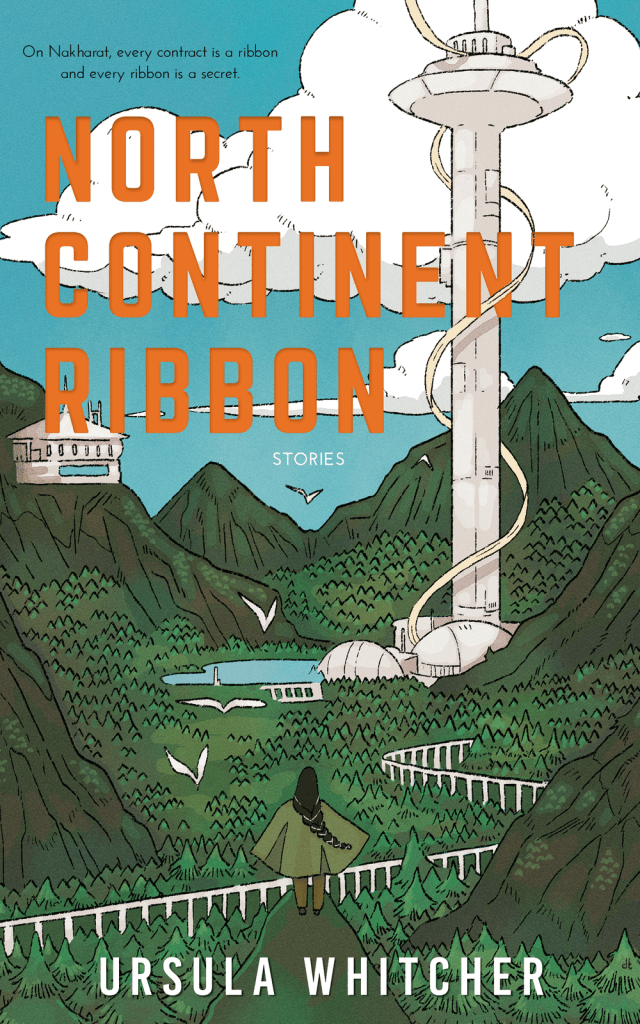
North Continent Ribbon went on my reading list after it got shortlisted for the Ursula Le Guin prize. Those books tend to be hit or miss, but always have a strong sense of identity and something new to bring to the genre. Ribbon was no exception; I’m sure the structure of this novella has been done before, but I haven’t read one like it. It lives in an in-between space between a short fiction/mosaic novel and a more cohesive novella, which was a really cool experience. This story isn’t the densest thing I’ve read, nor the most profound. It has lingered with me, however, and I think that’s the sign of something really special. I think I’d have picked it to win over Rakesfall, which won that year.
The Premise:
North Continent Ribbon covers ~450 years of a far flung planet, initially settled as a location to build faster-than-light ships. Each story is a discrete piece of short fiction, focusing on its own characters and conflicts. However, they layer on top of each other to tell a larger story of cultural formation and change.
Read If Looking For: unique worldbuilding that doesn’t feel gimmicky, nuanced anticapitalist themes, interpersonal conflicts framed through systemic pressures, collective bargaining
Avoid If Looking For: the protagonists always winning, traditional story structures, conflict resolution via combat, romance-free books
The six stories that weave together in North Continent Ribbon are
- Closer than Your Kidneys: a failed assassin becomes bodyguard for their former target: a data analyst of a space fleet.
- The Fifteenth Saint: a judge with good intentions navigates shifting attitudes towards technology and a looming invasion
- Ten Percent for Luck: a military grunt gets pulled into a conflict between Companies and Armies and falls in love
- The Association of Twelve Thousand Flowers: a sex worker tells the story of a particularly fateful night and the secrets it held
- The Last Tutor: a spoiled brat rebels against their Shareholder family
- A Fisher of Stars: a sentient spaceship starts a union
What Worked for Me
A lot of North Continent Ribbon felt like a thoughtfully written, vaguely experimental exploration of a society through many varied perspectives. Perhaps not the most inspiring book in the world, but interesting in small and quiet ways. It had a consistent set of running motifs and values – respect given freely, communities over corporations, the corrosiveness of power, social systems that don’t work for their people – that were clear without saying everything out loud. As you wind your way towards the end of the novella, however, these pieces come together to become something greater than the sum of their parts. I was happy to see collective bargaining make an appearance here! The Twin Cities are a union town, and I’m a proud union teacher. After our city’s 2026, North Continent Ribbon was a love letter towards how power corrupts, all work is valid, and that we are stronger when people show up for each other. It avoided both grimdark and utopian messages, and the tone felt optimistic, even when things were bad. This novella isn’t a particularly loud or flashy book, but it’s stuffed full of interesting strings to tug. It’s the type of story that I imagine will benefit from a reread as you look back on how everything connects with each other, allowing you to place the initial stories into the larger context and giving them new meaning.
The structure of the book also lent itself to some really interesting worldbuilding possibilities. We’re focused on the development of a dominant culture, with a special focus on its relationship with technology, across many years and social stations. Each short story is an interesting tale in its own right, with compelling protagonists and conflicts and nuanced things to say. However, you’re frequently shifting perspective so radically between stories that it takes you a little bit to anchor the new setting in relation to where you were before. Each story builds upon the previous, giving you more information and trusting that you’ll start putting the pieces together yourself. There aren’t big infodumps in North Continent Ribbon, which can sometimes be a bit confusing. However, Whitcher saturates a lot of culture into small puzzle pieces. You learn more and more about contracts woven into hair, representing your connections and commitments in the world, and of how various factions balance each others’ power. The political web is built string by string, often through the observations of characters who don’t understand all that’s happening behind the scenes. In the final story, all those pieces come together in a way that marries wonderfully with the juicy thematic work that Whitcher had cooking. You visited space, street life in cities, a countryside at war, and the idyllic backwaters of a rich businessman’s hunting retreat. The blend of rural and operatic didn’t feel out of place, and had a very distinct visual and tonal ‘thumbprint’ that make this world one that will stick in my memory. There was a cohesive and evocative vision in North Continent Ribbon, perfect as a novella.
Now, this is not the most original or thought-out Dystopia in the world. Corrupt companies and governments aren’t a new story feature, and the rich aren’t generally painted with a very deep palette of colors. However, Whitcher engages with the fears around job-automization, looking at a society that grows to reject the role of the machine in any important role. It’s a speculative extension of discussions in our world – capturing the current desire for humans to remain in control. However, as with most policies built to try and protect humans, it gets twisted and distorted into something grotesque and horrid, all for the sake of the bottom line. What was once a desire to ensure that humanity remains human becomes a chess piece for corporations to move and manipulate as they work to adjust cultural sentiment. Towards the end, Witcher pushes this idea into something truly horrific and utterly believable. This story focuses on the hijacking of progress. Those with power will seemingly align itself with those who seek to destroy that power, only so they can rot the resistance from within. We see this same dilution and distortion in our world, and North Continent Ribbon feels frighteningly current despite all the details being alien and novel. It’s the perfect sweet spot for socially conscious science fiction.
What Didn’t Work for Me
Those who have read The Goblin Emperor will know the feeling of pushing through an impenetrable maze of names and titles, obscuring what the hell is happening. That happened for me in North Continent Ribbon, though not to such an extent as in Goblin Emperor. Especially at the start of stories, characters are going by first names, last names, titles (sometimes multiple different titles), which often left me struggling to figure out what was happening in the first few pages. I spent an oddly large amount of time rereading passages despite how simple the prose felt. In Goblin Emperor, this obfuscation felt like a choice to help the reader align with the protagonist’s own feelings of being lost in court politics. Here, it felt incidental and unintended, especially when these titles came at the same time as an oddly-structured turn of phrase or confusing bit of speech.
I do generally think the later stories are stronger than the earliest ones, which means that the novella opens in a way that feels a bit more surface level – but still very interesting. Additionally, there’s a decent amount of Romance happening in the opening half, including at least one explicit sex scene. This was 100% not an issue for me, because I think romance often gets wrongly derided as a place theme and nuance go to die. It’s a fairly prominent part of the plot of the first three stories, much less in the final three.
Conclusion: this novella did a great job of building meaning without being didactic, instead using intimate stories get at deep themes in a fascinating world.


2 thoughts on “Novella Readathon #10: North Continent Ribbon by Ursula Witcher”