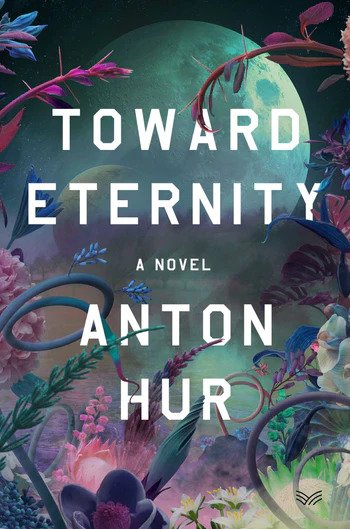
It’s been a while since I read a book whose back cover so poorly represents what is in the book itself. Anton Hur was done dirty by his publisher on this one, because the premise for the book is much more interesting than what’s shared. I expected a story about how society is adapting to technology that turns people immortal, with a focus on a patient/researcher and his poetry AI bot. While all that is indeed there, this story is actually a millennia spanning reflection on what it means to be a person, a unique individual, and how choices can echo across time. It has at least seven different POV characters who almost never repeat past a single chapter. A much more ambitious novel than it appears; it reminded me a lot of The Vanished Birds by Simon Jimenez, which is about as high of praise as I can possibly give.

The Premise:
Okay, let’s try to do a better job than the publishers. This book starts in a near-future world where emerging research shows nanomachines can turn you immortal and cure pretty much any ailment. Dr. Beeko runs this lab with Yonghun (who has undergone the research) and who has disappeared mysteriously. One of the only witnesses is Panit, Yonghun’s AI poetry-analysis machine who has been collecting dust for years. From this setup, we start exploring these events from these character’s points of view, then shifting to other patient’s experiences with nanotherapy, before jumping forward in time to explore a new version of the world where we see how these nanobots have shifted the world again … and again … and again. To give some sense of scope, the book is split into five sections: near future, future, distant future, very distant future, and eternity, and the choices of the original cast filter down into later storylines, they aren’t lead characters continuously throughout the novel.
Read if Looking For: books spanning millennia, philosophical musings, epistolary novels
Avoid if Looking For: straightforward stories, single POVs, everything explained in the end