
When I was browsing new releases in January, I passed over George Falls Through Time; admittedly this was mostly because the publisher dropped Ministry of Time as a comp title. I despised … pretty much everything about that book, and it’s gotten worse with time. Thankfully, this got put back on my radar via being pitched to me as an ‘interior existential fuckshit novel’ which is right up my alley. It’s the type of controversial book that is executed well enough to cater to very specific tastes, meaning that most people who picked this up hated it. Honestly, this is likely going this year’s biggest gap (other than DNFs) between my rating of a book and the general consensus.
And honestly, I blame the marketing. It’s pitched as “A confessional queer romance, a swords-and-sorcery soap opera” … which is missing everything this book is trying to do. It is a glorious train wreck in slow motion. This is not a fun book full of whimsy and romance with a historical serf trying to find his freedom (well, there is that, but not like you’re thinking). Instead, this book is the hollowness that comes when when you fixate on the pointlessness of life, the artificiality of all human connection, and the lack of agency over your own destiny. It is cyclical and frustrating and uncomfortably real.
No matter how conflicted (in a good way) I feel about this book, the sign that this review is looking to be one of my longest is a sign that this novel had lots of interesting things to say.
The Premise:
George has lost his job, his boyfriend left him, he has no sense of meaning in life, and now walks dogs. When two run away and things spiral out of control, he ends up falling into 1300s England. Honestly, this was probably the best thing that could have possibly happened. There’s some business with a dragon, but the book is really about George’s internal journey to find meaning in life.
Read if You Like: intense depictions of depression, speculative fiction character studies, the power of a quiet life, simple vocabulary arranged intentionally
Avoid if You Dislike: time travel light on historical detail, books that de-emphasize traditional plot structures, characters (and romances) that are hard to cheer for
What Worked For Me:
I cannot stress enough that anyone considering reading this book should:
1. Throw away your preconceived notions of what this book is about
2. Evaluate whether you can enjoy a book about unlikable people
3. Read a free online sample of the first page or two
Collett’s writing is arresting. I had a headache when I picked up this book for the first time, and got through three sentences before my brain went ‘oh … oh … ohhhhhhh!!‘ You see, this book is gloriously not written in the traditional style of speculative fiction these days. It is meandering, assertive, and melodramatic. As an English teacher, I spend half my time heckling preteens about the importance of using periods, not beginning with a coordinating conjunction, and a million other rules that Collett throws out the window. He does this quite intentionally, as a way to let the prose rip its way straight into George’s brain. Here’s a little quote from page 3:
“This was a city where your boyfriend became your ex-boyfriend because you quit (you weren’t fired, no way) your data entry office job because you were beginning to imagine arguments in your head like this, actually mutter under your breath as you walked aimlessly in circles on your lunch break and ran into people, smacked shoulders, and your boyfriend was worried about you – but only worried enough to leave you, not worried enough to stay.“
Reading the sample is important, because I think you are either going to adore how Collett writes or absolutely despise it. The prose becomes more erratic the further George unmoors from reality. When he finds more grounded moments, adapting to his new situation, Collett’s writing smooths out into something almost typical. The style itself is communicating things about George to the reader. That said, these choices spiked my anxiety, secondhand embarrassment, and insecurities about all the things I think are wrong with my own life. Not exactly light and fluffy reading material.
It doesn’t help that George himself is either a trainwreck (if being generous) or a shit person (if being realistic). This is most apparent when he’s reflecting on his life before dropping through time, where he loses himself in cocaine and corporate workplace culture, revealing a protagonist who us utterly flawed and unable to find a concrete path back towards the life he’d like. George finds himself a hollow shell, a pit of depression and self-destructive tendencies that are at their sharpest when his personal past and the ‘current’ past crash together. In some ways, the rather intense focus on a character’s implosion reminded me a lot of Welcome to Forever by Nathan Tavares, one of my all-time favorite books. In the sea of saccharine gay men whose worst vices are grumpiness, a well-executed psychological profile of a work-in-progress was delightful. This novel got intense enough in this regard to trigger my own squeamishness and anxieties, which a sign of excellent writing.
Finally, on the subject of queerness. As with the rest of this book, there’s a lot of raw emotion and frayed edges. George and Simon’s love story follows very few traditional beats; anytime you find yourself rooting for the pair of them, you’ll quickly sink back into feeling like there’s nothing worth saving. It’s a great bit of tension, and anyone wanting a Genre Romance from this should stay far, far away. George’s own relationship with homosexuality is rather fraught. He sees himself outside it, like most queerness in the modern world is a set of clothes that others put on which he doesn’t quite fit into. There were a lot of tidbits that spoke to my own experiences as a gay man. There’s an amount of folding yourself into the stereotype – or intentionally refusing to do so – that was present in my own self-discovery and coming out. Like with the rest of this book, there’s not much in the way of breezy queer joy. I don’t always want something like that, but it really hit spectacularly well.
What Didn’t Work for Me:
In the end, there’s too much discomfort in George Falls Through Time for it to be a contender for my book of the year, or to make it on my list of favorites. Even though Collett was achieving everything he set out to do, that doesn’t always make the experience fun. Actually, this novel feels very adjacent to Literary Fiction; the speculative elements mostly seem to be present to support exploring the psyche of a tortured soul. You won’t find a ton of interesting spins on time travel here. There’s some fun tidbits, such as George’s clothing causing a stir, but ultimately you’ll find little of substance to the time travel mechanics or using that plotline in gripping ways.
But what a tortured soul examination we get! Plus, Collett leverages all the simple prose and modern stylings of genre fiction to achieve this. In some ways, I find it the inverse of The Spear Cuts Through Water, which lays Literary prose techniques at the altar of Epic Fantasy plotting. Unfortunately, this cross-section of genre and literature makes George Falls Through Time a fairly specific read.
I’m also wholly unqualified to talk about this book as an adaptation of Saint George and the Dragon, which I have not read and do not (currently) intend to. Similarly, this feels like the type of time travel that wasn’t rigorously researched (but this is entirely supposition on my part), and I anticipate history-buffs to be disappointed. I did learn about the gay King Edward II though; like all of the best homosexuals from history, he was a delightful bit of chaos.
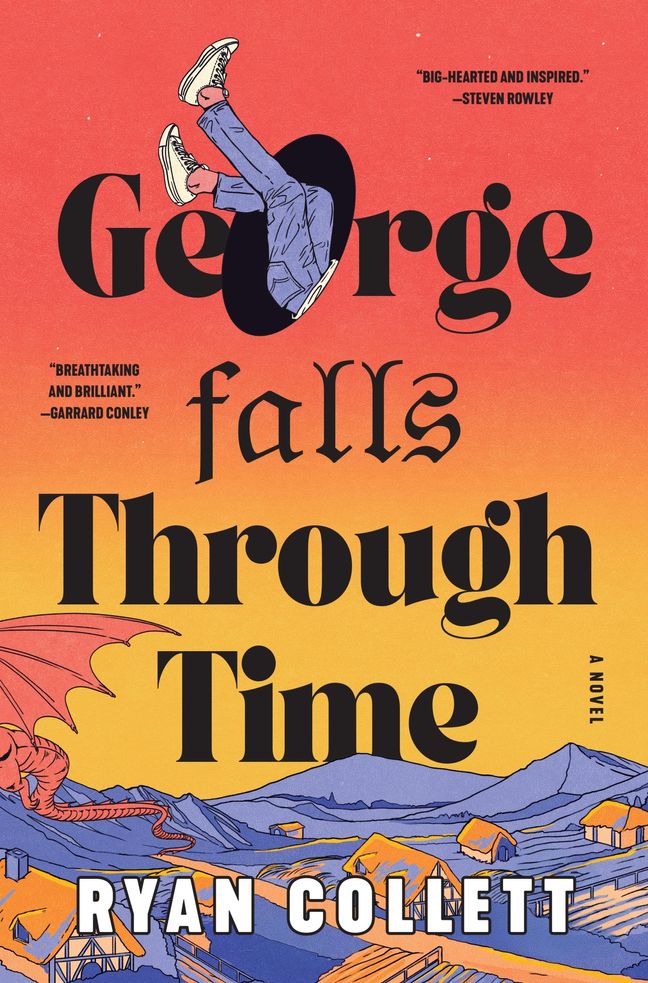
Final nitpick: it is rather important in the early chapters that George is wearing athletic shorts. The polyester in particular comes up multiple times in plot-important ways. And yet, we get a pair of blue jeans on the cover. I understand that its more aesthetically appealing, but I hate it so much.
Conclusion: not for most, but for those interested in frank portrayals of unlikable people, this is hard to beat in the genre fiction space
- Characters: 5
- Setting: 3
- Craft: 5
- Themes: 4
- Enjoyment: 5, but not in a ‘wow that was fun’ type of way


Sounds like a very interesting book that I would absolutely hate 🙂 So I will be skipping this one but have to admit that I enjoyed reading about it.
x The Captain
LikeLike
Definitely for the best. I think the majority of readers should skip this one
LikeLiked by 1 person