
I have been super hit or miss with Klune. He’s definitely the biggest gay author in fantasy right now, but I don’t find myself terribly interested in pursuing his backlog. However, since We Burned so Bright is a novella, featured elderly gay protagonists, and got a reputation for being a tonal shift from his normal writing, I figured it would be worth trying out. I still don’t think Klune is going to be a must read author for me, but this settled some hesitations I had about his older work.
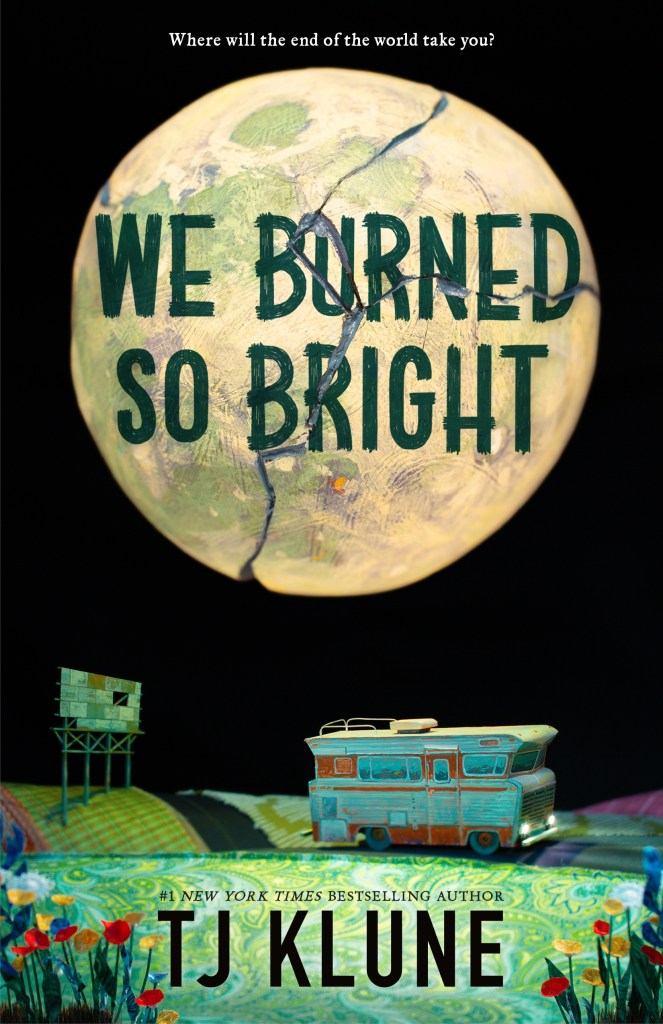
The Premise:
The world is ending. A black hole is slowly consuming our solar system, and everyone’s lives are measured in weeks. Don and Rodney are an elderly couple. As the world ends, they buy an RV and set to travel from Maine to Washington. Along the way, they meet all sorts of folks who are facing the end of the world in their own way. At the end of their journey is a piece of their own past that they never completely came to terms with.
Read If You: want to watch the world crumble, enjoy episodic stories, crave elderly protagonists who don’t descend into stereotypes
Avoid If You: are looking for cozy fantasy, salacious gay romance, or saving the world
What Worked for Me:
I really liked how Klune approached the end of the world. Not the impending black hole; that was a bit dramatic even for me. However, the hard timeline for everyone’s death led to some great moments. Don and Rodney weren’t my favorite characters in the world, but I loved how they encountered a wide variety of different perspectives on an apocalypse. You’ll find hope and violence and fear and joy in this story. I knew this book was on the more serious end of Klune’s writing, but it got far more intense than I was expecting. There was an entire chapter where a ranch hand recounted how she murdered her family in an attempt to spare them pain, just as she would stun cattle before slaughtering them. Not every chapter goes that hard or dark – some are delightfully joyous – but you’ll encounter a spectrum in this book. I really liked that choice, and I’d love to see Klune write more in this style in the future!
I thought this book was a frank and honest examination of how humankind isn’t a monolith, and how a hard end-point puts a lot of things into perspective. Different characters prioritized different things, but everyone was chasing something in their final days, even if just peace and quiet. There isn’t a huge connective tissue between each encounter Don and Rodney have, but each one brought something different to the table. Life is short, and this book is a call to action to start chasing what matters to you now, instead of waiting.
The rest of this section will have spoilers for why Don & Rodney are travelling on this road trip, which aren’t revealed until the final act of the book.
While we get hints throughout the book about Don & Rodney’s son being the driving force behind the story, Klune keeps details very sparse. Decades ago, the pair adopted a young boy who had experienced significant trauma, lashed out frequently, and generally had a shitty hand dealt to him. We get a (truncated) story of his life from Don and Rodney’s perspective, culminating in his suicide. They are travelling to spread his ashes at the location of one of their happiest shared memories. Back when I read The House on the Cerulean Sea, I really struggled with how Klune introduced us to kids with similar levels of trauma, only for a single kind conversation to ‘fix’ them. As a teacher, that isn’t how it works. I understand that’s a very cozy book, but it was very frustrating because it played into how people without that type of trauma perceive the healing process. This was a much more honest portrait. Now, honesty need not mean suicide, but at least it acknowledged the real issues and challenges that severe trauma take on a person. Klune doesn’t get it perfect, but it’s a hell of a lot better than his previous attempt. I was glad to see him take a misstep and try to fix it in his later writing.
What Didn’t Work for Me:
There were so many interesting characters and narratives in this story, but Don and Rodney were rough. I can’t even say they were a slog, because it actually felt like they were pretty nonexistent for most of the story. They weren’t quite self-insert characters, but they also felt very passive and bland. On paper, everything about them should have really resonated with me. I love reading about established queer couples, where gay men aren’t horribly toxic or saccharine messes. However, it felt a little bit like Don and Rodney existed only as a vessel for others’ stories to flow through. It was common for entire pages to go by without them saying a word or doing a thing. Klune poured all his energy into the characters they met, but our main couple felt emotionally distant. There were a few exceptions (the hippie commune comes to mind), but I wish he’d have given them center stage more often. Even the end, which is ostensibly ‘their’ story, didn’t engage with their emotions and experiences quite as much as I’d have liked.
Conclusion: a powerful theme and interesting choices, but the protagonists needed a bit more development
 Marked for Plot
Definitely want to pick this up. Sad to read that the character felt flat because in his others books the characters are so well written.
LikeLike