
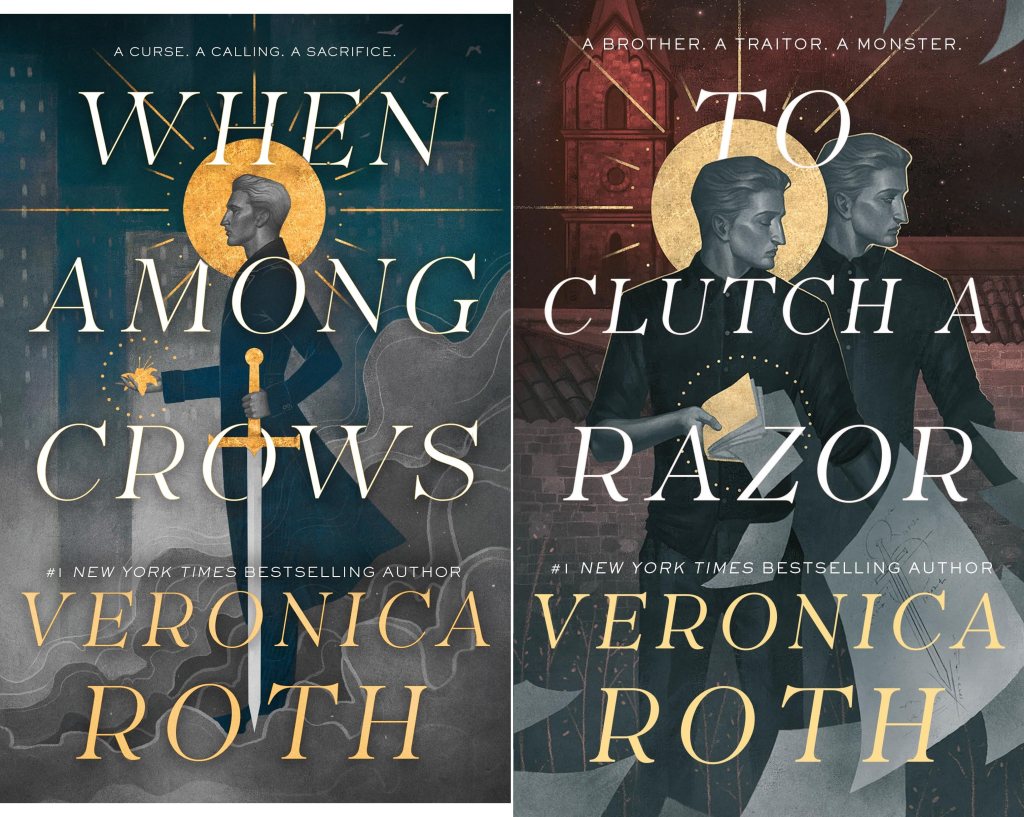
As a middle school English teacher, I get swamped with essays and book reports about Percy Jackson and comparable titles. This means I sometimes grow weary of gods and monsters in the modern world, especially if they lend themselves to a more lighthearted or comedic romp of a story. I avoided When Among Crows mostly because I found Roth’s Divergent books to be fine, but relatively unremarkable in the crowded YA dystopia landscape. However, this book hit generally settled in a much better spot for a more mature look at a similar idea. If you’re looking for a story based on Slavic folklore with a bit of action, a bit of character development, and a bit of spookiness, this will be a satisfying read. I thought it was a hair predictable and lacked a wow factor, but I immediately put the sequel on hold with my local library. A much shorter summary of my thoughts about the sequel are at the end of this review.
Read If Looking For: Baba Jaga, monsters that typically don’t get much screen time, secrets in every backstory
Avoid If Looking For: plot twists you don’t see coming, deep internal monologues, realistic portraits of queer men
The Premise:
Dymitr is seeking out Baba Jaga. Being a human, this is probably a very bad idea. However, he’s equipped to handle the dangerous world of Striga and Zmora who feed on the pain and anger of mortals and outlive all of their food. He comes bearing a gift in exchange for aid: a cure for a cursed Zmora with a penchant for elaborate illusioncraft. Their path to Baba Jaga, and Dymitr’s motivation for the journey, unravel over the course of their travels through Chicago.
What Worked for Me:
The strongest part of this novella was how Roth welded her prose and setting together. This book dances of the edge of horror at times (I skipped about a minute of audio where Dymitr cut out his own fingernail), but mostly lives in the spooky corners of Fantasy. We get intimidating grandmothers drilling lessons onto child Dymitr’s brain, hordes of gruesome critters, and disturbing imagery when creatures reveal their more monstrous sides. Roth just nails the emotional beats of her characters and settings. Things she intends to be unsettling left me antsy; the alluring man whom everyone else avoids piques my interest; the hokey movie theater showing horror movies to collect fear was just a little humorous (who doesn’t want a drink served in a massive skull-shaped goblet?). There’s plenty of imagination here while still feeling very old, the way a story steeped in folklore should be. One of my favorite moments was an in-universe story about Baba Jaga outsmarting a witch who tried to steal her power, which was a simple and effective way to integrate folklore into the story’s plot and raise the stakes of seeking this witch out.
Roth’s rendition of Chicago felt like a drawer of sharpened knives about to overflow. Its Polish community was both deeply steeped in tradition while also feeling very Chicagoan. There’s a focus on sacrifice and debt that feels very honest to the dark tales common in European folklore. When Among Crows never slid into monotony, and the world always felt lived-in and dark without being overly gritty or nihilistic. In some ways her writing reminded me of how Vo tackles her modern – and near-modern – settings: they feel alive in ways that most Urban Fantasy fails at, and there’s never a veneer of artificiality that you have to push past to get to the good bits of the story. The good bits often involve warriors pulling out their own spines to use as magic swords … which is badass and terrifying.
I worried a bit when I realized this novella was going to bounce between two – and then three – character perspectives. I tend to prefer this in full novels or short stories, but it was handled very well here. There are some common-sense writer moves to make this work; the three mostly stick together, and each brings a unique set of skills and knowledge to solve conflicts. However, they also each have a unique narrative voice and way of thinking about the world. In proper dark(ish) fantasy fashion, each is fucked up in their own personal way, and you won’t find anyone without a traumatic backstory. They’re perhaps not the most original characters I’ve encountered: a tortured soul, a powerful outcast, and a desperate survivor, but I’m excited to follow them in the second half of the duology.
Really, if fantasy inspired by Slavic Folklore is of interest to you at all, I think this novella is well worth a look.
What Didn’t Work For Me:
Simply put, this story was a bit predictable for me. I liked most of the individual scenes, but the connective tissue stitching it together felt a bit weaker. I kind of wish Roth had abandoned the idea of twists or reveals, which do form a rather core part of a few significant scenes. Instead, had she chosen to explore secrets and their psychological impact on page 1, instead of page 70, I think the novella would have been much stronger. However, I smelled the twist coming very early, and it’s really hard to tell when this is a universal experience and when I just got (un)lucky.
I also feel the need to put in a note that Dymitr’s homosexuality didn’t quite ring true. As someone who isn’t Polish, I hesitate to speak too much on this. However, the more ‘old school’ side of Polish culture seems – from the outside – to be wholly unaccepting of queerness. I wish Roth would have dove into this. As someone raised in a very anti-queer community, it’s tough to overstate how much it shapes your views on the world. I’m not mad at how Roth wrote Dymitr, but neither do I choose to laud it as an example of quality writing of gay men from a female author.
Otherwise, When Among Crows is an example of a great workhorse book that doesn’t really aspire to greatness. Roth is happy to tread some well worn paths with a new and evocative set dressing. There’s some light thematic work around pain and sacrifice, what repairing harm looks like, and family. However, not much innovation is happening here beyond creatures that typically don’t get much attention in fantasy books.. It’s the type of story that I think most people who read fantasy will enjoy, but I don’t think it’ll make the cut for most people’s favorite books lists.
Conclusion: A wonderful setting, with moody vibes and interesting characters, but a predictable plot.
How’s the Sequel?
The second half of the duology: To Clutch a Razor, is largely going to provide more of the same, though I enjoyed the first book more. This story takes Dymitr back to Poland for a funeral, and to meet his family for the first time since the events of book 1. Without spoilers for the earlier book, there are some specific reasons why he thinks his reception may go very badly.
The thing I was most excited about from this novella’s description was a heavier focus on Dymitr’s internal struggle with his place in the world, and what it means to love people and places that you now see as monstrous. There is a little of this in the book, but Roth seems averse to any sort of commitment to explore deeper thematic ideas or psychological anguish in her characters.
Instead, she finds a way to get Niko and Ala to join Dymitr on this journey too. This felt very awkward to me, like she couldn’t imagine a sequel that didn’t include all three protagonists. At least in Harry Potter, JK Rowling didn’t write Hermione into the story when Harry was at Ron’s house, you know? Roth also took this book into more of an action direction. It still had the mystic vibes, but I think the story got consumed by plot, when the plot was the least interesting thing about the book’s premise. A story that should have been about the pain of sacrifice, the duality of love, and the grief for someone still alive turned into something much shallower. It wasn’t empty of meaning, but it didn’t take the leap of faith I wanted it to. Instead, it leaned into parts of the original book that I was most unimpressed with.
To be clear, this sequel wasn’t bad – though I do think the awkwardness of forcing the story to maintain all three protagonists equally was a bad decision – but it is not the novella that I craved.
 Marked for Plot