
Eden Royce has one of my favorite Middle Grade books of all time (shout out to Root Magic!), and I’d been excited to pick up one of her adult works. Unfortunately, I didn’t find Psychopomp and Circumstance nearly as compelling as I hoped. There are a lot of individual pieces that worked, and certainly it’s exploring an uncommon time period for genre fiction (The Reconstruction Era of the US). There’s enough appeal here for me to recommend it when relevant, but not enough that I’ll be launching any campaigns for other people to pick it up for more general recommendation requests.
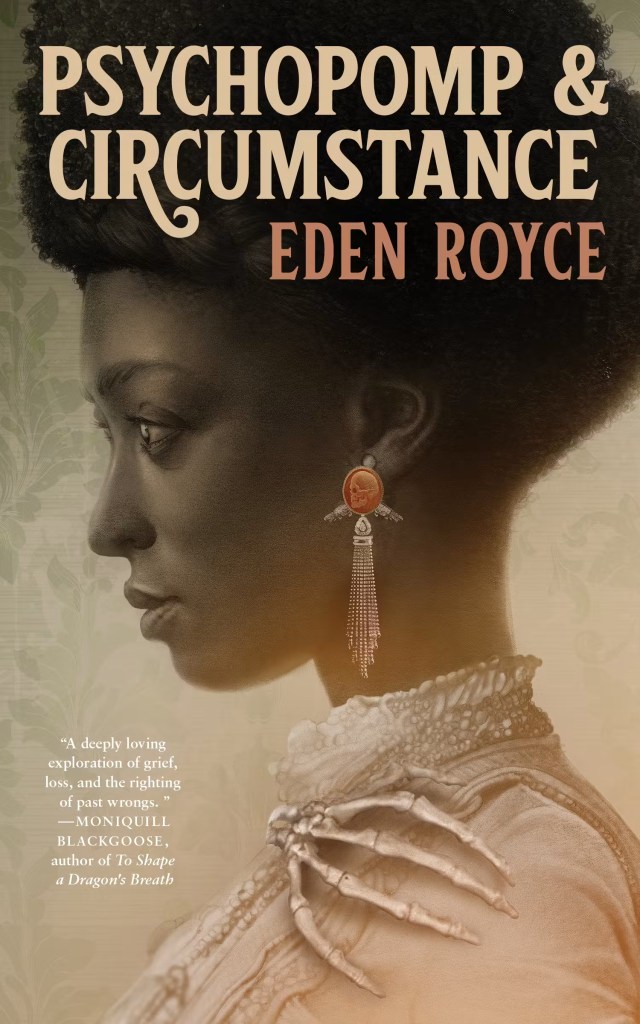
The Premise:
Phee is 21, navigating a mother trying to marry her off and a father who doesn’t trust her with any real work at the distillery. When she learns of her Aunt passing away, she agrees to Pomp for her Homecoming. Aunt Cleo was cast out from the family at her own mother’s Homecoming. Phee has fond memories of her, and she kept up a correspondence with Cleo despite her mother’s wishes for distance. Grieving and regretting her choice not to spend more time with he Aunt, Phee visits the odd community her Aunt founded, a home that isn’t hers, and the knowledge that she needs to prepare a proper send-off to honor her Aunt Cleo’s memory and spirit.
Read If Looking For: Historical Fantasy with Gaslamp aesthetics, the fog of light amnesia after a nap, doors without handles, themes of family and community
Avoid If Looking For: good parents, focused narratives
Comparable Media: Witchmark, The Gilded Age (Peggy only)
What Didn’t Work for Me
The big issue I had with Psychopomp and Circumstance was that Royce didn’t commit to a single idea. That’s when novellas sing. Pick one thing to focus on, and you have a recipe for an excellent 150 page story. Royce’s story is just all over the place, building up an idea only to abandon it right when it requires more serious attention. At first, the Homecoming duties seem like they will dominate the story. Lifelode really lit a fire under me to find more Domestic Fantasy, and I was excited to explore the intricacies and power of something quiet and emotionally important. Turns out that’s a lot of worrying about being thrown in jail if you didn’t do a good enough job (see below note for more on this), and worrying about what a good Homecoming entails. We get a brief detour into a straightforward Haunted House story. The funeral director interviews should have been a return to Homecoming planning, but instead Royce pivots into a moderately developed Romance Plot. That gets interrupted by some explorations of Black life during Reconstruction (both hopeful and mournful). We then return to the Family narrative that wove throughout the entire book, which was really a gorgeous way to close things out.
The book just kept popping between things. Just as the haunted house was getting really good, Royce changed styles. Each individual piece showed promise: the romantic relationship was believable and interesting, the haze that the House puts over Phee was a really good ‘soft’ horror. However, the constant change sacrificed satisfying payoff of individual plotlines. If Royce wanted to include and balance all of this, I think Psychopomp and Circumstance should have been a full novel. There was enough to explore, and a higher page count would have allowed disparate elements to weave together into a cohesive whole.
I do need to spend some time talking about what felt like an absolutely bizarre setting detail. It comes up many times that there are criminal consequences if you underperform when you are a Pomp for a Homecoming. Not even mismanagement of the body; Royce makes it seem like simply running an unsatisfactory event is enough for serious jail time. Phee perseverates on these dire outcomes throughout the book, and its a major motivating factor for her. I’m curious if it’s historically accurate, because it felt like such an extreme choice that it kept pulling me out of the story. Surely social ostracization was motivation enough to keep the stakes of the story high? But Phee is monologuing about pressing her face into jail bars if she can’t get her act together (in the narrative, this planning ends up being nothing more than picking out a Funeral Director, because the rest of it gets almost no page time), and that felt very jarring to me. It’s the type of detail that, if based in history, would have warranted an author’s note to discuss more.
What Worked for Me
Asshole Parents have been a trend in my reading life recently (for this readathon alone, they appear in A Taste of Honey, If Found Return to Hell, and Autobiography of Red), but this is an example of where they were leveraged well. One of the many plot threads I found compelling in this story (perhaps the most compelling) was Phee’s relationship with her mother. It’s a masterclass of crafting a convincing portrait of an emotionally abusive parent and using it to build tone and theme. On both a plot and character level, seeing Phee grapple with her views of her relationship with her mother – and to a lesser extent her father – is an interesting and well-crafted thread. This is also the only plotline that truly felt like it carried across the entire book. Royce used this trope in a way that makes me want to see more. Speaking more broadly, the way that Royce wrote about family in general was compelling; Phee spends a good amount of time mourning that she didn’t choose to invest in her aunt while she lived, and the story explores how you can still build relationships after death, even if it’s only one-sided. Lots of emotion in how messy and beautiful family can be. There was nothing rote or simple about how Royce handled this theme, and it had my tearing up near the end.
Setting wise, this novella was a phenomenal historical fantasy. It takes place in the Carolinas shortly after the Civil War. While Royce doesn’t explore the brutality of this time period as viscerally as authors like Octavia Butler would have, she doesn’t shy away from many facets of life at this time. Royce takes care to highlight the many different situations Black Americans might have found themselves in the Reconstruction. Similarly, this book is not one that can be separated from the cultural touchstones of the Black community in the United States. Royce’s rendering of this setting is crisp, efficient, and evocative. Then she adds in talking bird messengers, hexes, and illusionists as Cotillion ambiance. Phenomenal use of a historical setting to enhance the story, even when it wasn’t the focus.
Conclusion: a novella with so much promise, and so many good scenes. However, it was scattered and unfocused, meaning nothing got developed enough

