
Sometimes, a book hits you like a ton of bricks. They help you redefine your taste, shift the types of stories you pick moving forward, and relentlessly find their way into your recommendations to other readers. Over time, I’ve noticed that my version of these books tend to have rigorous character development, a strong narrative voice, and something to say that goes beyond ‘kill the villain’. The God Eaters is one of those books. Like most of the stories that rip my heart out of my chest, I don’t think it will be for everyone: This novel has too much romance for the typical Fantasy fan, and it trades the tropey goodness Romance enthusiasts crave for a more serious examination of trauma, colonialism, and survival, and most Western fans don’t want to read about two dudes kissing. For me, those elements add up to lightning in a bottle.
Will it be my book of the year? I hope not, only because I would love to read other books that hypnotize me like this one does. It’s definitely a frontrunner though
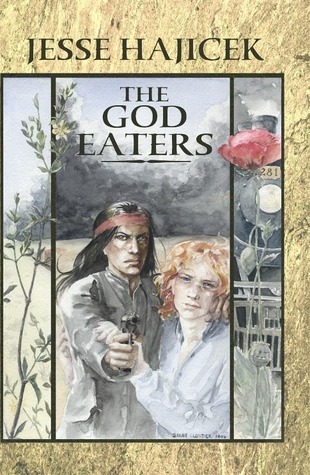
The Premise:
In a religious theocracy, a pair of remarkable men end up as cellmates in a prison for the magically talented. Kieran is a bandit fighting back against the country who killed his people, forced him into sexual slavery, and addicted him to opium. Ash and his Aunt published rebellious propaganda. The bandit can kill those he hates with a thought, and the writer has a minor empathic gift he uses to avoid trouble. Their journey involves ancient gods, prison breaks, treks across vast deserts, and a lot of agonizingly slow negotiation of their feelings towards each other. They mostly just want to live their lives free from the shadow of religious tyranny. However, the White Watch is relentless and the god who rules them even more so.
Read If You Like: Fantasy Westerns, introspection, anti-colonialist Fantasy from decades ago, awe-inspiring storms, thematically rigorous Romance
Avoid If You Dislike: yearning and pining, underexplained magic, tonal shifts in the third act, ‘he could never like me’
Comparable Media: Heart of Stone, Aristotle and Dante Discover the Secrets of the Universe, The Fall of Kings
What Worked for Me:
The God Eaters’ success rests on our core duo. Kieran and Ash both could have turned out as shallow stereotypes. Certainly on the surface they seem that way: Kieran is harsh and abrasive, feeling undeserving of love. Ash flinches easily and seems to avoid open conflict. Hajicek takes these two starting points and dives deep into them. Kieran’s healing process is slow, frustrating, and often recursive. Once Ash adjusts to his new surroundings, he reveals that he leverages his supposed softness as its own power over guards and inmates. The main focus of this novel is on the psychological states of these two characters, and we spend more time exploring their brains than we see traditional plots – Fantasy or Romance. Yes we see shootouts and magical mysteries, but th emeat of the story happens in their brains. Both characters are constantly in a state of change, re-evaluating what they need to move forward in life. Because there’s a heavy Romance element here, part of the answer is each other. However, Hajicek doesn’t shy away from challenging them with difficult conversations either; at one point in their journey, Ash and Kieran encounter a priest who tried to convert the local indigenous community (whom shares a language with Kieran’s tribe), and unintentionally called mass-murder to their doorsteps. When Ash calls him out on this, he responds by showing how Ash’s actions also brought death on the doorstep of those who did not deserve it. The Priest remains a racist prick, but Ash is forced to come to terms with the brutality of revolution that his pre-prison life shielded him from. Kieran is not a survivor of sexual assault who gets ‘fixed’ through love, and rage remains a core part of his character throughout the book. Hajicek’s handling of these two is truly incredible, and both are prime examples of the types of characters I wish other authors would begin writing more of.
While this book feels a lot to me like a Fantasy Western, I don’t think this book will satisfy Western purists: too much romance despite the clear homages to the genre. The novel is set in a reskinned America; more than simply filing off the serial numbers, but still with clear references to Native Americans (not specific real tribes that I could identify, though I’m far from an expert) and the Irish. Hajicek didn’t pull any punches, but also didn’t slip into the issues that so many Westerns face. His development of indigenous people is especially notable here, as The God Eaters neither gives us Noble Savages nor bloodthirsty villains. Kieran is our only Indigenous character who gets significant development – to be fair, almost nobody beyond our core pair gets developed much because they move from place to place so often – but we see a wide variety of Native American coded characters. A brothel owner who’s trying to establish herself in the opium trade after offing the rapist who ran the establishment before her; a girl who has been adopted by a Missionary after he got her whole town burned down, holding her ground to keep her culture as much as she’s able; a crew who gets after Kieran for taking actions that will draw the attention of the White Watch down upon their communities. Most are from different nations, sometimes sharing language and cultural overlap, while others don’t. They react in a variety of different ways to how their government is working to erase their culture to force them to assimilate, and the comparison lines are clear between this story and the ways the United States and Canada attempted to erase Indigenous communities in our history. This book takes Genre Western ideas, throws in magic, and chooses a different path than the classics in that Genre. I’m not familiar enough with the state of modern Westerns to comment on how novel or unusual these ideas are now, but considering this was written in 2006, Hajicek was far ahead of the curve in terms of his writing compared to lots of Fantasy being written at the time.
Finally, Hajicek is a master of scene-work. There’s a lot of danger that an introspective story can descend into a rambling mess without any sense of direction or context. In The God Eaters, every scene has a purpose – sometimes pushing the plot forward, but usually exploring a new facet of our characters – but always remains anchored in the here and now. A good portion of the book takes place in prison or in desert wilderness. This could easily have felt like a monotonous set of conversations between Ash and Kieran separated by slight changes in scenery. Instead, each location, each moment, is infused with emotional intensity. Sometimes this is told to us (‘coming home felt like coming home’ as Kieran gets surprisingly nostalgic when he returns to the brothel his mother worked at) and at other times it is shown to us through dialogue and action. Locations have weight and meaning in a way that I rarely see in modern genre fiction. Everything in this book feels intentional, developed, and thoughtful. Most of all though, it felt like Hajicek wanted to prioritize depicting Kieran and Ash’s lives, not simply advancing a plot.
What Didn’t Work For Me:
SEQUELS! I would have loved if this were a trilogy giving the non-romance elements more room to breathe, exploring different pockets of the world, and fleshing out our protagonists lives much more. There’s so many hanging threads that could be pulled on; for example, Ash’s Aunt as her importance to him is mentioned several times, and it would have been fun to see he and Kieran pay a visit as they mounted their resistance against a tyrannical god. The last 50 pages of this book were a mad rush of revelations, fights, and wrangling that could have easily been expanded into a full trilogy that pushed into a more epic-fantasy direction. As someone who frequently advocates for authors slashing 50-100 pages from their novels, this is – in my view – praise in disguise. Of course, this would make The Godeaters a fundamentally different book, pushing the focus away from an introspective Romantic Western.
Really, this book was pretty much perfect for me, and I crave more of it. Sadly, it was written as a standalone. Hajicek passed away recently, and many of his books are no longer available for purchase, though it seems like his late partner has shared some of them for free online (including The God Eaters, though it’s also available to be purchased from several places, including bookshop.org and other less ethical online retailers). Definitely going to try and figure out how to read more by Hajicek without needing to sit at my desktop to read.
Conclusion: It’s blend of Character-Work, Romance and Fantasy won’t be for everyone, but it certainly was for me.
 Marked for Plot
I just finished The God Eaters and wanted to say thank you for the recommendation! I can’t believe it’s over… What a beautiful book!! It was exactly what I’ve been looking for and I never would’ve found a random self-published book from 2006 without your blog to guide me
generally, I’m glad to have stumbled across your blog via Reddit a few weeks ago when I was looking for recs of well-written gay fantasy books and saw that we share similar taste (anyone who loves The Spear Cuts Through Water knows what’s up). I can’t wait to see what great reads you’ll find for me next lol!
LikeLike
I’m glad you liked it as much as I did! It’s a book that really has something special, and in a style that I don’t see at all in books coming out today.
I am also excited to see what comes next. My TBR is embarrassingly long. And if you have any recommendations, throw them my way! As you said, anyone who loves The Spear Cuts Through Water knows what’s up
LikeLike
what is life without a long TBR list?
in terms of queer SFF, I’d recommend The Resurrectionist by A. Rae Dunlap (fun gay historical fiction about body snatchers), The Mere Wife by Maria Dahvana Headley (modern retelling of Beowulf), The Unmagical Life of Briar Jones by Lex Croucher (witty dark academia), and — a bit of a harder recommendation depending on your relationship with Christianity — Dayspring by Anthony Oliveira (relationship between Jesus and John told through anachronistic poems)
LikeLike
Oooh, Dayspring looks phenomenal! I’m pretty neutral about religion, I was raised in a super queer-friendly branch of the Lutheran church, which frequently attracted the ire of the Westboro Baptist Church (same city), so I grew up seeing the best and worst religion have to offer. I enjoy religion in fantasy though, and don’t treat Christianity as any more off limits than Greek Mythology or Buddhism in terms of inspiration for stories!
LikeLike
In that case you might enjoy it same as I did! Even though I’m not a believer, I find certain parts of Christianity to be beautiful and moving, and that appreciation (along with knowing the plot of the Gospels) is all I’d say someone needs to enjoy Dayspring
LikeLike