
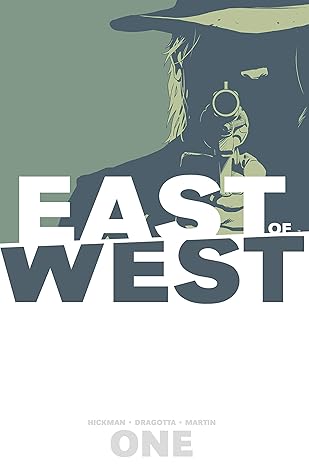
I’ve run into a lot of disappointing Weird West novels this year (followed by a really fantastic Fantasy Western in The God Eaters). East of West is a comic famous for being the Weird West of the comic world, though it mixes in more Sci Fi than true weirdness. Considering I read a trade, I only got about a tenth of the entire story to be told, which may not be enough to make a real judgement with. A lot of pieces got put on the gameboard, but none were developed enough to be anything other than introductory archetypes. There was enough interest here to make me want to read more, and the art style is just captivating
The Premise
Death is one of the Four Horseman of the Apocalypse, but he has broken away from his fellows. He now stands in opposition to them as he seeks revenge on those who killed his wife. Meanwhile, the other Horseman are trying to bring about the End of Times. Death will assassinate world leaders, wage war, and bring his inevitability to bear. Meanwhile, War, Famine, and Pestilence work behind the scenes to chase Death down and destroy the world as they know it. Threaded through all of this is a vast Science Western world, giant fights, and political maneuvering from human leaders.
Read If You Like: genre blending, tropes on tropes on tropes, epic stakes from page 1, the feeling of being small
Avoid If You Dislike: archetypical (stereotypical?) characters, multi-pov comics, plentiful violence
Comparable Media: Descenders, Mistborn Era 2
On Worldbuilding
Your enjoyment of East of West is going to live or die on the setting. At this point in the story, you’ve only gotten the broadest of strokes of this version of Earth, but it looks very different than our world. There are seven nations that come to be in the post-civil war. There’s still the US, which is seperate from the Republic of Texas. Portions of East Asia immigrated and carved out the militant nation of The People’s Republic. Meanwhile, most Native Americans came together to form The Endless Nation to fight against genocide. Then there’s the Kingdom of New Orleans, whose representative is the only Black character so far. Finally you’ve got The Armistice and The Black Towers, neither of which I know anything about yet. All of this is presented in quick snippets without any depth, mostly as a way to show that the Three Horseman have high ranking officials of all the countries in their pocket.
Because its so light on details, this conceit smacks a bit of lazy worldbuilding, sort of like how D&D has the Elf nation and the Dwarf nation, all of which fit into neat little pockets. At this point I’m willing to give this a pass because we haven’t actually gotten much time to explore any individual space, and I’m hoping the world will go beyond initial taglines. This is especially important, because I feel like some of these individual pieces could go very problematic very quickly. It’s tough to know how much Hickman is developing something new on top of Western’s problematic history of depicting Native Americans and how much he’s falling into the same trap with a shiny new coat of paint. Ditto with how the People’s Republic is depicted, potentially lining up with some classic post-WW II propaganda posters (but with mech suits). I think my thoughts about East of West has been influenced by reading it the same month as The God Eaters. That book immediately does a much better job with its nonwhite characters despite being written a decade earlier.
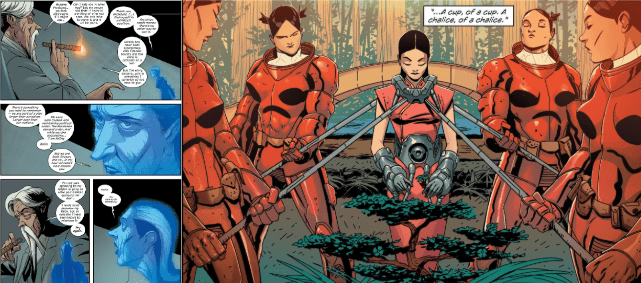
Of course, I haven’t even touched the blending of Sci Fi and Fantasy elements. This is the really captivating part of East of West, I think. In the same breath you see Crow turning from human form to, well, a flock of crows, mixed with Death’s robotic mount shooting death lasers out of its lamprey-like head. On one page you get megastructures right out of Star Wars, and on the next you see bison wandering on the open plains. There’s a commitment to Wild West aesthetics seen through this delightful kaleidoscope, and I just want to see more. I so desperately want to see more.
On the Art
Oh, but the Art is the true star of the show here! There’s not a ton of innovation in panel layout or pushing the boundaries of what comics can do. However, Dragota’s art is incredibly well stylized. Just as you get classic Western touchpoints in the story blended with some truly wild elements, so too does the art embrace Western caricature in a way that feels very tasteful. In particular, the use of deeply saturated blacks to create depth and contrast in the art made everything feel very evocative. This book is a feast for the eyes, and I couldn’t get enough of looking at it.
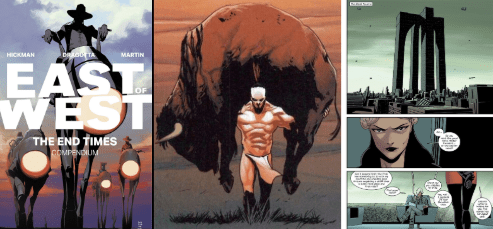
You also see the smashing together of genres here. Many of the western-heavy scenes are painted with a light sepia tone, but you’ll also find the vibrant blue holographs of any 80s Space Opera, and tricks of scale that you’d see in The Phantom Menace to give the illusion of megacities or giant armies without actually developing them.
On the Characters:
Like with the setting, it’s too soon to tell whether Hickman’s got a bag of engaging characters or cardboard cutouts who don’t stand up to any scrutiny. Death himself is kind of the archetypical quiet and brutal lone wolf you might see in a Noir novel. Similarly, he is accompanied by Wolf and Crow who … well they don’t exactly scream ‘thoughtful representations of native Americans’, but they also haven’t done much yet beyond look intimidating and show off magic powers. Xiolian is Death’s Wife, but it’s unclear at this point if she’s going to have a role in the story beyond ‘mother of Death’s child’, despite successfully becoming leader of one of the nations by the end of this volume. After rescuing her, Death promptly goes off on his own again, leaving me with the assumption that her role in the story if fairly small. It just feels like there’s an awful lot of pitfalls that could have been avoided with just a little bit more thought and editing.
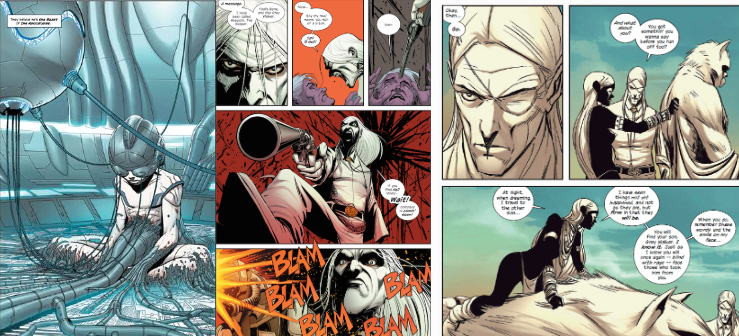
On the flip side, Hickman does a great job with dialogue. I sometimes thinks comics are lazy about writing good dialogue, because you can see who’s talking so clearly. Even their body language can lend inflection in ways that novelists don’t have access to. Not so in East of West. The monologues are captivating, the voices of characters clearly differentiated, and I never got bored of hearing them talk. These people have no depth to them (yet), but they are very well painted cardboard cutouts.
Conclusion: Stylized, Ambitious, potentially shallow and dated (tbd)


One thought on “East of West – Star Wars meets Silverado”