
This book has been sitting in my classroom library for a little over a year, and it hasn’t gotten a ton of movement. This is fine: most books don’t. However, as I’m revamping my curriculum, I began to realize that my favorite 6th grade unit, Fantasy book clubs, has no queer options. Fixing that got added to my summer to-do list. I don’t think The School for Invisible Boys is the right pick for my curriculum, but I had a great time with it, even if I can see the areas where I’d like it to shift. Certainly it took me back to my own childhood, even though I wasn’t a Catholic school kid.
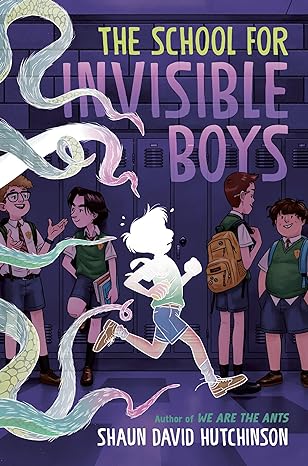
Also, shout out to Julian Callos for some ridiculously fun cover art!
The Premise:
Hector is a 6th grader at a Catholic middle school. Life is pretty hard for him right now. His new stepdad and stepbrothers are far more rough and tumble than him, and he feels consistently judged and bullied by them. He feels like his mother has left him by the wayside, and his decision to ask his best friend Blake to be his boyfriend had disastrous results. Now he’s on the run to avoid getting beaten up, only to find himself turning invisible. Turns out he’s not the only lost boy that St. Lawrence’s Catholic School for Boys has running around its hidden halls. Oh, and there’s also a giant tentacle monster too.
Read If You Like: the power of friendship, paranormal investigations, too many tentacles, Fantasy as allegory for the real world
Avoid If You Dislike: middle grade stories, tidy endings, muddled portrayal of healthy family dynamics, censoring slurs in kids books
Comparable Media: The Misfits, Lunar Boys, Spy School
What Worked for Me:
The allegory at the center for The School for Invisible Boys resonated with me a lot. Being unseen and feeling invisible is a pretty universal middle school experience. 6th graders think everyone is looking at them all the time, when in reality most of them are so wrapped up in their own brain that they don’t have time to realize what everyone else is up to. Lots of preteens would love to turn invisible, to remain unseen. Certainly those who get bullied do what they can to fade away. I kind of expected it to handle invisibility and the queer elements of the story differently, but was happy it didn’t. Hector’s situation is a bit different from mine – I wasn’t openly gay at 12, and certainly wasn’t about to be asking anyone to be my boyfriend – but closeted kids like me yearned for invisibility in a different way. We did everything we could to blend in, to adjust our behavior to conform to the society around us. More chameleon than ghost, I suppose. I wanted to just be a normal kid. Hector doesn’t, and that made me really happy. He regrets asking Blake out, but not because it means people know he’s gay. He just wants his best friend back. This level of openess about identity, especially in a book about a kid fading away won’t resonate with every kids’ experience. However, it brought me a lot of happiness to see that Hector’s invisibility wasn’t trying to hide himself, but instead a reflection of social isolation. It was placed upon him by other people, not something he chooses for himself (mostly). We aren’t in a space in the US where everything is good and fine for gay kids, but reminders of the progress we have made is a plus.
On a more concrete front, I think this is a great paranormal mystery story for middle schoolers. It’s a little scary, a little focused on social justice, and a little bit about the experience of being a kid. I was thinking the story would lean more into horror than Buffy or Scooby Doo, but it worked really well. Those investigatory elements managed to mesh seamlessly with the potential loss of a close friendship as a reaction to queerness, which brought back a lot of memories (looking at you Chris!) and the story didn’t overplay Hector’s ‘woe is me’ inner monologue. Hutchinson also lays out some groundwork for sequels, making this a ‘monster of the week’ type series, which I’m all for. The School For Invisible Boys juggles a lot, but it manages to keep most balls in the air in a way that holds your attention and keep turning the next page. I don’t think it’s going to win over anyone who dislikes middle grade writing, but I loved it for a cute little story I could bang out in a day while drinking Chai.
What Didn’t Work For Me:
A fairly major part of the storyline in Invisible Boys is Blake’s treatment of Hector. There’s a lot that goes into that, and I don’t dislike where most of the storyline heads – not every friendship deserves repair, but it’s okay to want to fix a relationship that broke unexpectedly. However, it’s heavily implied that Blake called Hector a faggot, but the book substitutes the work freak in instead (in italics). This happens quite a bit, perhaps 20 times throughout the book. I don’t know whether it was Hutchinson or his publisher’s decision to censor that word, but I strongly dislike it. I understand the choice, but I don’t agree with it.
Middle Grade Fantasy has cemented itself as a place where readers are not allowed to be confronted with actually difficult situations. Gone are the days of Animorphs when characters struggled with suicide, engage with the traumatic aftermath of violent situations, and grapple with serious mental health struggles. If we’re going to write a story about a kid getting called a faggot … I think it’s worth treating kids with the amount of respect to actually use the word. I was getting called a faggot while in 6th grade. As a teacher, I know for a fact that it hasn’t gone away. I get all the reasons why the decision was made to avoid using the word faggot in this book. I cannot imagine this book would have been marketable otherwise. It did make me sad though. If this book is really for gay kids getting called faggot, they deserve others to live in the discomfort of having to read it, confront the damage that words can cause, and stand up when people in their lives use the word. I think the book would have needed a bit of a rework to handle the situation with care, but we can’t run away from difficult topics. Hell, I’d even have accepted an informational foreword or postscript educating kids about what the actual word is, its history, and why they chose to substitute freak into the story instead. Avoiding bad things doesn’t make them go away in kids’ lives. It just makes them less equipped to deal with it. As it stands, a reader is going to leave this book not even knowing the word faggot exists unless they google search ‘bad gay word that starts with f but isn’t freak’. Kids can handle it! I promise they can!
Hutchinson nails a lot of the social commentary parts of this book, but I wasn’t sure about how it handled family dynamics. Hector’s mom has gotten remarried to a man’s man, and he now has two older stepbrothers who are best described as developing frat-boys. There’s some light bullying that eventually develops into a ‘you’re my brother and I’ll fuck up anyone who messes with you, even if you do play the piano which is lame’ situation. Hector feels unseen and forgotten (yes, it’s a running theme), and he expresses this to his mother several times. She never really engages with his concerns seriously, even at the end of the story. She flat-out tells Hector that he needs to be the one to make the sacrifices more often. I’m not entirely sure Hector is the most reliable narrator, but this was the one area of the story where I didn’t love Hutchinson’s handling of interpersonal dynamics. I don’t know that Hector’s experience itself is a problem, but the narrative seems to want the convenience of Hector feeling unseen at home without putting in the work to try and shift and improve his relationship with his mother, making the fully happy ending feel a bit unearned and shallow.
Conclusion: A fun paranormal mystery, but it lacked the teeth that could have made it truly great.
 Marked for Plot
One thought on “The School for Invisible Boys”