
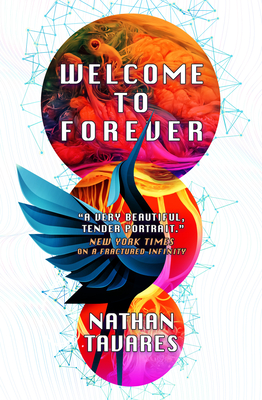
This is a book that I picked up more or less on a whim. Another book by this author (which I haven’t read yet) was recommended to me, and when I saw this was being published in 2024, I committed to picking it up for my bingo challenge. I was not prepared for a story that would make me cry, force me to sit with my emotions for about a month before I could read anything with any depth whatsoever, and rocket into my all time favorites.
Read if Looking for: experimental books, weird memory stuff, complex characters, crying
Avoid if Looking For: straightforward writing, characters making good decisions, plot focused on action and/or external conflict
Elevator Pitch
Fox is a memory editor. He tinkers in people’s heads to delete trauma, raise contentment, and smooth out rough patches. He’s also recently been left by his partner of 16 years, Gabe. Oh, and he was the victim of a neuro-terrorist attack that killed Gabe and left him with almost no memories.
Now Fox is at a memory rehab facility, struggling to call back his past and figure out who he was, only to discover that he doesn’t necessarily like that person very much. And then there’s Gabe, who seems to be at the center of his world, but whom Fox can barely remember at all. As Fox explores his memories and the brambles of his relationship with Gabe, Fox is forced to confront his past and carve a new path forward.
What Worked for Me
This book felt pretty darn close to perfection for me. I could gush about a lot, but what really makes it work is how well-realized Fox and Gabe are (or rather, Fox’s memory of Gabe). Both characters have their own baggage from their lives as refugees, and both have incredibly unhelpful ways of coping with their trauma, their emotions, and their relationship. If you want characters who do the right thing all the time, this is not the book for you. But Tavares does a really good job of framing Fox as someone who is self-aware of his own flaws and desperately wants to be better; he just doesn’t quite know how. I empathize with the feeling that I know something is a bad idea, but doing it anyways because of impulsiveness, the immediate hit of dopamine, or because sometimes its so exhausting to fight your emotions. And Fox’s past is littered with bad, petty, and destructive decisions.
Gabe is presented through the lens of Fox’s memories, but I’m amazed at how Tavares was able to craft a picture of him that worked both as giving the reader a feeling of Gabe as an individual, but also as a character our narrator is unable to objectively consider due to their personal history. Despite that faulty representation, Gabe feels like he could jump off the page and have a conversation with you, a personal trainer inhabiting the bodies of his clients. While this book is not a romance, the romantic history and connection between Gabe and Fox is central to the story, and it really sings
Characters aside, the book does a great job of capturing the feeling of falling into and out of memories. This book is a mess of timelines, edited memories that hide even more edited memories, and dangled mysteries about the past. While things do end up explained in a more-or-less straightforward manner by the end of the book, for most of it you’re doing your best to piece things together while knowing that your current theory isn’t right because these three things you know don’t fit. I’m sure if I sat down I could try to solve the mystery, but really enjoyed getting lost in the story that Tavares was telling. You’re left with this constant nagging sensation that something isn’t quite right with how you’re seeing the world. You become Fox.
Another high point was the ending. To avoid spoilers, all I can say is that the author had a lot of directions he could go with how this story ended. And I think he picked the version that completed the story best, even though it wasn’t the easiest option. The epilogue (coda) is probably one of my favorite epilogues of all time.
I do want to acknowledge my own biases here. This book really plays to my preferences. I love nested stories (The Spear Cuts Through Water), captivating characters who struggle with their baggage (Jade City) and books with gay characters that go beyond the romances and coming out plot points that gay leads are shoehorned into (A Choir of Lies). But this book certainly resonated with me in a way that likely created a different experience for me than others might feel.
What Didn’t Work for Me
Honestly, precious little.
It was tough to remove my personal emotional response from this book, but when i do I think that the thriller and cyberpunk elements are underdeveloped compared to the rest of the story. There comes a pivot point where the book shifts from highly experimental to something more traditional, and that writing isn’t quite as tight. Had this storyline been the central part of the story, it would have impacted my feelings for the book, but it was a side dish, not the main story.
If Tavares were to revise the story, I think I’d have liked to see some more explicit musings on the ethics of memory editing. There’s the beginnings of looking at how memory editing could be used for good, as a tool to cope with and heal from trauma, but it ends up as an exploitative corporate tool. I would have liked to see Fox’s slide down that path more an more. It’s still present, but an undercurrent that I’d like to see plucked into the forefront.
In Conclusion: This book about two messed up soul-mates. Is a labyrinth of memories, unreliable narrators, and people dealing with their own trauma (often badly). It is a beautiful book that made me feel so many things, but it’s not a breezy popcorn read. It was incredible.
- Characters – 5
- Worldbuilding – 3
- Craft – 5
- Themes – 5
- Enjoyment – 5
 Marked for Plot
4 thoughts on “Welcome to Forever, by Nathan Tavares”