
It’s unfair of me to claim that Fungi are having a moment right now, considering some of the oddly high amount of mushroom content came from books half a decade old, or my tabletop group’s year long campaign dedicated to them elevating their fungal deity to ascendency. However, I do feel like I’m seeing mushrooms around more the past year or two. Maybe it’s because The Last of Us show was such a hit?
Anyways, I thought this one was serviceable. Great mushroom content, but that’s about the only thing I can recommend the story on. I think there’s a New Weird reinterpretation of The Handmaid’s Tale out there for me to love, but this one didn’t hit the notes I needed it to.
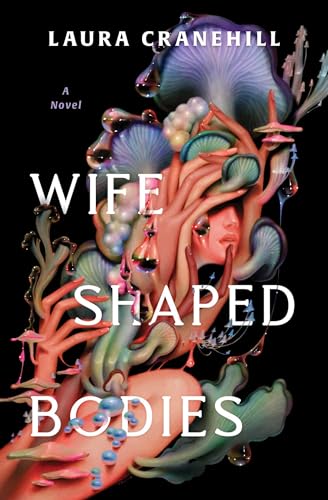
The Premise:
Nicole’s mother just died, and it is her wedding day. She hasn’t left her house … ever. And now she must obey the whims of a man she has never met. While living in his home, she becomes connected with the mysterious Teagan, whom she as long admired from afar.
Read if You Like: ambiguity on bodies, weird science, disturbing sex scenes
Avoid if You Dislike: mushrooms; extensive depictions of marital abuse, sexual assault, and pregnancy (amongst other things)
What Worked For Me:
Bodies is part of the title of the book, so it shouldn’t be much of a surprise that bodies, and the descriptions of them, feature prominently. I think there’s some delightful, but low hanging fruit to discuss with the women’s fungal bodies. They are asked to shave their growths, and Nicole lets hers grow out most when she becomes infatuated with Teagan. This feels pretty analogous to the fact that women choosing to not shave body hair is more common in queer women. Simple, effective, just subtle enough that you need to make the jump, but not so abstract as to feel pretentious.
However, the women’s bodies are left much to the imagination. They always live somewhere between human and fungus, but belonging to neither. It’s a bit of a sliding scale though, and Cranehill makes a (successful) effort to portray the women of the compound as something intimately human and utterly alien, depending on the needs of the story. We do eventually get a few firm and science-babble explanations, but I kind of loved how amorphous Cranehill kept things. It let my imagination do the work, which was exactly the right call here. The mushroom elements intensify more and more as the story continues, including one very explicit sex scene that was both similar to and very different from human escapades. I was a bit disappointed by how normal the fungus seemed at first, but Cranehill really leaned into the viscerally in the back half of the book.
Finally, I liked the refusal to keep the story anchored to traditional plot and character arcs. Some of this is overt plotting (Nicole investigates somewhere she shouldn’t with her crush. It’s important, but visiting there doesn’t become the focus of the story, nor does the crush). At other times, Cranehill was willing to present Nicole seeing bright spots in her new marriage, authentically enjoying a moment even after previously being raped by him. This is both honest to some people’s experience and also not the typical way authors handle this storyline. Usually there’s a much more clear ‘realizing he’s abusive and starting to fight back’ line that moves steadily upward throughout the story. I don’t know that Cranehill was able to find the deep themes she was hoping for, but I do think she succeeded immensely in the realistic writing of complex and uncomfortable life situations.
What Didn’t Work for Me:
This book just wasn’t enough for me. Not ambitious enough. Not horrific enough. Not disturbing enough (mostly in the first half for this one). This is the story should vibrate. You can’t call a story Wife Shaped Bodies, throw mushrooms into the picture, and then leave me with something that never quite found something new to say. Aside from fungal bodies, the journey just didn’t have anything interesting to say. Not about the patriarchy, about domestic abuse, about sapphic love, about societal subcultures, about anything other than the physical bodies of the wives. Nothing was ever bad. I didn’t abandon the story. I just felt like I was in a constant state of feeling like this book deserved more than fine. I can name a decent number of books the in the sapphic awakening + abusive male society-marriage + horror that just executed so many of the basics better, even if they aren’t as weird. I’d point you first to The Book Eaters by Sunyi Dean for something simply divine. I would also point to Hungerstone, even though I had nitpicks with that as well. Wife Shaped Bodies is a book that needed to have more thematic heft to it, I think.
It isn’t that I wanted the content to be more intense. You’ll see plenty of despicable acts of violence here. However, I never felt like Cranehill pushed as much emotionally as she should have. Even in the sections where Nicole became numb and unfeeling, I never felt like that emotion got put onto me, the reader. With how much Cranehill is willing to forgo traditional elements and stylings, I’m surprised that this wasn’t more of a priority for the story.
Also, this book needed to start earlier! I feel like I never say this, but we needed another 50 pages at the start. Nicole’s wedding day is an apt and metaphorical time to begin. However, I think a childhood build-up arc would have allowed for some much needed worldbuilding to happen. There were hints of a flourishing Wife subculture. We never get to see it because of the men in Nicole’s life being overly controlling, even for the men of this compound. However, the bits we did see seemed like a really interesting bit of exploration, such as the safety advice given to Nicole before her marriage (at the funeral of Nicole’s mother no less). I think there was a lot of room to really flesh out the setting, which I think would have been an interesting thematic point to build around.
Conclusion: Recommended enthusiastically for weird mushroom stuff. Outside of that, other books have more to offer.
- Characters: 4
- Setting: 2
- Craft: 3
- Themes: 2
- Enjoyment: 3
 Marked for Plot