
Earlier this year, I fell in love with the slice of life Intergalactic Idol boot camp that was Divinity 36. With my push to actually continue reading the series that I’ve been enjoying – instead of leaving everything abandoned at book 1 – I picked up this audiobook for some long car rides to and from a cabin weekend. While it didn’t quite have the magic of Divinity 36, I had a great time with it and will totally and definitely finish the series this year … probably … assuming I don’t get distracted.
The Premise:
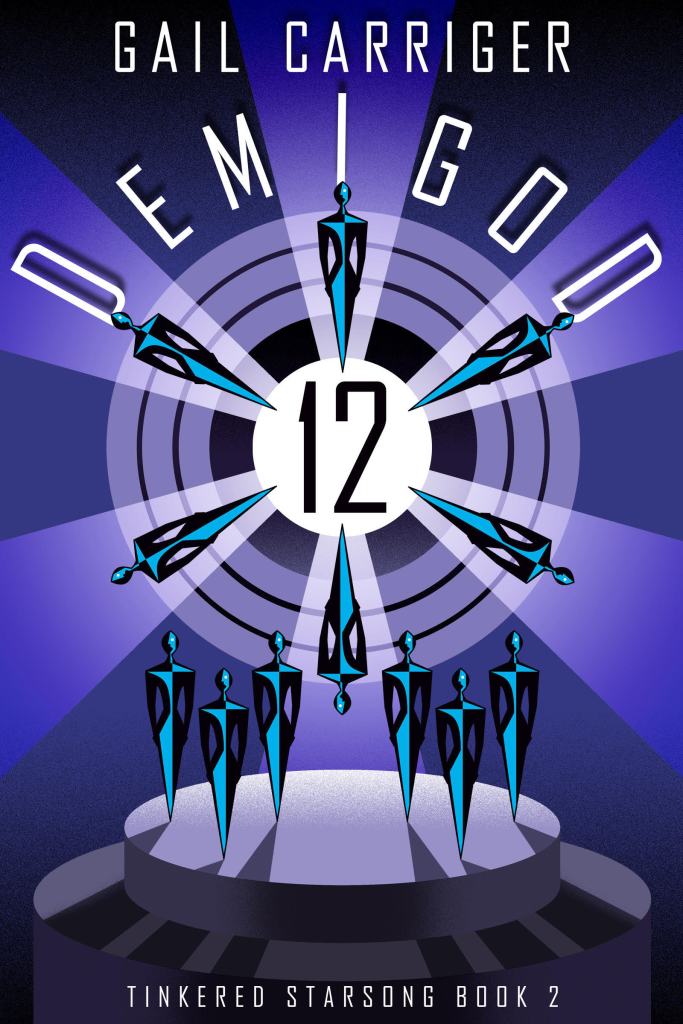
This book picks up with Phex and company going on tour as the opener for Tillum, the universe’s most popular Pantheon. Phex needs to balance the needs of both Pantheons with his growing feelings for superstar Missit, in a job where romantic and physical love are forbidden.
Read if You Like: the dangers of parasocial relationships, angst and yearning, the lack of agency in idol culture
Avoid if You Dislike: ‘how could he possibly love me’, protagonists without real flaws, grumpy/sunshine pairings
All in all, I didn’t quite enjoy this book as much as Divinity 36, and I’m pretty sure it comes down to the romance between Phex and Missit. Carriger wasn’t shy about foreshadowing where their relationship was going, but it had remarkably little page-time in book 1. Demigod 12 takes away a lot of the exploration of how Godsong is made, which was one of my favorite parts of Divinity 36, and replaces it wholesale with a fairly traditional romance plotline. I missed getting lost in the details of color and pattern and dance and sound and how they all interwove. However, since Phex – and by extension the reader – now understand Godsong, repeating plot points would have gotten old quick.
And a decent number of Romance elements worked for me. It was forbidden love that actually felt forbidden, especially when taken in context of our growing knowledge of the biology and reasoning of their alien managers. There was a rather delightful conversation after all members of the pantheon were forcibly sterilized that was a high point of the whole book for me, actually. Phex and Missit sneaking around on a spaceship felt realistic and grounded, as did his groupmates worries that Phex’s new relationship would end the careers of their own group as he gets absorbed int Missit’s A-Lister orbit.
My delight in how realistic some parts of this romance grated against the frustrations I had around Missit and Phex not communicating openly. Missit thinks Phex’s grumpiness means that he isn’t interested in Missit. Meanwhile Phex thinks that Missit’s flirtations are just a way to fill the hole that a sick groupmate has left in Missit’s heart. Both felt like their crush was unrequited, and that storyline plodded along far too long. Holy shit, just talk to each other and stop assuming that nobody in the world could possibly have any affection for you. Admittedly, this is a trope I happen to dislike, and fans of teenage angst in Romance might enjoy this a lot more than me.
This series continues to be at its best when defying genre conventions in how it handles character and plot. When I think of my favorite moments from the book, they typically focus on social and societal dynamics that pull the story in unexpected ways. I’ve mentioned the forced sterilization, which led to a variety of reactions that felt very accurate to each of their upbringings. Another highlight was Phex’s relationship with Missit’s dying groupmate, whom Phex has been tapped to replace on the group’s final tour. It was a delightful little blend of pettiness, support, and brutal pragmatism that defied easy labels and conventions. It would have been so easy for that to have turned into a relatively bland jealous-ex situation. Thank you Carriger, for letting YA books have complex and nuanced relationships that reject categorization!
In the final book, I’m hoping we dive more into some alien cultures, specifically the Dysei, who manage the Pantheons. We got enough tidbits about them that I’m very excited to see where Carriger goes with that. I’m also hoping that now our main couple has actually gotten together, the bits that annoyed me here won’t pop up again in the sequel.
Conclusion: a sequel that pushes more into Romance than I’d have liked, but still an enjoyable portrait of intergalactic idol culture.
- Characters: 4
- Setting: 4
- Craft: 3
- Themes:3
- Enjoyment: 3


One thought on “Demigod 12 – Romeo and Juliet, but via Intergalactic Eurovision”