
I am a sucker for watching competition TV shows. Survivor was a family staple growing up, and Top Chef has gotten me through many marathon grading sessions. Divinity 36 felt a lot like that, both in content and style; it isn’t going to satisfy anyone looking for deep commentary on the human condition or societal power structures. However, it was a fun ‘idol training program’ story with a Sci Fi veneer and some interesting takes on what alien music might look like. It isn’t the fastest-paced story in the world, closer to something slice of life, and it was a phenomenal book to listen to over an 8 hour drive.
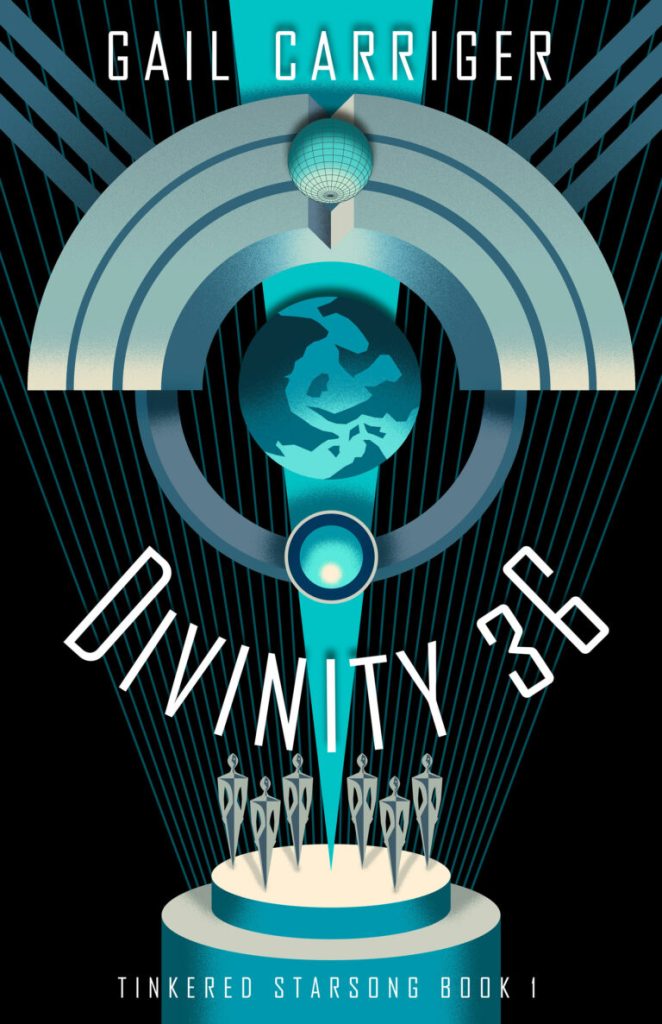
The Premise:
Phex grew up in The Wheel; a violent and xenophobic space station who genetically and cybernetically modifies their babies. Phex’s body rejects cybernetic implants, forcing him into non-human societal status. When he escapes, he gets a job as a child refugee at a coffee shop that hosts Dome shows, where Pantheons perform Godsong. He gets recruited by a scout and finds himself on Divinity 36, training to become a god himself. For most, this is a path to fame and glory. For Phex, he’s just happy he got a pay raise. However, the grumpy singer grows more and more enamored with the music he can create, and finds himself with friends for the first time in his life.
Read If You Like: slowwwww burn romances, idol training camps, barista tips, grumpy/sunshine friendships
Avoid If You Dislike: ‘special’ protagonists, vague alien worldbuilding, extended rehearsal/performance descriptions
What Worked for Me:
The main thing that made Divinity 36 work for me was how laid back it was. YA right now is filled with books that feel the need to be relentless. Every look is brooding. Every conversation pushes the plot forwards. Every rivalry is destined to involve a knife in the back. Divinity 36 is much more relaxed, to the point where I kept double checking that it was indeed a YA book. Phex’s journey is fairly meandering. Yes, Carriger is setting a bunch of dominoes to knock over later – especially relating to the eventual love story between Phex and the universe’s favorite singer – but they all feel very natural to the situations that Phex finds himself in. You get interpersonal conflict between Phex and his competitors for godhood, but there’s never anything over the top. They’ll call each other out, socially shun each other, etc. However, nobody is putting glass in each other’s shoes or trying to trick Phex into dating someone – an expellable offense. This also had the side effect of love triangles being blissfully absent. Characters succeed and fail in organic ways, not necessarily lining up with traditional growth arcs. The dorm room socialization is just as important as the music, and Divinity 36 provides us with a cast that feels large enough to give a school fantasy and small enough to develop a variety of different character types. This book is a little bit cozy, a little bit stressful, but mostly just wants you to enjoy a good story. If traditionally published YA could take some notes and bring some structural and tonal diversity into their books, I would really appreciate it!
Considering this story focused on a talent-development program in space, I was thrilled to see Carriger put thought into how entertainment might be different in her world. Like most idol groups, there are talents recruited for both singing or dancing. However, the Dyesi, the alien race who runs the entertainment world, has the ability to produce patterns on their skin in response to music and dance, and then project these patterns onto giant domes. The end result is more the sum of its parts, Godsong, which truly does seem to have a deeper impact on those viewing and listening than earth music does. It drives some to literal insanity, and the rabid worship of the fans goes beyond what we see in our world. I was hesitant about this at first, but as Carriger built Phex’s (and by extension, the reader’s) knowledge and understanding of Godsong, I found myself invested in the intricacies of something completely fictional. Phex, of course, has a super special 10 octave range (thank you genetic modification) and spends a lot of time holding back to avoid hurting his Dyesi classmates with his song. Add onto all this a layer of discomfort of alien aesthetics that Phex and the others don’t quite understand, and Godsong feels both mystical enough to feel like magic and technical enough to enjoy many scenes where characters workshop songs and hone techniques. I can happily say that I loved how Divinity 36 mostly avoided petty squabbling and bickering in favor of focusing on the art that consumes Phex’s life.
What Didn’t Work For Me:
I talked a lot about how I loved that Divinity 36 broke away from a lot of the current YA trends. One of the ways it didn’t was our protagonist. Phex is sort of a carbon copy of any main character from a Dystopian book. He’s from the bottom rungs of society which equipped him with a unique set of skills that differentiate him from everyone else, along with a wealth of body scars. He’s broody and taciturn, naturally skilled but needs to put the work in, and gets several moments where all his friends are appropriately horrified when his backstory is revealed. None of this is actively bad, but it was notable with how fresh so many of the other story elements felt. I’m hopeful that Carriger does some interesting things with this archetype in sequels, as I think the parasocial relationships of fame could have some interplay with such a storybook tragic history. Time will tell, I suppose.
The only other thing that really detracted from my experience is that I wish Carriger had done a better job with alien descriptions. There are several characters that I just don’t have a good picture in my head. Characters come in three main varieties: sapiens are more or less humanoid variants with different skin colors and minor alterations; the Dyesi, who are graceful and emotionally distant and run the entertainment industry; and aliens, which are a catch-all for everything else. Phex does acknowledge that this categorization is fairly specific to how the Dyesi organize their Pantheons, and that he would be ‘alien’ to others, but Carriger is sparse on the details on what the ‘alien’ species are like. Berril is the most important alien, and quickly slots in as Phex’s best friend. I have no idea what she looks like other than having yellow wings. I must have missed a description somewhere, but it’s like that for most characters. I’m certain my internal pictures of them are nothing like what Carriger had in mind, which feels like a missed opportunity. We’re also missing almost any alien species that feels truly unknowable to humans, and feels very ‘star wars’ in how it handles aliens. The Dyesi’s sense of aesthetics gets close, but I hope to see more aliens that push beyond human-like conceptions of existence and socialization.
Conclusion: one of my favorite YA books in a while, though not one that has much to say beyond the scope of the story
 Marked for Plot
I had lots of fun with this one too! Sometimes a chill, meandering plot is EXACTLY what is called for, and this was so great for that. And I SO loved how much thought had gone into what the entertainment worked – down to the structure and dynamics of the pantheons! I had a lot of fun trying to picture all the colours being set off by the music.
Hard agree about the worldbuilding being pretty vague and handwavey. So far that’s been the case in every Carriger book I’ve tried. But the tone she writes in makes it okay for me? It’s when a book wants me to take it seriously that I need detailed, believable worldbuilding; Carriger’s books don’t, so I don’t mind the hand-wavey stuff.
LikeLike
My negatives here were both pretty light. I ended this and thought ‘do I want to read the sequel immediately?’ which is not typically something I do. I decided against it, but I would be surprised if I don’t pick it up by the end of the year. The narrator for the audiobook wasn’t my favorite, and I’ve got quite a bit of visual reading already on my plate for the next month or so. But definitely in the cards for the future!
LikeLike