
The Empress of Salt and Fortune is one of my all-time favorites, and I have a lot of love for the Singing Hills Novellas. I actually use two of them in my high school genre fiction class for a novella-focused book club. They had some of my favorite explorations of how truth isn’t always a single idea, that a story is just as powerful as an action, and using framing narratives in novel and interesting ways. This book, like some of the other recent entries in the series, mostly lacks those elements. I implore you to set aside your expectations and come in open to something a bit different. I enjoyed the book a lot more once I gave up those comparisons – it was hard though.
This is technically #7 in a series, but the novellas are all independent and can be read in any order.
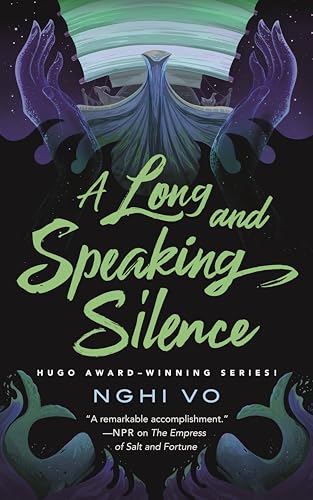
The Premise:
Chih is new to their job and has arrived in a river town preparing for a festival. Their purse is stolen, so they wait tables as waves of refugees enter the city. They collect stories, do their best to help others, and listen to the advice of Almost Brilliant. Mostly though, they’re desperately trying not to fuck up while they fake it until they make it.
Read If Looking For: mouthwatering food descriptions, a story focusing on Chih, sassy birds, the exhaustion of working multiple jobs
Avoid If Looking For: fresh examinations of refugee themes, explorations of truth and multiple perspectives
What Worked for Me:
Once I adjusted my thoughts on what the focus of this book was going to be, I had a lot better time with it. It’s billed as a story about refugees. Really though, it’s about Chih themself, even down to the title. Still learning their craft and on one of their earliest solo-missions, Chih’s casual grace from earlier books is absent. Instead, they’re bumbling and awkward, consistently losing out on opportunities to collect stories by causing offense and stepping on proverbial toes. In this book Chih learns how to shut up and let others fill the silence. The refugee narrative provides a convenient frame within which Chih learns and grows, as it allowed them to navigate several different social groups simultaneously. If I’m getting Chih as a main character, instead of as a vessel to experience the main story, then I appreciated that this book still anchors their experience in growing as a storyteller. This story reminded me a lot of being a first year teacher, and the growing pains that came with that experience. Chih is flying solo … and they hit a lot of rough patches.
This was also probably my favorite portrayal of Almost Brilliant so far. The little knowledge elemental/bird is sassy and sarcastic here, frequently nipping Chih to keep them from messing up even more. The two have not yet settled into an easy comfort with each other, and certainly Almost Brilliant doesn’t yet see Chih as an equal. I really appreciate how we can bounce around in the timeline with these novellas, but it always feels like Vo manages to keep the core parts of our two main characters consistent.
Also the food. Oh this book has so many delicious descriptions of food! Vo continues to be able to evoke strong emotions with sensory descriptions. You will leave this novella very, very hungry.
What Didn’t Work For Me:
I don’t know that this book had much that pushed me or challenged me in terms of its refugee storyline. There’s some elements that feel pretty classic to this topic. You’ll read “where are you really from?”, get asides on how older immigrants may not extend grace to newer immigrants, and other true yet established beats. I think the book came from a very humanist perspective, and it wasn’t bad; I just didn’t feel like I encountered much that I hadn’t seen before. It was a tough comparison to Kalyna the Cutthroat, which I read earlier this year and ran circles around this book in how it handled the topic of refugees in a fantasy setting.
One of my continual struggles with the Singing Hills Cycle is that I keep comparing the new books to the early entries. I had a great time with this book, but I kept holding on to how innovative and multifaceted some of the others were. If this isn’t your first Singing Hills Cycle novella, I’d recommend coming in thinking about it as a standalone story that happens to feature Chih as a protagonist, instead of as part of the extended series. It simply doesn’t have the elements that caused me to fall in love with The Singing Hills Cycle. I have yet to read A Mouthful of Dust (#6), and I’m hoping that – or the recently announced 8th book in the series – revisits some of what I see as the core ideas of this series.
Conclusion: delicious food, growing pains as you learn your career, but not as much thematic content as I’d have liked.


One thought on “A Long and Speaking Silence – Delicious Food, Deficient Social Skills”