
For whatever reason, I’ve decided that this is the year I try and figure out what types of cozy fantasy I actually enjoy. It feels like there’s a ton out there in the mystery and/or small business owner space, ditto with cottagecore vibes. However, I’ve found that type of story hasn’t managed to hold my attention much. My favorites have all diverged from that formula pretty heavily. Chai and Charmcraft struck a similar chord to Hands of the Emperor by Victoria Goddard and The Goblin Emperor by Katherine Addison. It’s more saccharine than either of these, but retains some of the sharp edges and personal stakes that form the core of my cozy fantasy preferences.
The Premise:
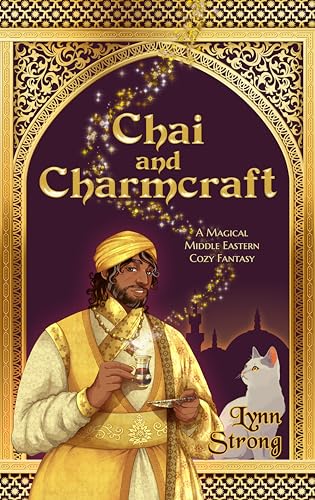
Faraj is the God-Emperor’s brother, gifted with prophetic visions that make him invaluable to the throne. On a single night of indulgence, he chases a vision of a man tending a Jasmine plant that has followed him for decades. This leads him to a bathhouse/brothel in the Catspaw district where he meets Asharan, the keeper of the bathhouse. The two are smitten with each other, but their encounter quickly has implications far beyond what either of them ever intended. It doesn’t help that the night brings a cat-familiar into Faraj’s life, which are banned in the palace.
Read if You Like: the politics of gossip, indulging the joy of children, fat protagonists treated with dignity, catfolk who feel like cats
Avoid if You Dislike: extended conversations, overly-sweet dialogue and internal monologue, unconventional Romance plot structures
What Worked For Me:
Strong does an excellent job of taking a single encounter and spinning out the ripple effects far beyond what I thought possible, without the plot feeling forced. The prologue chronicles the night Faraj and Asharan meet and quickly begin falling in love, and I girded myself for 500 pages of sweet nothings. Thankfully, this is not the case. Actually, the two spend almost the entire book apart, dealing with the fallout from that night. Asharan’s public affection to the disguised prince unleashes matchmaker hell upon himself, as Aunties try to line their daughters up to inherit his bathhouse. He also struggles with his role in complicating Faraj’s life and navigating his rash involvement of the Fat God’s priesthood to provide cover for Faraj’s visit. It’s all very personal and neighborhood-level politics, but the stakes are very high for Asharan as he seeks to do right by his friends, his community, and the prince. It’s also given the same complexity and care that court intrigue gets in Game of Thrones.
Meanwhile, Faraj realizes that coming home with an illegal cat-familiar bonded to his soul creates a dangerous situation for both himself and Asharan. He doesn’t want to bring down courtly attention on Asharan, fights to keep his new beloved familiar, and begins to sees the flaws in the government he represents. There’s plenty of political chess with well-intentioned government officials who care for him personally and worry that he has been ensorcelled: after all, someone under a spell would never admit as much, or the spell wouldn’t be worth its salt. Seriously, the main antagonist of this book is someone who ardently admires Faraj and is trying to save his life. The plot was a lovely little string of dominos that helped provide balance for the sweetness of the romance. And that is very sweet, sweeter than I tend to prefer. It’s a warm blanked + hot cocoa (or chai, I suppose) + cute kittens with big eyes + sunsets + the light of my life + well, you get the picture. The whole story could have gotten far too gooey for my taste, but Strong had a really great sense of balance. There’s sweetness in most of Faraj’s relationships, despite his lack of any sense of self-worth.
It was clear that the setting had already been well fleshed out; Strong has written several novellas in the world already. I haven’t read them, but it seems like many major side characters here have a novella for themselves. There’s a lot to love in this world, which feels lived in. There’s far more than a few simple descriptors doing the heavy lifting; Strong put the work in to create a fleshed out setting ranging from food to architecture to religious holidays and more. However, the real star of the show are the catfolk! They exist in the city alongside humans, able to take on either traditional cat forms or a more bipedal human/cat hybrid. This alone isn’t unique; shifters are a pretty common trope. However, Strong makes them feel so much like cats. Their social structures and priorities don’t align with humans at all. The human government sees themselves as ruling over the catfolk. Meanwhile the catfolk can’t believe how stupid the humans are, with their silly metal coins and obsession with water. They’re happy to create mischief for the joy of it, claim humans who need guidance and shepherding, and laugh off humans who think they’re in control. Could Strong have gone harder in this direction? Probably, but it’s a much better-realized portrait of what humanistic animals would be like than most shifter stories give us. Hell, they’ve got their own jewelry and cosmetic traditions that, while mentioned mostly as asides, are well thought out and utterly different than how humans view adornments. One of my favorite chapters in the book was from the perspective of Asharan’s accountant, a catfolk who started greasing the wheels of cat society to protect her human from gossiping aunties.
What Didn’t Work for Me:
I made an early comparison to Hands of the Emperor, and some of my complaints about that novel (which I love) come up here as well. This book is simply too long and overwritten for what it brings. Strong’s scenes feature lots of dialogue, and some conversations run 40+ pages. As with Hands of the Emperor, I think Strong repeats character moments more than I’d like her to. Repetition has its place, and Strong builds a lot of thematic depth. However, the scenes sometimes felt circular in ways that didn’t always feel like they were building towards anything. The story sometimes veers into slice-of-life territory, with plenty of conversations that have little to do with the main or side plots of the story, but flesh out the world and side characters more. I think I’d have liked it if this book were trimmed down a bit and given more narrative focus. Its indulgence is a perk and a plus, but even 50 pages less would have still felt indulgent and relaxed in its pacing.
My other complaint is that there’s LOTS of vocab in this book. Many of the terms are very real, which meant a lot of me stopping my reading to google things, because Strong often doesn’t explain them. This alone is not a complaint, but it creates a choppier reading experience for me personally. It turns out there’s a whole glossary and pronunciation guide at the end of the book! I am begging authors, BEGGING THEM, either put that shit at the beginning, or leave a big note at the start that you’ve included a glossary – to her credit, Strong did this very well for content warnings. However, once I was finally looking at the vocabulary resource, I didn’t think it was the best organized. Strong lays it out by category, which isn’t helpful if you don’t know whether something is a title or an adjective, for example. There’s also some entries such as ‘Rahat’s terms of address and endearment’ which is of no use if you’re trying to find ya habibti, because it’s located in the ‘r’ section instead of the ‘y’ or ‘h’ sections. The actual entries are super informative and well explained, going above and beyond what glossaries normally bring. It’s a labor of love, just not helpful for a reader quickly trying to locate an entry for an unfamiliar word without losing the thread of the scene. Instead, I think it works better as a world reference or miniature encyclopedia. Lots of depth, but less utility.
A final note that will bug some people, but was a nonissue for me. This book is both a romance and not a romance. Clearly there’s a slow burn going on, but Asharn and Faraj spend very little time together after the prologue, and the ending doesn’t bring them back together. So this feels sort of like a Romance but also sort of not? I respect the hell out of the unconventional plot structures, and also there’s a weird tension with how over-the-top romantic the opening was only for that to mostly vanish. This is book 1 of a trilogy though, so I’m assuming we’ll see more of this duo together in the next installment.
Conclusion: a very sweet cozy fantasy that had a great sense of personal stakes, though it’s longer than I wanted it to be.


I’M SO GLAD YOU ENJOYED THIS ONE! (I think? You don’t use ratings so it’s sometimes hard to tell, but I think you enjoyed this more than you didn’t?) I’m especially glad you drew attention to the catfolk, since they are objectively awesome and I don’t think I gave them much featuring in my review (clearly a sin, they would be so unimpressed, eek!)
Do you plan on reading the sequels? Or the other books in this setting?
LikeLiked by 1 person
I’m starting to think I need to start including star ratings again. This is the second time recently that I liked a book quite a bit but my review maybe led people to think I wasn’t as enthusiastic about it. I think my ratings tend to be lower than the typical blogger. 5 stars is vanishingly rare for me (typically 3-4 books per year), 4.5 stars is something I thought was amazing, and a 3.5 is a solid read that I’d happily recommend. I think others see a 3.5 as iffy or verging on DNF territory, which is one reason why I pulled back on including more traditional ratings in my reviews here.
However, the way I structure my reviews definitely leaves some ambiguity on how much I liked something unless I was absolutely raving or ranting about it. I gave this one 4 stars on goodreads, and don’t think I’d have adjusted it a half star up or down. I like talking about weak points in books. Both because I think it’s interesting in and of itself, but I also think it helps highlight areas that might make books a bad fit for some readers. That’s always been how I approach reviewing books, which is one reason why I think my reviews tend to include as little plot summary as I can possibly manage without the review being a confusing mess. Welcome to Forever by Nathan Tavares was a 5/5 read for me, but it has some pretty serious pacing issues, and the cyberpunk elements aren’t as well thought out as the weird memory stuff, for example. I think it comes in at a 3.5-4 stars for most other readers.
Anyways, liked this one a lot, though I think I was feeling a little burned out on it by the end (to be fair, I did get a concussion halfway through reading it, which has led to a lot of shifts in my reading for the past week, including an unusually high number of DNFs for me).
Absolutely going to read the sequel! However, if it were already released fully (I think you’re reading an ARC copy?), I probably wouldn’t pick it up right away. That’s my default for almost any series at the moment. It’s actually on my agenda to be more intentional about reading sequels in the latter half of this year to try and make progress on series I’ve enjoyed, like Houndstooth, Tinkered Starsong, and the Noss Saga. I’ll return to the Chaiverse, including the novellas, but I definitely need something with a little less dialagoue and/or shorter scenes for now.
LikeLiked by 1 person
You got a concussion?! Eek! I’m sorry that happened, and hope you’re all the way better now ❤
I think what leaves your reviews ambiguous is not the lack of star ratings – it’s that the last part of the review is where you talk about what you didn’t like, and that feels like your conclusion/it’s the takeaway readers remember. If I overall liked the book, I go positive/negative/positive, structurally. Or you could try adding a sort of ‘in conclusion’ final section to your reviews, to sum up your overall opinion.
(Star ratings are such a pain. I would much rather mark books out of 10, but that’s not doable with the plugin thing I use.)
I’m not reading an arc of the sequel – it’s not finished yet! I’m currently reading another book in that setting, Haroun and the Study of Mischief, which is extremely adorable.
I don’t think I understand what you mean about being more intentional about reading sequels. What does that mean in practical terms? And how is it different from your usual reading? I’m just curious! But happy you want to try out the rest of the Chaiverse eventually 😀
LikeLiked by 1 person
I have no idea what it means in practical terms, just that I’ve noticed that I’ve enjoyed quite a few series openers in the last few years without reading the sequels yet. They’re almost all self-published too. Usually with the bigger releases, I can simply throw an audiobook hold out there and wait five months for it to pop up. I don’t feel like I’m missing out on other books that way for some reason, vs my visual reading time or audiobooks that I purchase myself.
Realistically, it’s probably just going to look like me intentionally making time to read some sequels in addition to all the shiny new releases I’m excited about. I think? Probably. Things always get thrown in the air a bit when school starts back up again.
LikeLiked by 1 person
I bet there are reading challenges built around sequels…I’m tempted to go looking for some, or make one, because I’m sure I have a tonne of sequels to get to as well…
Mostly unrelated: how are you at reading plans? I’m a mood reader, I don’t usually do very well telling myself I have to read this or that – but you seem a lot better at it, from what you’ve said here and there?
Granted, as you said, I’m sure school starting makes everyone’s plans go out the window!
LikeLiked by 1 person
I really enjoy r/fantasy’s bingo challenge, but I used to plan out my cards a lot more. This year I decided to just go with the flow, and it ended up (mostly) filling itself in naturally. I would not be the reader I am today without bingo, as it forced me to try out things beyond mainstream epic fantasy, and it turns out I really fucking love some niche stuff that doesn’t get much attention. Unless there’s a huge upset, this will be another year of a pair of relatively unknown books being my top 2 reads of the year (God Eaters and Iron Below Remembers, probably with Iron Below getting the edge)
I think I tend to enjoy setting intentions to help me manage my TBR. Obviously I just did a bunch of novellas, and Spring/Summer tend to be a more achillean-heavy reading season after the new bingo card comes out.
I’ve tried out some different systems to try to manage my tbr, but none have really stuck. Of course, nothing is going to be impervious to me picking up random shiny new things, but I’m really trying to find a balance of following up on books I was excited about with newer releases. My physical TBR is sorted into sections, with achillean, comics, priority non-achillean, and then everything else in its own disorganized pile. Electronically I’ve made an achillean TBR with some color coding and have picked ten books I’m commiting to read before the end of the year, I have a novellas list going, and then my goodreads TBR is in utter shambles.
I don’t know. The more I read, the more overwhelmed I get by all the stuff that I’m never going to end up picking up. I’m actually having mixed feelings about library books (audio specifically) since I tend to use that for bigger name books, but I’m finding that I’m putting loans on books I’m not that excited about just … because, and then pressure myself to listen to them instead of something I’m jazzed for because I only have that book for two weeks.
It’s a work in progress, I guess. Probably I’m less organized in ‘what comes next’ than you’re thinking, but I’m not 100% a mood reader either.
LikeLike
I have a different book in this setting, though I haven’t read it yet. It sounds like something right up my alley, though, so I’m hoping I like it as much as you liked this one! But thank you for the note about the glossary at the end. That’s a pet peeve of mine as well.
(Side note, I started using star ratings again after a period without using them for exactly the same reasons you laid out here.)
LikeLiked by 1 person
Glad I’m not alone! I enjoy the descriptive work a lot more, but I also tend to enjoy seeing a star rating on other people’s reviews as a very quick grounding that helps me interpret the rest of their review through. I’ll play around with ideas and figure something out.
LikeLike