
This book really snuck up on me. I enjoyed Kalyna the Soothsayer quite a bit despite some flaws and a hefty dose of suspended disbelief. I knew this story would be a different, more somber tale, but I didn’t expect to get sucked into this book as much as I did. It’s got some flaws – major ones, in my opinion – but I found myself consistently thinking about the questions that Spector posed. My reaction to it reminded me a bit of Walking Practice by Dolki Min (a very different story) because I just couldn’t stop thinking about the ideas presented. I’m beginning to think Spector is a writer capable of writing a real masterpiece, and I’m excited to continue following his work.
I think this book can be read independently of its predecessor, but you’ll be aware of the fact that there was a book that came before. You’ll be able to smell Kalyna’s main character energy, and her exploits from the previous book come up several times. However, the core story is about a new character and his complicated relationship with society.
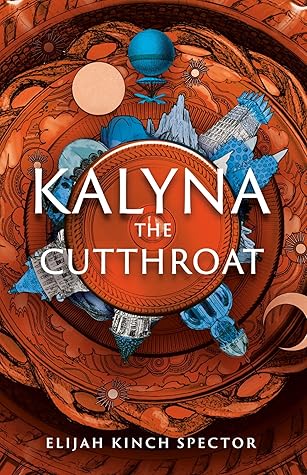
Elevator Pitch:
Radiant Basket of Rainbow Shells is a scholar of curses, travelling abroad to collect knowledge. When the Loashti Empire declares his people as dangerous and revokes their citizenship, he flees with the help of some mercenaries, including Kalyna. We get a decent amount of travel at the start, but most of the book centers around their time at the Lanrius River Guild (spelling? I listened to the audiobook), an anarchist utopia that’s going through plenty of growing pains but is trying to live with as little hierarchy and division as possible. Radiant negotiates whether he wants to be part of this community, whether the community is a good place, and what he can do to help both his family and his people, whom face a persecution he is temporarily free from.
Read If Looking For: fantasy that deals with ethics, casual queerness, optimistic anarchists
Avoid If Looking For: action, comedy, or magic
Comparable Media: The Mars House, A Choir of Lies, The Ones Who Walk Away from Omelas
What Worked for Me:
As with Kalyna the Soothsayer, this book places us in the mind of a character who is in a constant state of otherness. Radiant’s home was colonized generations ago by the Empire, which has sought to file off all the things from Radient’s culture they see as disagreeable. He is not fully Loashti, and cannot exist without frequent reminders that he is seen as less than others. Usually, the people who demean him don’t even realize they’re doing it. He must compromise on when to speak up about historical figures who hunted down his ancestors and when to avoid picking a fight that will threaten his personal security. A man that Radiant perceives – rightly – as racist towards him happens to view Radiant as his best friend. Of course, everything intensifies when the government revokes his people’s citizenships and warns foreign nations to be on the lookout for travellers with the papers of his people. Spector’s exploration of collective and personal identity is layered and thoughtful and far more interesting than most speculative fiction whose protagonist is part of an oppressed ethnic group. There’s clear connections to Jewish identity here, which makes sense as that Spector is open about his Jewish heritage. The racism in Spector’s world is as obvious as it is subtle, and he expects readers to fully immerse themselves in that perspective to get anything out of the book. Kalyna the Soothsayer is a political thriller with comedic wit, but Kalyna the Cutthroat is a prolonged thematic exploration of serious issues. The ending of the story has a more traditional ‘plot’, but most of this book is firmly centered in Radiant navigating his feelings about himself, his new community, and the experience of being torn between worlds.
I also really enjoyed Spector’s writing of the Lanrius river guild. It’s got lofty goals and generally sees its setup as better than anywhere else (what society doesn’t believe that at some level, though). They preach equality, asking people to do work that they find value in. Money doesn’t exist, and leaders serve as guides rather than commanders. The idea of utopias as unbelievable is an old one in fantasy – thank you Le Guin, for your fantastic short fiction – and Spector is willing to acknowledge flaws without turning the commune into a secret dystopian nightmare. They are a group flourishing when free from pressures of the outside world, bought with the benevolence of their founder’s noble status in the outside world, but as the world begins to take more note of their existence, their virtues begin to crack under pressure. Radiant is taken with how wonderful their attitude towards life is. Kalyna’s response: ‘they’re just smiling at you’. The reality, I think, lies somewhere between these two perceptions; they are a group of imperfect people striving to be something better than the world would let them become. And Radiant’s shifting perception of the community comes as he finds himself nestled right at the center of their imperfections.
I’m unsure how much of Radiant’s perspective aligns with Spector’s. Certainly there are moments where I find myself in disagreement with Radiant. His actions make sense considering his situation and history, but also he holds ethical views that I don’t perhaps share. Should people who arrived in a community three days ago (who would not stay if they had any choice) have an equal say in the election of the leader of the community as those who have built the dream for years? Does the commune have a responsibility to accept refugees that will double their population, a decision that all agree will draw the wrath of two nations upon their town? I wish Spector had developed the viewpoints of those who disagree with Radiant more than he did, but I also generally felt most characters beyond the central two were underdeveloped. However, this story presents meaty questions that Spector asks his characters and readers to grapple with. It’s the type of story I’d like to share with my Ethics class, and it brought to mind the wonderful essay Fear, Affluence, and Morality, by Peter Singer (read if you ever want to be challenged on whether your life is horribly unethical), and I respect Spector for tackling big issues.
One of the things I really liked about Kalyna the Cutthroat – and what its predecessor didn’t do – was to avoid giving easy solutions to problems like these. At times it is a very uncomfortable read as I struggled to parse my own feelings about a situation. This book provoked a lot of reflection about my initial reactions to a situation, opposing views, and mapping them onto my own life – this should have felt very close to home considering what Minnesota has gone through this year, but I found they were actually quite different. Chain Gang All Stars comes to mind as a masterfully written book for those who agree with its viewpoints, but it’s also a story that will ultimately fail to challenge the beliefs of anyone who doesn’t already agree with the author at page 1. Spector’s approach reminded me of The Mars House by Natasha Pulley, which also sought to explore complex refugee political dynamics. However, I thought he did a much better job of sticking with the tough conversations instead of manufacturing convenient solutions that remove all tension from the plot. While the closing quarter of the book did chase solutions, they didn’t wave a magic wand that removed all tension from the choices characters made, even if it did radically simplify the ethical questions involved. Thankfully, the middle 50% of this book was exactly the type of introspective fantasy I craved. I’m going to chew on it for a while.
What Didn’t Work For Me:
I think some of my complaints about Kalyna the Soothsayer apply here as well. For both, I thought that Spector started the book about 50-75 pages too soon. He seems to love an opening travel montage that showcases delightfully creative worldbuilding details. However, I don’t think it actually added much to the story when I view the book as a whole. His chapters could probably be tightened up, and I think this book should have been a 300 page story instead of a 450 page one. Scenes linger perhaps a little too long for me, and it keeps me from wanting to tumble into the story and get lost in it. Despite the change in tone from book 1 to book 2, these stylistic choices have remained the same, so I think I may just be brushing up against a dislike of Spector’s narrative voice. To be clear, I didn’t hate it. I just thought it slowed down the narrative without offering a concrete benefit. I can also acknowledge part of my frustration here might be that my loan for To Ride a Rising Storm came in, and I can’t bounce between audiobooks without causing myself a major headache.
Truly however, my biggest issue was Kalyna, whom overwhelmed the story in a negative way. This is a minority opinion, as most complaints about this book seem to center on the fact that Radiant is our storyteller instead of Kalyna. To me, she feels like the darling that Spector couldn’t bear to keep away from this novel. In the previous book, she was portrayed as a con-woman leveraging coincidence and quick thinking to navigate tough situations. That’s true here, but it certainly reads as ‘my favorite character is good at everything’ when a different character is our viewpoint for the story. She simply sucks up too much of the oxygen in the story, overwhelming Radiant’s tale just enough to bug me.
Her charisma also veers into the unbelievable for me. At one point the River Guild is in a position to select a new leader. Kalyna wins overwhelmingly despite both being a newcomer to the settlement and also not actively campaigning for the role. It is in moments like this that suck some of the credibility out of her other antics throughout the book. Spector took her established skillset and reputation from the first book as a blank check to do … whatever he wanted with her. I’d rather she either be a proper protagonist, have a much smaller role in the story, or have been removed entirely. As it stands, it feels like Spector still very much wants the story to be about her, even as everything else pushes towards a focus on Radiant. The underdeveloped side-characters didn’t help my feelings in this regard. If you pulled a name out of a hat that wasn’t Radiant or Kalyna, I’d give you even odds whether I’d be able to tell you who they were in the story.
Conclusion: a strong thematic read that I’ll think about for a while. It suffers from pacing issues however, and an underdeveloped cast of characters
 Marked for Plot
2 thoughts on “Kalyna the Cutthroat – An Introspective Refugee Story”