
Fonda Lee won my heart with The Green Bone Saga, but I’ve been less thrilled with the work that she’s released since then. That’s how I felt when I got to the halfway point of The Last Contract of Isako. The book won me over in the back half though, which reinforced that Lee is going to be an author I follow closely. This book has a lot of her hallmarks from Greenbone Saga – complicated character relationships, a clear sense of culture in the world, and a small number of highly impactful fight scenes – and I eagerly await what she puts out in the future!
The Premise
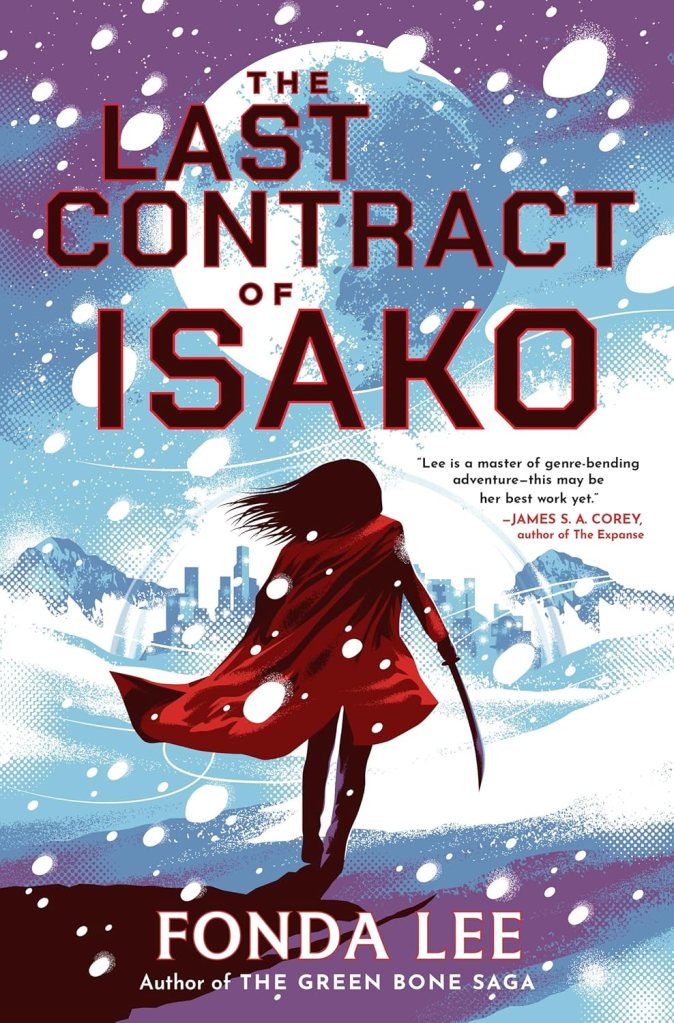
Isako is a Contractor, legally connected for life with a company Director. She is one part spy, one part guard, and one part voice of reason. Unfortunately, her boss just lost a corporate war, and she consigns herself to Resigning. Before she can take the long walk into the cold, saving oxygen and water for those with life ahead of them, she is given one final job. Her joints ache, she’s disillusioned with her work, and she just wants it all to be over. For the sake of her daughter – whom will receive her retirement bonus only if she fulfills her duties till the end – Isako will do everything she can to prevent Sandbar Uchi from getting confirmed to the Board of Directors. Things get personal when she realizes something terrible has happened to his contractor & her former apprentice.
Read If Looking For: realistic-feeling dystopias, the cutthroat realities of terraforming, late-late-late stage capitalism, protagonists past their prime, atypical endings
Avoid If Looking For: characters tearing down The System, modern senses of morality, chosen ones or zero-to-hero
What Worked for Me:
I think the real winner in The Last Contract of Isako is Lee’s worldbuilding. Corporate pragmatism and the brutality of terraforming go hand in hand, so the combination here isn’t unique or notable. However, I think the specific details that Lee infuses into a familiar idea turn it into a world that I wanted to learn more about. The samurai-esque Contractors and their unique code of ethics (mostly service to one’s client above all else, including taking the fall) felt like a natural extension of how corporate espionage might evolve as a way to protect the rich in an enclosed community. The specifics of retirement were evocative. Retirement = walking into the cold to die. This sacrifice is honored by the community as a way to give to future generations. As the city expands, those who walk into the cold get buildings and fountains and benches named after them where they fell, immortalizing them in the city. There’s some working practicalities here, what with the limited resources of such a society requiring some level of population control. However, any semblance of fairness is thrown out the window as corporate greed encroaches on the ideals of fairness. The rich get to live second lives within robotic bodies, and people are always one week of subpar luck away from being forced to resign or live in shame. The setting had a clear stamp of identity, and when worldbuilding keeps you thinking even while not reading, you know it’s done well.
I also loved how the characters fit into this world. Isako – as well as most other major characters – are part of the system. They may have doubts, break rules, or get angry about the unfairness of it all. However, they are still influential cogs in the machine and don’t suddenly transition into fighting against The Man to make a better world. I think this was a realistic portrait of interesting and complex characters that was consistent with the setting. One of the best things about Lee’s writing is how she can put aside modern sensibilities of morality when writing. Her characters are seamless with the world, not stand-ins for what the reader is thinking or feeling. Their decisions make sense within the context of their upbringing and culture, which is not something they share with the reader. This also puts The Last Contract of Isako apart from many other Dystopias which so often shift into revolutions and rebellions. Those stories aren’t bad, but it’s nice to see something different. The story does escalate and go in directions I didn’t expect, but it never truly departs from the corporate culture of this slowly terraforming world.
Finally, the second half of this book was gripping. I truly can’t say anything substantive to avoid some rather delightful little twists that Lee puts on the playing board. It became the type of story that I started cleaning my house just so I could keep listening to the audiobook. And what Lee chose to do with the ending was simply divine. It’ll upset a lot of readers I think, but it’s the type of choice I associate with Lee; unafraid to rock the boat for the sake of thematic cohesion. This book still didn’t hit the heights of Green Bone Saga, but its a great damn book.
What Didn’t Work For Me:
For the entire first half of the book, I thought the story was fine. It was a workman’s novel, something I’d be happy to read, that might get nominated for some awards, but which ultimately didn’t strike me as doing anything particularly noteworthy. I still think the first half was generally on the weaker end, but the back half really made up for that. I can see in hindsight the choices Lee at the start to create a satisfying puzzle, but I wish she had leaned more into the political maneuvering. Isako’s situation is so unusual and awkward that I didn’t feel like we got a good idea of what the ‘default’ for a Contractor was. I typically rant about how authors start their books too early and need to skip to the good stuff. Here, I kind of wish Lee had backed up and let us see the types of things that Isako did during the ill-fated corporate war that she lost. Once the second half started up, I was authentically engaged, instead of along for the ride.
I was lucky enough to listen to the audiobook for this book. While the narration was fine – not bad, but also not particularly notable – it eased me away from some things that would have annoyed me greatly. Lee plays with how terminology shifts over time, such as C-Suite becoming Sweetsea. Similarly, Isako is an atier (pronounced A-Tier, not like the French word), which indicates she is the highest rank of Contractor. I get that readers are supposed to begin to get the joke in ‘aha’ moments, but this would have been frustrating. It would be one thing if Lee were actually interested in linguistic drift as a worldbuilding conceit. This is not the case, however. Instead, it felt like something a bit cute, a bit cheeky, but ultimately more annoying than impactful. Again, happy I read the audiobook for this one.
Conclusion: a slightly tepid start, but overall a phenomenal Corporate Dystopia whose vividly imagined setting is the highlight of the story
 Marked for Plot
2 thoughts on “The Last Contract of Isako -Corporate Samurai in Space”