
I haven’t been super in touch with new releases, and thus have not read the vast majority of the books nominated for this year’s Hugo Awards. However, Summer War seems to have enough buzz to be a realistic contender for winning the novella category. Novik’s work has always been enjoyable, and Schoolomance is a series that I’ve reread more than anything else in the past few years. The parts of Summer War that I liked were divine, but is it award worthy? Probably not, because I thought the story missed some opportunities for depth. Overall I think Cinder House was superior in almost every way.
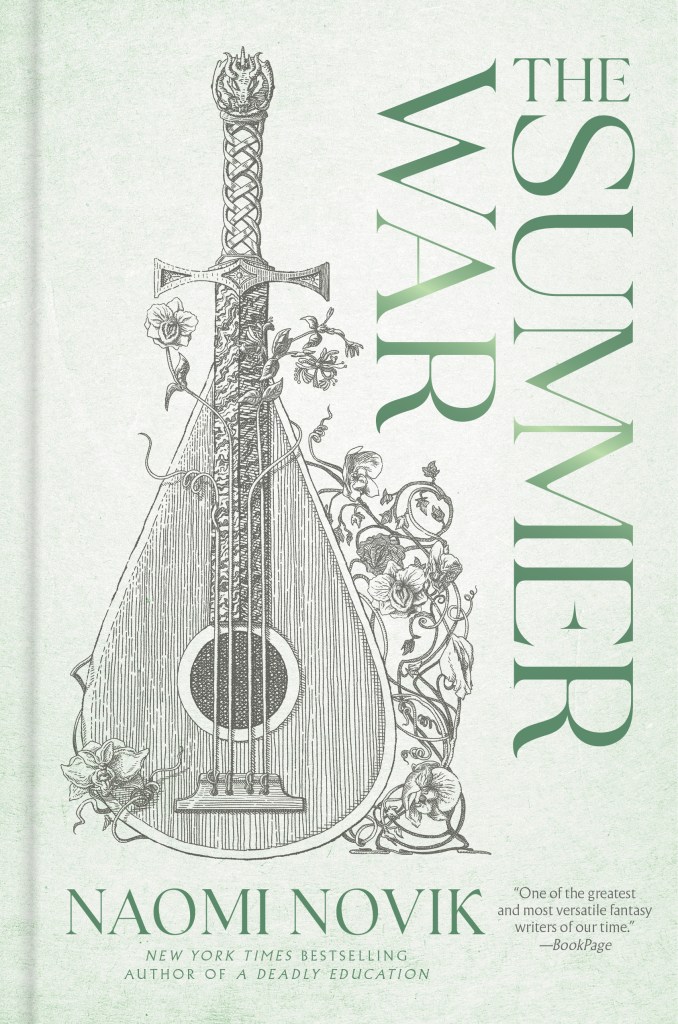
The Premise:
Celia discovers she is the first Sorceress in generations on the same day her older brother rejects his inheritance and leaves, abandoning her as well. She curses him to be loveless, her father goes into despair at his departure, and she finally realizes her other brother is more than a useless nobody. The King now wants to marry her into the Royal family, but she’s only 12, so that likely won’t happen for a while. And behind it all the threat of brutal Summer War, the hundred year conflict with the Summerlings, looms.
Read If Looking For: fey that feel truly inhuman, fairy tale structures, wordplay and tricks, original fairy tales
Avoid If Looking For: plots that flow naturally, good fathers, the true meaning of love
What Worked for Me
This book has one of the best representations of fae that I’ve ever seen. Novik captures the essence of something that understands reality in ways that humans cannot. They stand on the banks of time, stuck in loops of thinking even as generations of humans pass. They are creatures entrenched in stories and symmetry, caring more for the shape of things than true fairness or justice. It does not matter that a century has passed if balance has not been achieved with the great wrong done to them. Their logic is consistent, but utterly unlike ours. They will feel nothing at the slaughter of towns, but shed tears for the death of a great human knight. It’s almost like the stereotype of chivalric romance tuned up exponentially with a layer of magic thrown into the equation. Novik nailed the vibes, and I think the success of this book rides more or less entirely on whether or not these fae depictions work for you.
The Summer War also does a good job at throwing a bunch of plot elements into a single small package and making them work. It begins laser focused on Celia’s curse of her brother, moves to a thorough divergence of her father’s ambitious path from nobody to great lord via Summer War victories, looks at the budding relationship with the forgotten brother, dives into some political scheming against the crown, and finally shifts to a trip to the Summer Lands (which have their own many plot beats). It doesn’t overwhelm the novella because this is a story about stories, and oral storytelling is full of digressions, tangents, and sidequests. I know some feel like the pacing at the start was slow. In particular, the long focus on the father’s accomplishments has gotten some criticism, but I really liked it. I ended up being invested in the setting more than the plot or characters, so possibly this is why I didn’t mind that the ‘story’ proper didn’t start till halfway through the book This could have easily expanded into a full length novel without any additional plot points. That would have been a delightful book as well, but the abundance of plot didn’t bother me in a small package.
What Didn’t Work for Me
Novik’s humans are wooden as fencepost. I know she can write better characters than this, so I think it was an intentional choice for the sake of the fairy tale stylings. Celia gets the tiniest bit of nuance, mostly of her being a stuck up noble without realizing it. However, she is not at all a convincing child. At 12, she’s acting like a 30 year old woman. You can’t even age-up the characters in your head, because her being 12 is a major point of contention between her father and the King in the marriage negotiations. Her father goes through many abrupt personality shifts that are not at all believable, and Rorick (the forgotten brother) is a nothingburger of a character. The oldest brother – the valiant and heroic knight who leaves because their father won’t accept his homosexuality – is literally just a knight in shining armor but gay. They’re all fairy tale archetypes with one or two superficial twists, but the lack of depth really hamstrung how much I cared about their fates. The second half of the book really leans into sibling love and care as a central conceit, but it all fell flat to me because of my apathy towards the cast.
I also thought there were too many thematic threads that Novik did nothing with. A great deal was made of Celia’s sorcery, including a lengthy explanation on its mechanics as an outpouring of pain and heartbreak. However, she doesn’t use her magic to do much throughout the story. This is totally fine, since it’s about human choices (though I didn’t think that worked either) but it felt odd the details got so much screen time. The societal rejection of Argent (the shining knight)’s queerness got early billing, including Celia’s lack of recognition of his situation. While she makes amends to her brother in the end, she never returns to the societal problem that landed their whole family in this mess to begin with. It’s like Novik wanted the aesthetics of homophobia without closing the loop or actually doing anything more than using it to grab attention and move elsewhere. The book took tiny steps towards exploring how women lack power or agency, yet Celia is the only living female character of any significance. I didn’t mind the expansive plot elements, but Novik could have tightened up the thematic weight of this story a lot. As it stands, it is a gorgeous story that never goes deeper than surface level.
Conclusion: read if you like stories with fairy tale structures mixed with modern storytelling choices, or because you want to read the best rendered fae I’ve seen. Not a lot of depth though.
 Marked for Plot
This was an intriguing story. I read an ARC of it (I still need to write my review of it) and I enjoyed it a lot. The author always writes brilliant fae stories with the right amount of twists in them.
LikeLike
I definitely enjoyed the Fae here more than in Spinning Silver (though my memory of that book is admittedly hazy). The twists all slotted together quite nicely. Everything introduced at the start becomes important later, almost like a puzzle box
LikeLike