
I’ve been on a long kick of bad dads for this project, so I wanted something that I knew would not feature that character archetype. I actually almost read Of the Wild last year for the Parents Bingo Square. This book was satisfying, but probably not going to stick around in my head for a long time. I think it’ll be a good option for people who want a cozy fantasy that has a different vibe than most, or a different take on Romantasy than we’re used to seeing from the current boom.
The Premise:
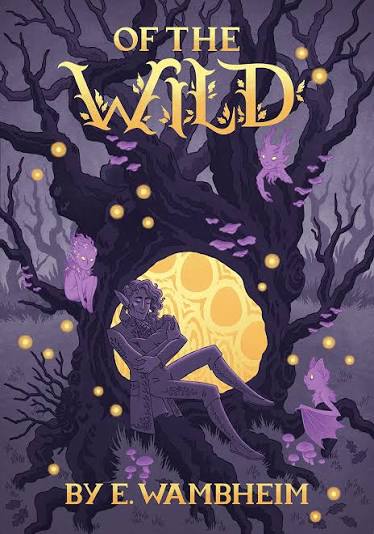
Aeris is a fae who rescues children whose parents do not want them. However, the fruit of his tree, which allows his children to thrive and grow in arcane ways, are harder to find and less powerful every time one is picked. He is dying, and his tree dies with him. The Tall Ones are waiting to consume the children when Aeris can no longer defend his home. When a human dreams his way into Aeris’ domain, he sees a potential successor to take on his mantle once he passes on.
Read If Looking For: found family themes, love stories that don’t involve sex, cozy fantasy with some teeth
Avoid If Looking For: developed love interests, realistic portrayals of childhood trauma, bespoke prose
What Worked for Me
This has been an off year for cozy stories with me. I’m growing less and less enchanted with the type of cozy fantasy written after Legends and Lattes became a breakout hit – not because it’s bad; it just doesn’t work for me. However, I’ve found that I really like Cozy when there are some teeth and some stakes to the story, especially when there are strongly developed internal conflicts and convincing interpersonal relationships. I think Of the Wild largely succeeds at doing something different in the Cozy space. Since it was written before the subgenre got popular, that makes a lot of sense. It’s revealed pretty early that Aeris and his arboreal sanctuary are dying, with Tall Ones at the gates, excited to consume the juicy flesh of children. This could have skewed comedically evil, but instead its just creepy enough to be effective while still not infringing on the wholesome vibes of the book. Wambheim succeeds at establishing high – though not epic – stakes while remaining comfortably within a cozy atmosphere. This through-line – his acceptance of his eventual death and trying to chart a future for his children – is my favorite part of the book. The ending is a bit predictable, but one that was consistent with Wambheim’s foreshadowing and appropriate to the themes of the novel. I wasn’t ever surprised by this book, but I was consistently excited with how Aeris was handled as a character.
Of the Wild also one of the better takes on found family I’ve seen. The default when authors approach this topic – either intentionally or accidentally – is a relatively permanent situation. Birth family wasn’t great, so a chosen family takes its place. Wambheim takes this a step further, that no family need be permanent. Part of parenting is letting your children go, and Aeris accepts that his charges will leave him when they are ready, though they can stay as long as they wish. He uses the metaphor of a plant, that when it struggles in soil, you try it in a different garden to see if it grows more healthily there. While obviously one hopes for a family situation to always remain what you need, and I think this novella takes seriously the obligations people owe their dependents. It’s also good to acknowledge that found families need not be forever and that there don’t need to be major problems to justify leaving. Family means extending your love, and sometimes loving someone means letting them go. Thanks Sting!
What Didn’t Work for Me
This book felt a lot like House on the Cerulean Sea, both in the good and bad ways. Yes the story is heartwarming and gooey. However, it deals pretty explicitly with kids who have been through traumatic situations. Wambheim’s starting point was less problematic than Klunes, but it still engages with trauma in children that doesn’t quite sit well with me. Some of Aeris’s children were brought home early enough that they likely wouldn’t have much trauma, but others came later after physical abuse by parents, severe malnutrition, etc. There’s a bit of engagement with their situation (the one conversation that touched on this was handled very well), but mostly felt skated over. Obviously I can’t get into Wambheim’s head, but it felt like they wanted to put a spin on the archetype of Fey who steal children, but repositioning Aeris as our hero. Rescuing children from neglectful and traumatic circumstances is a tidy way to let both ideas exist simultaneously, but the follow-through of exploring that trauma didn’t approach what it needed to be. This topic is one that is hard for me to suspend disbelief. Kids grow from trauma in all sorts of ways, but with 24 kids, it’s notable that none seem to have lingering scars that are anything more than surface level. Also … Aeris is remarkably not stressed out by taking care of 24 kids at once. There’s joyful chaos in the house, but I cannot imagine the workload that would require. In the end, it’s just a realistic element that got dropped for the vibes of the story. However, it kept snagging at my attention as I read. I’m unsure if I’ll find a cozy book that will be able to successfully tackle raising kids with trauma, or if my demands of such a topic (unfair as they possibly are) precludes those two from existing together.
From a prose and characterization perspective, I thought that Wambheim spent too much time repeating ideas. I think the attempt was to build up meaning, but I ended up getting tired of the discussions where Aeris reassures William that he’s welcome to stay if he wants, on whatever terms would work for him. William seems blissfully happy to not ask any logistical questions at all, and accepts pretty much everything at face value. Actually, William in general is fairly disappointing from a Romance perspective. In single POV Romances, you’ll always get more depth from the protagonist, but William only exists as part of Aeris’ love story. He doesn’t feel like a character that has a life outside the fey realm he wanders into. Despite only being 140 pages long, I kept feeling like Of the Wild was overwritten, that a page was taken when a few sentences would do. This can work when the prose and themes are doing the heavy lifting, but Of the Wild never achieved that for me. I kept wanting to skim the story and then forcing myself to back up and slow down.
Conclusion: I enjoyed the protagonist and some of the thematic work around found family, but I struggled with the prose and how the love interest was written.

