
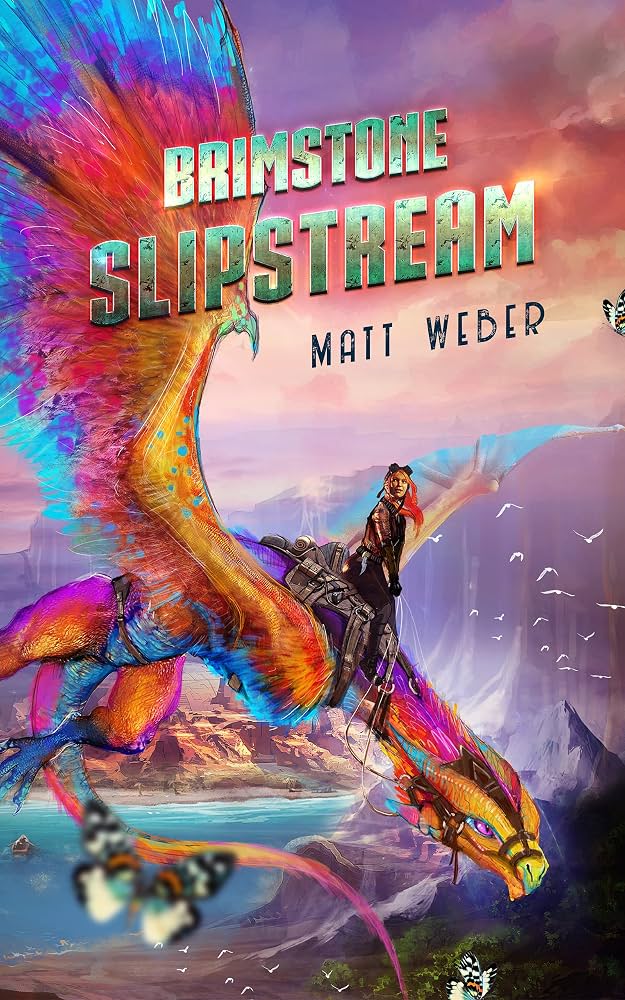
I underestimated Brimstone Slipstream, and for that I think I owe Matt Weber an apology. I looked at the cover of this novella and assumed it would be a high-octane dragon racing story; Nascar meets Fantasy. I would have enjoyed this of course, otherwise I wouldn’t have bought the book. Instead I got a delightful epistolary novel masquerading as a long-form news story, one whose political undertones are far more interesting and serious than my expectations. In fact, it looks like book 2 in the series, a full-length novel, is going to be more traditionally structured and plotted. Goodness knows I’ll find out before too long, because this kind of knocked my socks off. Finished the whole thing after driving for 5 hours, when I should have been asleep and bone tired. At ~50 pages, this is probably more a novelette than novella proper, and it is well worth the time. Plus, it works well as a standalone, not requiring sequels for the story here to feel like a complete product. Plus it only has five ratings on goodreads. Be a trendsetter! Dragon lovers unite!
The Premise:
Zaya and Kiriki are the rising stars of Brimstone Slipstream. Notably, their success hinges on a whip-smart ground crew and their mastery of psionics. Anyone can become empaths, but the skill comes more naturally to their ethnic group, who form the majority of the working class but almost never the financially stable. This report chronicles moments from their rise to fame and success, their support team which is akin to family, and the history of both the city and dragon racing.
Read If Looking For: narrative reporting, the brutal exhaustion of a culture without maternity leave, evocative infodumps, transparent portrayals of well-meaning people with biases
Avoid If Looking For: flashy dragon racing sequences, fully explained worldbuilding, books that follow the laws of physics
What Worked for Me
This is the nerdiest book I can possibly imagine. I say this with love, of course; as a nerd myself I must champion my people. Brimstone Slipstream is a delightful peek under the hood of what the mechanics and culture of a pseudo-criminal dragon street race circuit might look like. There are a couple traditional plot threads, but it feels more like a narrative worldbuilding experiment than traditional story. The epistolary format works wonders for this: Weber floats between interview transcripts, narrative reporting, and mini-essays that could have come from history textbooks. This allows him to silo individual aspects of racing into neat and tidy sections. You talk to the stablemaster and then the flight coach before flitting over to the oddsman and analyst. There’s a fine line to strike in terms of how much information to give. Too detailed, and the novella loses momentum as it gets mired in minutia. Too little, and you may as well not include the segment at all; the book is about exploring the inner workings of dragon street racing culture, after all. Weber leans on Zaya and Kiriki protecting trade secrets to prevent the various experts from getting too technical, but succeeds in getting the reader to immerse themselves more and more into the complexity of a fictional sport. It’s such a hard-pivot away from how this information could have been delivered; through intense action scenes or a character’s internal monologue, that it kept my attention the whole way through the book.
The tone of this journalism is on the casual side: more 60 Minutes than Associated Press. Our storyteller is happy to embellish, crack jokes, and take some creative liberties to make her final product sell more copies. When interviewing Zaya and Kiriki’s main competition, she describes him thus: Instead of a knife, he carries around a longsword so massive the inevitable phallic jokes wilt in its shadow. This humor is infrequent enough that I never got tired of it, and certainly I wouldn’t label this book a comedy. However, Weber uses our journalist narrator to shade the story in ways that can make light of serious situations. She’s not a perfect reporter either. She manages to piss off most interviewees and, more than a few times, makes assumptions about them based on their ethnic backgrounds that rely on harmful stereotypes. In fact, most of the cast feels well-realized, despite most getting only 5 pages of screentime. It seems like many of these characters will feature in the more-traditional sequels, and I’m excited to see them from a different character’s point of view, to see how trustworthy our reporter really is.
Along with Party of Fools, which I also read for this readathon, this is the second book that proved unexpectedly political. It isn’t the overarching focus of the story, but Weber packaged something a bit more complex than depicting the tactics of top-tier racers. Instead, it also explores how dragon racing, much like Horse Racing and Nascar, tend to be sports for the filthy rich to compete in. The financial barrier to entry is high enough to keep most others out. In this world, Zaya and Kiriki have voting rights only because they own land, which they can only afford because they’ve been winning. Should they start losing, they do not have the financial backing to retain their home, making the stakes higher for them than their competition. The governing board changing rules to counter empathy is simply another tool to disenfranchise the poor, despite the fact that anyone can learn it. Beyond looking at social structures, Weber also provides us with a varied set of perspectives and backgrounds to help flesh out how social biases manifest in the world of expensive sports. Both our Journalist and a fellow racer come from more privileged backgrounds. Microaggressions abound, which that the racers’ coworkers (who are also family) are quick to call out.
Lastly, the world is really fun. Ironically, we’re missing a massive amount of information about the setting. It isn’t clear what technology level this world has achieved, what the different types of magic are (other than that Sorcery and Empathy are different), or the power structures of the world. However, we do get snippets of how 700 years of national history have shaped the modern practices of dragon racing and lived experiences of various ethnic groups. While it clearly references South American cultures, it also doesn’t feel like a cheap version of ancient history with the serial numbers filed off. We get a horrifying city built around the nesting sites for dragons who mate on multi-year cycles, like Cicadas. Both the mating and the maturing of these dragons is dangerous, so most folks move neighborhoods on a set schedule to avoid dying by fire and fang. There were a lot of cool details, none of which got explained much, but which still managed to craft the illusion of a well-realized world. Again, the narrator’s role as a reporter is useful, both as a technique to explain history and it’s relevance to Zaya and Kiriki’s careers to people who aren’t familiar with the past. When we get to see the dragons, they’re colorful feathered things, fearsome beasts that aren’t totally safe or controllable. The races that get narrated or referenced paint the neighborhoods with just enough color to lead your imagination into exciting places without committing to long action sequences. Really cool setting, but you couldn’t pay me to move to this city.
What Didn’t Work for Me
Honestly, my only real complaint is that I felt it got a little name-heavy at times. Especially near the start of the story, I found myself scratching my head, wishing for a city map or glossary, and generally not always knowing who or what we were talking about. I’m still confused about bits of the city’s history. I mostly found my feet however, and the things I didn’t understand aren’t bugging me, though I anticipate they might for some readers. I also credit me reading this while exhausted as part of my struggles here.
Conclusion: a journalistic exploration of the dragon racing sport


Okay, this sounds really fascinating! And maybe one for my dragon-mad sister as well… 🤔
LikeLiked by 1 person
I hope you both enjoy it! I’m really in love with shorter books right now that deliver something really interested in a small package
LikeLike
I’M SO INCREDIBLY HAPPY YOU LIKED THIS! No pressure, but I’m massively looking forward to you getting to the rest of the series. IT’S SO GREAT.
LikeLiked by 1 person
Thank you for hyping it so I discovered it! Am I right in assuming that the sequels read more like traditionally-structured novels? I’m assumign they’ll be a bit more on the pulpy side of things (fantasy racing book), so I’ve been mentally slotting them in as something good for the wintertime
LikeLike