
As I slowly grow into reading horror, I’ve had a complicated relationship with the more grotesque side of the genre. I thought I disliked it, and certainly I need to avert my eyes in any medical show I watch. Body horror authors like Andrew Joseph White capture that visceral repulsion that forces me to skip pages. I thought that The Salt Grows Heavy might be similarly challenging for me. This book features the plucking of eyeballs and the cradling of intestines in one’s hands, yet it was palatable even for me. Khaw married this body horror to a dark fairy tale atmosphere; the result so enchanting that I couldn’t look away.
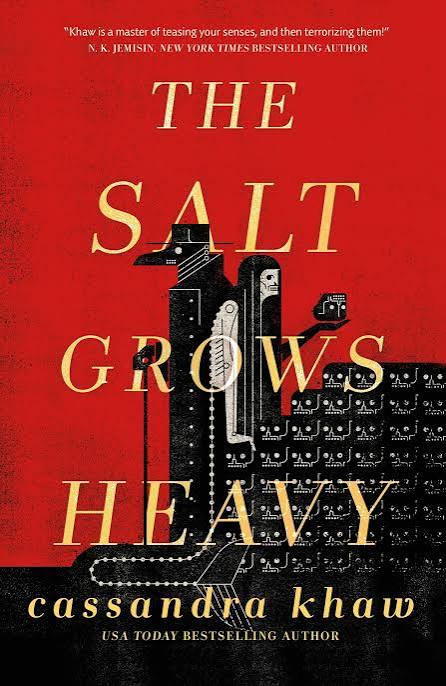
The Premise:
The mermaid has given birth to her children, and they have feasted upon the land. The country which stole her from the water lays in ruins, a corpse to rot in the sun. Now she travels with the plague doctor, seeking a new country and a new home. They come upon a commune of children and their saints, the strange trio who pursue surgical immortality. The mermaid and the plague doctor’s shifting relationship is confronted by the plague doctor’s past, and the mermaid must decide what is important to her, versus what is simply meat to be consumed.
Read If Looking For: bespoke body horror, the tentative love of monsters, uncommon word choices, inhabiting the mind of a creature of the deeps
Avoid If Looking For: windowpane prose, genre romance, Disney mermaids, fast pacing
What Worked for Me
I think one of the most successful things in this novella was capturing the voice of our narrator. Written in first person from an unnamed and inhuman perspective, Khaw’s writing succeeds at making her feel unnatural, simply through the prose of the story. I noticed early that Khaw enjoys playing with sentence lengths, including many extraordinarily short sentences and long ones strung together by a series of semicolons. Their word choice feels just a little bit alien, such as describing the Plague Doctor’s laugh as “arsenic sharp.” The Prince did not cut her tongue out; instead she was given an ‘assisted autosarcophagy.’ The narration never becomes difficult to parse, but it keeps the reader with a constant sense of how much she is not like the reader. One of my common complaints is how monstrous protagonists trend towards normal human attitudes disguised with a trenchcoat of unusual body parts. This novella makes you believe in the sharper side of mermaids, the ones who became a scourge upon that land that took her apart, piece by piece.
Of course, Khaw doesn’t shy away from a dark tone. Our opening scene follows the mermaid’s children feasting on the bodies of one of the kingdom’s last humans. Violence is treated with casual afterthought, as something banal, less interesting than the weather. It strains against the dark fairy-tale veneer that settles over The Salt Grows Heavy. There is, of course, references to Earth fairy tales. However, Khaw also gave other nods to this style. For example, Khaw choses to leave the mermaid and plague doctor unnamed, just as in fables Rabbit is both a name and a physical descriptor. References to The Little Mermaid are mostly asides, casual throwaway lines of a backstory that is irrelevant but for her simmering anger and desire for revenge. As she contemplates the countries in the mountains, she thinks that she might ‘find another sovereign who’d fish a mute from the waters, who’d marry her, bed her, murder her sisters for a superstition, and then pry the teeth from her gums for the sake of caution.’ Envisioning this future happens only as a consideration of whether or not she’d like to give her children another country to feast upon.
More broadly, Khaw’s mastery of tone in The Salt Grows Heavy is simply superb. In the hands of a less skilled writer, it would feel like a thesaurus had gotten thrown at this story. Look at the low goodreads ratings, and this will be a running trend, but I thought Khaw used unfamiliar language to great effect. The novella drips with quotable lines, insightful asides, and a language that feels slightly formal, a little bit eldritch. This novella is sleeping in a haystack, only for a single invisible needle pricking your skin to keep you awake. I’ve no idea whether or not this is typical for Khaw’s work or if they made this choice for this story and narrator in particular. Personally, I found the story and prose hypnotizing. Like the many autovivisections we witness, this book unfolds as a grotesque menagerie of self-reflection, body horror, and the slow transition of something eldritch into something a little more human.
What Didn’t Work for Me
I fell in love with this novella, but I do question a bit why this was the plot Khaw chose to tell with the narrator they chose. Our mermaid is entrancing; she is the one undergoing slow changes, facing internal conflicts, and propelling the story forward. However, the plot belongs to the plague doctor. The surgeon saints are their creator, but have nothing to do with the mermaid’s story. Yes, the mermaid is falling in love, but there are no stakes for her other than how this commune is affecting her plague doctor. As this plot (and the romance) began to pick up, I did feel the emotional intensity start to drift a bit. The book is separated into three parts, and I found the third a comparatively a let-down. The language shifts near the end, becoming something closer to the norm for the genre. Perhaps this was a reflection of the mermaids growing humanity, but I got lost reading the first two sections. The third was just fine.
Conclusion: entrancing prose and characterization makes up for a slightly lackluster plot


3 thoughts on “Novella Readathon #15: The Salt Grows Heavy”