
Two weeks ago, if you asked me the novella I was most excited to read, I’d have responded Autobiography of Red. It’s got several ardent supporters whose taste I trust, it tackles an obscure figure from Greek mythology, a creature whom exists only for Herakles to kill, and it deals in thorny and tragic gay relationships. Unfortunately, what should have been catnip for me ended up as a frustrating reminder of why I tend to avoid Literature. While I’ve enjoyed several novellas with a more Literary bent (most recently On the Calculation of Volume), this one ended up feeling more like work than enjoyment. I do plan to eventually reread it, and I’m hopeful that I’ll get more out of it on a second look, because the bits I liked were really quite phenomenal.
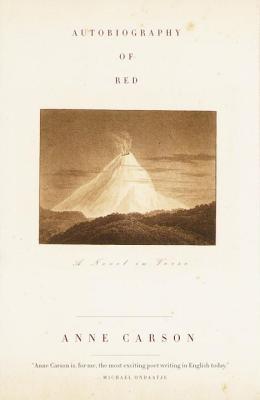
The Premise:
While there are some introductory materials and extra bits, most of this story is the autobiography of Geryon: a boy and man in the mid-1900s who is red and has wings. This goes largely unremarked in the story. It traces his troubled childhood and teenage affair with Herakles, his listlessness in adult life, and a chance reunion with Herakles that is perhaps not everything Geryon wanted it to be. This is … a poor description, I will admit. I’m not sure how to give a better one though. Mostly it asks you to crawl inside Geyron’s head as he floats through different portions of his childhood and young adult life.
Read If Looking For: Literature with a capital L, tortured souls, photography motifs, blank verse, books that feel like Indie Films
Avoid If Looking For: straightforward narratives, clear happy endings, adventure and thrills, Romance beats
What Didn’t Work for Me
I want to start with the negatives for this review, which is unusual for me. I kept running into a wall with Autobiography of Red: I couldn’t figure out what Carson was trying to accomplish with this story, what ideas she was trying to get at with her scenes. This is … probably an indicator of good writing. I sort of came into the story expecting the relationship between Geryon and Herakles to dominate, and that the novella would trace their relationship dynamics with experimentation in style. However, Herakles is notably absent from much of the story, and I couldn’t ever pin down where the story was headed outside that context. Carson is clearly interested in talking about time and distance, oftentimes through the lens of photography. She wants to trace the mind of a tortured soul, a man sexually abused in his childhood by an older brother, developed an unhealthy attachment to a man who doesn’t love him back, and who struggles to fit himself into the social norms of daily life. Geryon is anxious and withdrawn, but despite being able to tell you all these things, it just never felt like the story went anywhere. Plenty of things happened (Carson isn’t afraid of abrupt scene changes or flitting between many moments in life) but I couldn’t follow the disparate threads into a cohesive whole.
Perhaps this is a failure on my part as a reader. Is my attempt to impose a specific set of structures that feel familiar and easy a good thing? This book stretched me, and at times I did feel like I understood where the story was headed. But not enough. There were moments that felt crystal clear, showcasing how haunting Carson’s writing can be. At one point a romantic rival asks Geryon “so what’s it like fucking [Herakles] now?”. The response? Degrading, said Geryon / without a pause. There’s no ambiguity here, and certainly this moment is heartbreaking when you observe how Geryon isn’t able to place limits on his own feelings towards Herakles. However, I didn’t feel like I saw this sentiment built up throughout their interactions. This conversation had an emotional impact, but I think it would have wrecked me utterly had we built up to it more. However, most ‘payoff’ moments felt like this to me; a desire for catharsis that was built upon foundations I didn’t see or understand. Carson gives us fleeting moments and asks the reader to extrapolate further than I was willing to.
Every review is subjective, but most of us try to apply some layer of objectivity to our critiques and celebrations beyond simply ‘I liked this’ or ‘I thought this was bad’. My lodestone when thinking about books is
- What is the book trying to do?
- Did the book accomplish that goal?
- If you aren’t interested in #1, this probably isn’t a good fit for you.
Here though, I never felt like I was able to answer question #1, leaving me unable to articulate my thoughts as clearly as I’d have liked to. However, I think it’s safe to say that Autobiography of Red is not a good book for those of you who have no interest in Literature. I think it’s significantly more Literary than most of the speculative fiction books given that label.
What Worked for Me
So where does this leave us? One of my rules for this novella project was to not write up reviews for anything I’d give less than 3 stars to. This book is hovering right on the edge of that boundary. I probably should have put it down and walked away to try another book. I kept reading for a few reasons. First, I’ve got a special interest in reading Achillean fantasy and science fiction, especially those that push beyond saccharine niceties. Autobiography of Red fits that brief magnificently. I also thought that my disconnect from this book was an example of a style of writing I don’t experience much, and these challenges are all about trying something new and stretching yourself. I don’t want most of my reading experiences to be like this, but neither do I want to only remain in the comfortable bounds of what I’m familiar with.
However, there were enough things I did like about Autobiography of Red that I found it worth pushing through. I think I got very little from the overall book, and the themes had little impact on me. However, I can still appreciate some of the incredible writing that Carson brought to the table in this novella. She has a habit of capturing the magic of a single moment, even if I don’t understand how that moment fits into a larger narrative. At one point Geryon is in a Tango bar and ends up talking with the singer. He rather disliked the music once the vocals started, and she enjoyed playing with his awkwardness around admitting that fact. It was a moment that shouldn’t have had much of an impact on me. Yet it was evocative in a way that was hard to quantify, and Carson succeeded at transporting me into a physical and emotional space with clarity at odds with how opaque I found the novella at a larger scale. Other times entire poems are centered around a single photograph that Geryon took, and these were some of my favorites. I’m a sucker for transposing the emotions of a moment in time into an object – see my love for The Empress of Salt and Fortune. Honestly, this reminded me quite a bit of reading some of Gabriel García Márquez’s writing; gorgeous and evocative (One Hundred Years of Solitude has perhaps my favorite opening line of all time) but I wasn’t able to slot the beauty and emotion of those individual moments into the deeper portrait that forms, I believe, the true beating heart of the story.
Finally, I enjoyed all the ‘extra’ materials of the novella. The translations of ancient Greek poems about Geryon, the fictional interview with Stesichoros, and the appendixes. No idea how these pieces all fit together (par for the course), but they were enjoyable and set a good mood to start and end the novella.
Conclusion: I found this confounding and frustrating. Those who enjoy picking apart stories which don’t present clear answers are the target audience here. However, it’s a book that I desperately want to like, and will try reading again in the future.

