
I’m not sure why I haven’t read any KJ Parker yet, despite feeling like I would absolutely adore his books. Certainly, the premises for his stories always seem riveting. There were three strong options for which Parker novella I’d read for this project. I’m very interested in both Pulling the Wings off Angels and Prosper’s Demon, both of which promised something dark and thorny to grapple with. I went with Making History for two reasons: I spent my childhood romping through the backrooms of museums, leaving me with a strong interest in historiography, and I heard the main character of this book was a linguist – another casual interest of mine. I don’t think Making History quite satisfied either of those briefs, at least not in any rigorous way. It was, however, great fun. For those who have read both this and some of Parker’s other work, I’d be interested in how it compares to his other stories.
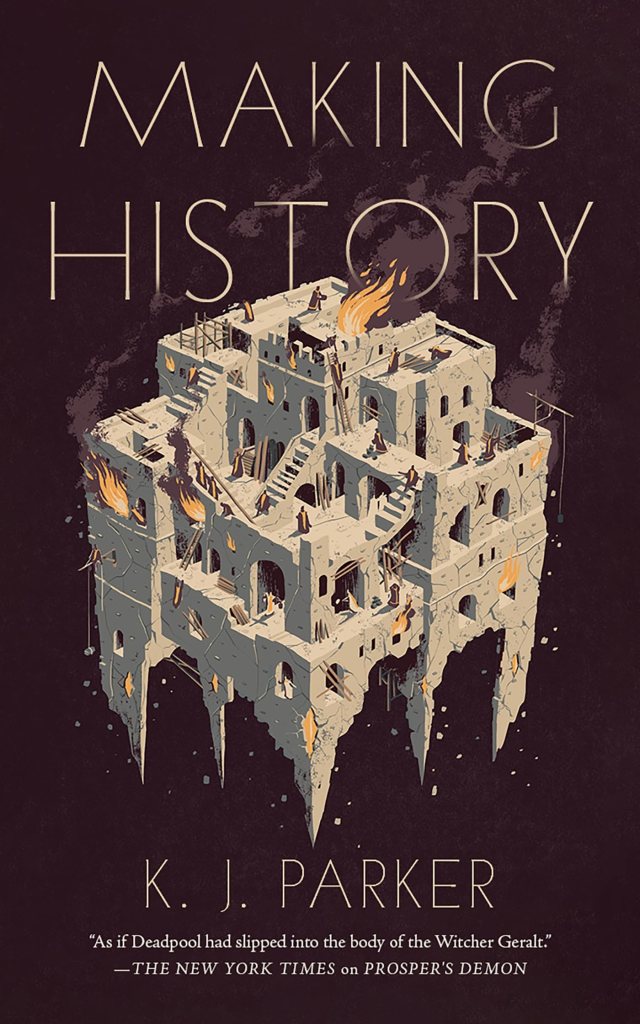
The Premise:
Our (unnamed) main character is a linguist, one of the best in the world. This is unfortunate; it means that he gets drafted into the new king’s hairbrained scheme to create a fake ruin to justify the invasion of a neighboring territory. He doesn’t see many options once it becomes clear that running away isn’t an option, so he hunkers down and proceeds to try and backwards design a precursor to his country’s modern tongue. Should his work not be satisfactory, his head will roll, and he rather likes his head … and the sound of his own voice.
Read If Looking For: unreliable narrators, competence porn, readable prose, explicit musings on theme from the protagonist
Avoid If Looking For: airtight plots, conventional endings, developed side-characters
Comparable Media: A Conspiracy of Truths, The Bone Swans of Amandale
What Worked for Me:
I’m a sucker for a charismatic narrator, and our lead in Making History is quite the charmer. This entire book feels like you’re sitting at the bar with a hairbrained and egotistical academic who gets so lost in talking about his own interests that you never have to open your own mouth. You don’t even get to know most of the side characters that well; other professors are nothing more than their discipline, and he has a stereotypically self-centered view of how his mistress views him vs how he sees her. He’s extremely unreliable, but absolutely captivating, especially since Parker captures the rhythms of conversational storytelling extremely well. You get plenty of diversions – and diversions within diversions – before looping back to what our narrator was originally talking about. You get plenty of opinions and exaggerations and colorful commentary about anything he finds remotely interesting. This makes the novella a light and easy read, not one that requires any real brain power. A great choice for when you’re looking for something light and fun.
This book didn’t scratch my urge for some deep exploration of historiography or linguistics. It became pretty obvious in the first few pages that this wouldn’t be the case, and it was easy to mentally shift gears. While our linguist is a hot mess in several areas, mastery of content is not a challenge for him. I greatly enjoyed his inner monologue on how he designed a new language, how neighborhoods develop organically in a city, and the importance of pottery shards to ‘authentic’ ruins. There’s not a lot of real tension in these parts of the book; it’s mostly just a way for the narrator to show off and gossip about something he finds interesting. The conflict in the story comes from external forces. There isn’t even much ethical hand-wringing about the fake he’s pulling When it comes to creating a convincing lie, he gets to spend the book showing off.
The explorations of historiography and linguistics is fairly surface level, and the narrator bundles the basics of linguistic drift and historiography in an entertaining package. The book isn’t going to replace an introductory class on either topic, but it does a great job of sparking interest in a topic that Fantasy stories normally don’t care to touch. You’ll get several paragraphs pontificating about how history is like coals – built from layers of meaning that slowly condense into something new – but very few parts of the book ask the reader to engage critically with the story or grapple with subtext. This is okay: it worked for me! However, those coming for something thematically meaty will leave the story disappointed. It’s an entertaining surface-level approach to the topic.
What Didn’t Work For Me:
It’s tough for me to talk about what I struggled with and also not spoil some pretty major plot twists. However, I did not find the twists particularly plausible, to the point where I wish the author had simply played the novella straight and done the predictable things. There comes a point when strange things start happening. You begin to wonder if magic might be responsible, or perhaps meddling foreign nationals, or just a backstabbing noble who wants a bigger piece of the glory. The ending that Parker chose was the most convoluted and inane path I could imagine, and it certainly wasn’t the most straightforward way for various forces in the story to achieve their goals. The last time I got this upset about implausible twists, it was Shoestring Theory. Thankfully, the twists here don’t tank my regard for the entire book, but it definitely put a shadow over what was an enjoyable (if not particularly deep) story.
Now, our narrator is unreliable. And his source for some of the key information that the twist is based on is unreliable. The book is about the nature of truth and how what you believe now is perhaps simply a happy accident of circumstances that has no basis in reality. On some levels, Parker leaving uncertainty about the fuckery he pulled is apt. However, instead of feeling like a nuanced exploration of his stated motifs, it instead felt like Parker knew his ending was on shaky ground and wanted to leave himself a narrative escape hatch. The second to last paragraph says
“All this may just be a piece of fiction, designed to vilify Gyges’ memory, or possibly to merely amuse and entertain (though I’m inclined to doubt it; if it was fiction it’d have a neater, snappier ending …)”
I’m choosing to give Parker the benefit of the doubt here, but it was a significant mark against him that he couldn’t find a more interesting way to execute narrative uncertainty. This text is fun, but it feels like the more cleaned-up version of ‘it was all a dream,’ and surely he can do better than that. If you want to leave things ambiguous, actually leave things ambiguous instead of giving me a very drawn out explanation followed by a ‘but maybe it isn’t’. For books that I think do a better job with how we construct history, see Empress of Salt and Fortune, Mammoths at the Gates, and The Forever Desert; more suggestions on this theme would be welcome, of any length. Like I said, I enjoy historiography.
Other minor nitpicks include awkward phrasing and typos, more than I’m comfortable with in a traditionally published book. Self-Pub gets a minor pass because proofreading is expensive. TOR has no excuses. My negatives section is taking up a lot of space, but I did quite enjoy this book for the strong narrative voice.
Conclusion: A light and engaging read about a linguist with a shady past. There’s a lot of fun and charisma in this book, but the clunky elements near the end were rough.

