
There’s a special kind of magic when stories commit to telling the story of a person, following them throughout their lives. It was one of the reasons I enjoyed Sign of the Dragon so much last year! A Taste of Honey is a story that asks you to step back from your own life and settle into the skin of another. It asks you to reflect on your life, on your choices, and whether you can stand by the paths you chose not to take. It is a piece of unvarnished reality, even though it occurs in a setting somewhere between the Sparticus and The Expanse. It eschews grand epics in favor of the life of a man, and not a man who had a particularly large impact on his world. It also has cheetahs, and who doesn’t love a big cat?
Note: this is technically part 2 of a duology. My understanding is that both books share a world, but otherwise do not overlap terribly much. I’ve read the first book (several years ago), and didn’t see any connections; certainly my fuzzy memory about Sorcerer of the Wilddeeps was not a hindrance to enjoying this novella.
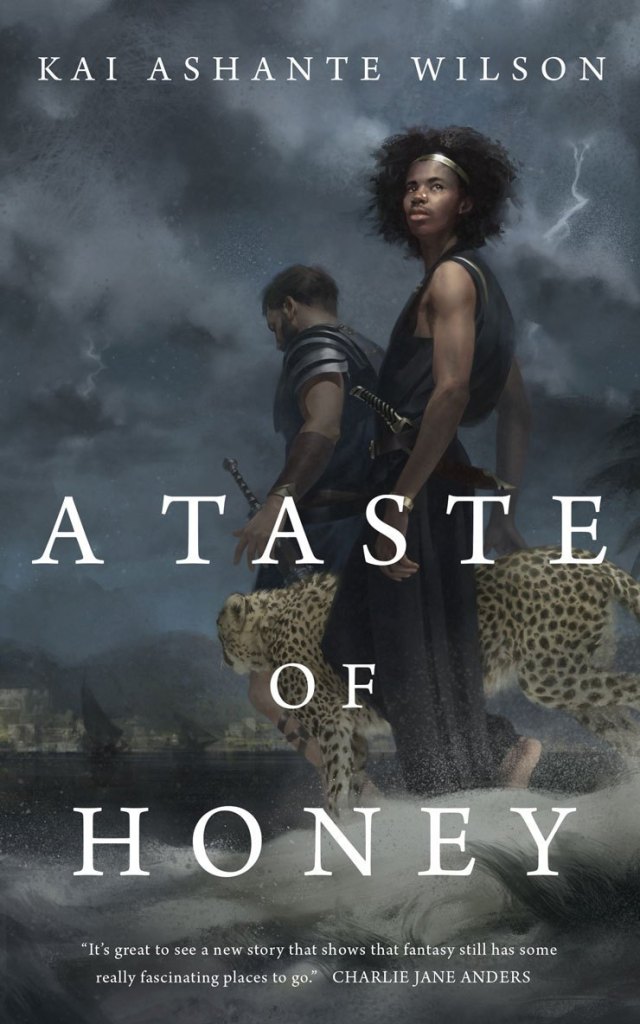
The Premise
Aqib is the son of The Master of Beasts, and has an affinity for working with animals. He has a chance encounter with a visiting soldier, whose nation’s gods are negotiating with Aqib’s nation’s gods. The two have an immediate spark, despite Aqib’s culture forbidding men from laying with other men. This story interweaves their ten day affair with the days, years, and decades that follow Aqib’s separation from Lucrio. Is the life Aqib gained, a wife and child and comfortable life amongst the high nobility, worth the loss of the love of his life?
Read If Looking For: the joy of young (and forbidden) love, the pride a parent feels in their child, second guessing the choices which form the fulcrum of your life
Avoid If Looking For: clear and conventional worldbuilding, invisible prose, Genre Romance
Comparable Media: Sign of the Dragon, Call me By Your Name, The Empress of Salt and Fortune
What Worked for Me:
Any story that is so laser focused on exploring the life of its protagonist will only succeed if the reader enjoys and is convinced by said protagonist. I am happy to say that Aqib passes with flying colors. Wilson’s writing isn’t free from tropes – nothing is – but A Taste of Honey felt refreshing in how little the characterization and plot conformed to common Fantasy and Romantasy beats. You won’t get browbeaten with character traits and adjectives. Instead, Aqib is simply a person, with all the bullshit that goes along with humanity. He isn’t a perfectly consistent robot; he has bad habits and feels things powerfully and is an impulsive teenager. He’s also a privileged asshole. Wilson does a great job of capturing the ideas of someone who was raised in a palace. Aqib is generally dismissive and rude to servants, especially when trying to cover the tracks of his affair. He doesn’t give them the same level of empathy as those with status. He’s derisive of women’s work (math, reading, and writing). All this gets mixed up with his own insecurities about not presenting in the muscular portrait of manhood that society expects of him. He doesn’t even have battle scars to make him enticing. Of course, this wraps right around when he’s a parent; he laments that his daughter is wearing pants – it will ruin her future prospects – even when he encouraged her in the first place. Wilson puts a lot of trust in the reader, and he leans into showing over telling whenever possible. Aqib isn’t necessarily likable. However, he’s believable and nuanced and human.
A Taste of Honey also needed a convincing romantic connection for the book’s themes to work. If we’re devoting so much time to Aqib and Lucrio’s ten day love affair and splicing those moments with the rest of his life, the amount of page space those ten days get should be damn convincing. Happily, they were! I’m actually not sure that TOR would spring for this book in today’s market. Its handling of romance is so far afield from the Romantasy trends right now. Wilson’s grasp of subtext in flirting is masterful, and it felt like I was watching a real relationship unfold. This is not a story where Aqib pines that life did not have meaning before Lucrio appeared. They do not have constant meta-conversations with each other about the state of their relationship. The tension is believable and grounded. I love a campy Romance, but this book felt very honest towards the experiences of gay men. We are not a monolith, but it is so very rare that I feel seen in speculative fiction, even as someone who prioritizes reading about queer men. The loss Aqib felt in the ‘later’ sections of the book only mattered because the relationship he had with Lucrio was grounded and tangible and real. Is this book a Romance? No, I don’t think so. However, it is a book centering a romantic connection, and done well.
Finally, let’s talk prose. In an interview with Strange Horizons, Wilson wrote
“There was, once—and still is in most other languages with a long literary tradition—a great and beautiful distance between what you speak in the street and what you compose for publication. In contemporary English, this distance is nearly gone.”
The man certainly puts his money where his mouth is, because A Taste of Honey is not written in conversational English. This book had me picking up a dictionary several times – no I did not know what pulchritude meant – and Wilson very clearly calls attention to his prose. I wouldn’t call the story dense or difficult to parse; even the less common words were placed in context where you could infer meaning from it. However, neither does Wilson’s language fade into the background, becoming invisible as you read. This will either be a blessing or a curse for you. While I personally enjoy books that use aggressively casual styles, I also deeply enjoy books that feel like every word was chosen with intention. A Taste of Honey is one such book.
What Didn’t Work for Me:
I’m all for unconventional worldbuilding, but the choices Wilson made in A Taste of Honey struck me as bizarre. Not the basics: the two countries, one of which is a poorly disguised Roman Empire, and their conflicting cultural values. This is a great baseline for the story Wilson is telling. Nor was it the gods that frustrated me, who mostly seemed to be superhumans in the veins of elves in Tolkien’s world. Instead, it was the relentless inclusion of technobabble and discussions of quantum physics in an otherwise medieval world.
You see, Aqib gets married to a mathematical savant that ends up as the Chosen One of the gods. They test her with complex math equations on planetary orbital dynamics (all written out), discuss microsingularities and holograms and technological biomodifications. Aqib understands none of this, but we the reader are treated to extended conversations on the subject. There was a lot of page space dedicated towards these elements despite their relative lack of impact on Aqib. The science does not matter to our protagonist; it is how the god’s meddling impacts his relationship with his wife (and their daughter) that truly matters to the story. I wish Wilson had abstracted away these discussions. As it stands, there’s enough description that I want to try to understand the discussion, but not enough for anything to be sensible. It isn’t even mimicking Aqib’s mindset, as he doesn’t particularly care about the discussion; maths is women’s work after all.
On the flip side, the first sentence on the back cover is “Long after the Towers left the world but before the dragons came to Daluça, the emperor brought his delegation of gods and diplomats to Olorum.” There are no dragons in this story, and we never learn what the Towers are (though The Gods going to space is implied based on some discussions). We have a bucket of very unusual worldbuilding choices that never get explained or explored. Nor do their additions impact the atmosphere or themes of the story Wilson is trying to tell. They’re included for vibes (I think) or perhaps because Wilson wanted to write more in this world. There’s a lot of promise for a larger epic Science Fantasy, if that were the focus. However, A Taste of Honey is deeply personal, and the epic space opera details don’t enhance that core mission at all.
Conclusion: A story about the turning points in our lives, and a phenomenal portrait of two men in love, even if that love is the impulsive kind that young adults run into with abandon
 Marked for Plot
One thought on “Novella Readathon #4: A Taste of Honey”