
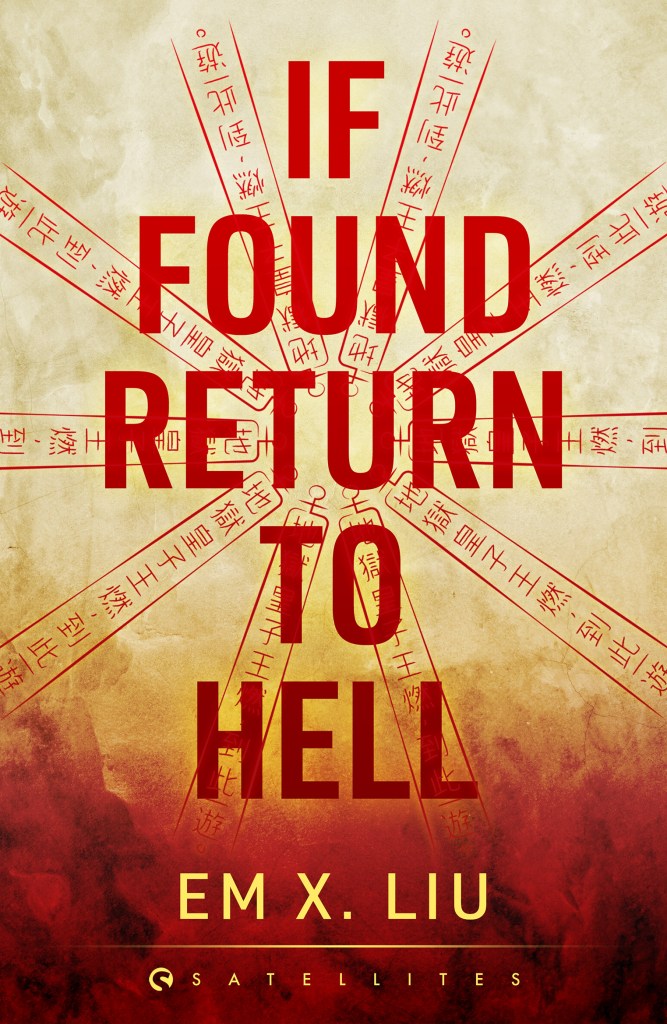
I didn’t know a ton about If Found Return to Hell coming into the first page, but I had assumed it would be a fairly standard horror story featuring a possession. Look at the cover! It’s actually a lot more like Penric’s Demon, though a bit goofier: this book is a big marshmallow with a gooey center. It finds a better balance in tone than a lot of cozy fantasy does, however, which made me like it a lot more than one of the many Legends and Lattes clones. However, I was kind of hoping this would be a nice accompaniment to The Haunting of Hill House, which my partner forced me to watch (though I’m now largely a fan). The second book of this readathon to underdeliver horror yet provide great cozy vibes, which is odd considering this is only the fifth book I’ve read for the challenge.
The Premise:
Wen works for One Wizard, a megacorporation to solve all of your wizarding needs! Unfortunately, they mostly answer phones, listen to complaints, and transfer customers to other departments. When a young man calls in with a massive sigil on his wall and no memories of what happens, Wen gets clearance to investigate. Soon, they end up playing host to a man possessed by a Prince of Hell, and Wen doesn’t know what to do about that.
Read If You Like: found family, late stage capitalism + magic, cozy fantasy that doesn’t overplay itself, developed platonic relationships
Avoid If You Dislike: second person narration, asshole parents, stories with relatively low stake
Comparable Media: House on the Cerulean Sea, Penric’s Demon
What Worked for Me
My favorite Superhero movie of all time is The Incredibles, and the glue that holds that story together (in my opinion), is Bob’s time in an insurance company. It’s tedious, repetitive, and draining for the soul. Liu perfectly captured that feeling in If Found, Return to Hell, because Wen’s time in the call center is delightfully shitty. Sometimes I think authors can overplay realistic scenarios transposed into a fantasy context (don’t get me started on how Teacher Professional Development sessions are to be written in fantasy books), but Liu gets it just right. There’s a sprinkle of absurdity with how stupid some of the callers are, the cloud of quotas hanging over your head, and the knowledge that you’re not actually making any change in the world. Wen is but a hamster on the wheel of corporate greed and mediocrity. I should note that this portion of the book has some fairly glaring plot holes for those whom this will bug: there’s some governmental licensing worldbuilding at the start that conveniently vanishes later in the story, and Wen gets away with far too much with far fewer repercussions than I’d expect from a high-turnover job like a call center.
As with The Incredibles, this mundanity is essential for the rest of the novel to work. Wen’s hatred of their job fits nicely with the fear Shine has as he calls in to help. This is an opportunity for Wen to actually do something. However, as the story shifts away from the office and into the home, that layer of frost thaws into something sweet and silly. Wang Ran is a bumbling and jumpy demon, fascinated with everything human. A highlight was him complaining about how inaccurately video games depict hell, and his comfort in hissing like a snake at animals. Liu does a great job of capturing the feeling of watching a shared body. There’s vocal bickering, the grabbing of one’s own hand to stop the vacuum cleaner from being turned on, and a friendly shadow war for control over the body that is all in good fun. Even when Liu didn’t tell me which character was driving Shine’s body, I could usually tell from their dialogue, which is a sign of high quality character writing. The story quickly develops into a Found Family storyline that feels earned and genuine. The developing platonic relationship between Wen and the others was treated with as much care as other novels treat romantic bonds, which isn’t something we see much. I don’t think this book is going to make ‘best characterization’ lists, but it’s a good step above most writers in the genre, which is probably why I think this book succeeded where so many cozy books fail.
Finally, I’m a fan of 2nd person narration. It used to be that I enjoyed it when used for a clear and innovative purpose – such as the narrative looping in How to Survive this Fairytale or Jemisin’s exploration of trauma in Broken Earth. This book has convinced me that I like 2nd person more generally, and I no longer will expect any justification for its use moving forward. Wen has a clear personality; they aren’t just a blank slate. The ‘you’ helped settle me into the call-center bits of the tale nicely. Wen is also given a gender-neutral name, and Shine/Wang Ran use female/male language for Wen respectively. I’m choosing to read this as Wen being nonbinary, but I don’t think this is explicitly confirmed in the text. If you hate 2nd person, ignore this book, because it could have been written in first or third person without much shifting thematically. For those who don’t mind the main character being ‘you’, however, this is worth picking up. Heartwarming but not drowning in sappiness.
What Didn’t Work for Me
I am a bit of a stickler for endings. I’m not the type of reader that thinks a bad ending ruins a story – except for Shoestring Theory; that was a train wreck – but I generally think it’s easier to create interesting challenges than to resolve them. If Found Return to Hell’s climax was mediocre. It pulled together a few Bureaucracy and Sigil Analysis plotlines, but Liu had foreshadowed this ‘reveals’ so heavily that the climactic legalese monologue actually ended up feeling like a recap rather than a reveal. The compromise Wen had to make didn’t have any teeth to it. Actually, it seems like the ‘bad’ part of Wen’s bargain ends up being more of a positive. I think this all loops back to the novella’s identity as a cozy novel before all else, so perhaps I’m applying metrics to the story that aren’t fair considering its subgenre.
Final note, and I will acknowledge this is 100% a ‘me’ problem. I’m kind of burned out on asshole dads (parents in general, but dads in particular). I’ve read a lot of them recently. They’re prominent in queer fiction, Romances, and adventure stories, all of which I read a lot of. So when two-thirds of our main cast had asshole parents – Sine’s mom is really delightful and was one of the highlights of the book – I’m starting to feel it as a shorthand to create a sense of sympathy for our protagonist. To a certain extent, this extends to Shine and Wen not having siblings, and are ‘alone’ in the world. Wang Ran has many, but we don’t hear about them at all, which is strange because it feels like it might be pertinent to why he’s running away from Hell. Actually, we get very little about why he wants to hang out in the real world vs where he was raised, and that feels like a bit of a missed opportunity.
Conclusion: A sweet and enjoyable found family story, one of my favorite cozy stories from recent years

