I’ve done more nonfiction reading than I can remember in a long time. I probably wouldn’t have picked up The Gales of November if it weren’t for my in-person book club. Naval history isn’t really my thing, and the sinking of a single ship on Lake Superior isn’t a terribly interesting subject.
However, my partner informed me that it is impossible to truly be a Minnesotan without knowing the story (and song) of the Edmund Fitzgerald. After 14 years, I can finally call myself a true lake country boy, I suppose. While I have very little nonfiction experience to compare this to, my gut is that it’ll be an enjoyable read for the layperson interested in boats or the Great Lakes.
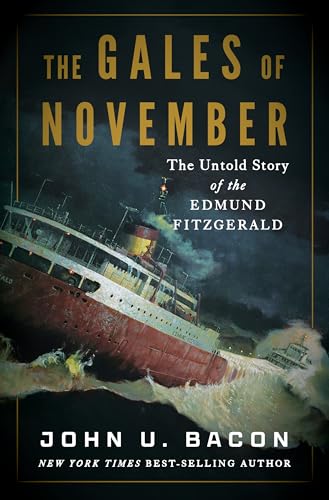
When I opened the book, there was an immediate sigh of relief; the entire story was not going to be about a single ship crashing. I couldn’t do that for the Titanic, let alone a wreck that was hundreds of times smaller. Indeed the bits of this book about the boat and the crew were the least enjoyable parts. They’re well-written, to be sure. Bacon takes great care to humanize everyone, to show the allure that the Edmund Fitzgerald held compared to other boats, even ones who eclipsed it in size. It was the VIP of the Great Lakes, a place that was awfully competitive to get a job on, and with sailors who knew their work. However, no number of chapters dedicated to portraits of individual people were enjoyable, but didn’t capture my attention the way it was intended.
No, my favorite parts of this book were about the lakes themselves, and about American History. I knew the lakes were big, big enough to be the largest source of freshwater on earth by orders of magnitude. However, I didn’t realize that freshwater seas carried their own challenges that made sailing on them different from, say, the open ocean. The naval difficulties, discussions of storms and wave heights, and evolution of safety regulations were something I had a lot of fun sinking my teeth into. I go up to Lake Superior every year, and it’s hard to describe the majesty of it. Bacon is much more eloquent in the beauty and danger of what must be one of the wonders of the natural world.
I also had a great time learning about the lake’s impact on American History! I’m much more in tune with the Mississippi River, which is the focus of a lot of my curriculum in school – and also led me to The Sea of Grass, which was a truly fascinating nonfiction read – but I didn’t realize how central the lakes were towards America’s industrialization, or how central the Iron Range in Minnesota was to the development of cities like Detroit.
All in all, I think I’d have preferred a book about the Great Lakes with an aside towards the Edmund Fitzgerald. As it was, this was a good stretch book that I’m excited to talk about with friends over the weekend!


One thought on “The Gales of November: Great Lakes History”