
Nathan Tavares has more or less cemented himself as an instabuy author for me, and Disco at the End of the World continues placing him near the top of my favorite author’s list. The early reviews for Disco had me hesitant: several readers I trust DNFd, and a 3.5 rating on Goodreads typically indicates that a book has some fairly major flaws. Like with most of Tavares work, I think my love for it is going to be higher than most people’s. He speaks to my soul in a way that few authors do. This book has some significant rough patches, but it also filled a void that I’ve been searching for: speculative fiction that seriously engages with historical underground queer spaces in America. If that isn’t something that immediately gets you excited though, there probably isn’t enough here for me to recommend it to the average reader.
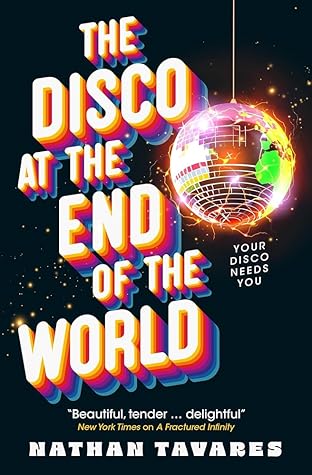
The Premise:
Mitch is a member of the Spaceguard, which has replaced Nasa in this version of the Cold War with more of a military emphasis than exploratory. He works on the moon base, where he’s known as a queer who doesn’t get a hard time only because he also smuggles contraband in for everybody else. He gets reported for morality breaches and is sent back to Earth, where he and his fellow servicewoman Gloria (not that most soldiers used that name for her) helped open an underground Disco outside Hollywood. Strange things are happening to Mitch however, and he ends up being a contact point for Aliens who are threatening to destroy Earth, unless he, Gloria, and his new family can bougie hard enough to change history.
Read If You Like: portrayals of underground gay culture, alternate space-race history, queer acid trips, disco ball spaceships
Avoid If You Dislike: characters facing homophobia, long stretches without speculative elements, the power of LOVE, intense tonal shifts
Comparable Media: Welcome to Forever, Exit Stage Left: Snagglepuss Chronicles, Disco Witches of Fire Island
What Worked for Me:
The thing that keeps bringing me back to Tavares is how he captures the voices of queer men. Obviously there’s no singular experience of what it means to be a gay man, but Tavares taps into the communal history and experiences of our community in a way that speculative fiction authors are generally reluctant or incapable of doing. His books make me feel seen, like this is a book for me and people like me. He is unafraid to write a book that doesn’t center a version of queerness palatable for the masses. This novel in particular relishes in the underground and countercultural elements of American homosexuality. Casual desire, cruising culture, queer magazines; part of his research for this book involved interviewing the owner of the last remaining vintage gay erotica shop in the world. It is impossible to separate queer joy and resistance from the DNA of The Disco at the End of the World. When your identity is criminalized, you either choose to blend in for safety or live in a constant state of reckless abandonment.
While there are absolutely parts of the world where the need for underground queer culture is strong, even the worst parts of America have largely moved on. Ironically, apps have fragmented our community even as they increase our physical safety, breaking down intergenerational mentorship and a tight fabric of communal organizing. As we appear more often in popular media, the intrinsic subversiveness of homosexuality fades away into something that exists more comfortably alongside mainstream sensibilities. I refuse to be a grouchy old man who says this is all bad; life is unambiguously and unarguably better for queer folks now than it was even twenty years ago, especially for kids. However, we can both celebrate progress while mourning and honoring parts of our culture that have faded. This book is an homage to the history of queerness, but queer masculinity in particular. This means it isn’t going to be for everyone, but it’s hard to overstate how much Tavares’ writing makes me feel connected to the history of gay men in America.
This all goes hand in hand with Disco’s place as an Alternate History. Tavares has a lot of fun making sweeping changes. Reagan is even worse than he was in the real world, taking on some Trumpian aspects in a world where Communists were winning the Cold War. Disco imagines America’s response by doubling down on repressive policies to enforce a particular brand of morality and a stronger shift to authoritarianism than we saw in our actual history. Layer onto all of this a stronger space-race craze that becomes a cultural monolith across TV, advertising, and even food branding. Knitted together with a growing hotbed of fascism is the revelry of the Disco scene, banned and censored in the US and thus smuggled in from Europe and Canada. The ease with which Tavares shifted between these two modes, of Mitch getting beaten up by cops only to lose himself in dance the very next day, is an endorsement for revelry when times get hard. I don’t go quite as far thematically as Tavares seems to want to – that this joy is itself the change – but its defiant joy is a necessary component of resistance to fascism. Minnesota had a rough year for that, and it’s challenging to find joy when those who are supposed to keep you safe are constantly pummeling you. The Disco at the End of the World reminds us of the importance of community and losing yourself to the moment.
What Didn’t Work For Me:
This was a Tavares book through and through, with all the good and bad that entails. Tavares is a master of characterization and compelling prose. However, I’ve generally found his implementation of speculative elements a bit lacking. While I enjoyed the Alternate History elements of Disco, I struggled once the aliens and magic powers came online. This book leans into ‘love is magic’ in a very literal sense, but mixes it with vocab like Ascended Beings and Tempo. There was lots of infodumping and talking about tapping into the power of the universe often felt stylistically divorced from other parts of the novel, like I had shifted to reading something with light and invisible prose. When magic and alien contact was hallucinatory, I loved it. Tavares is at his strongest when asking readers to disassociate from their bodies a bit. However, the longer this magic and alien contact remained in the story, the more I felt like Tavares’ writing shifted to something I’d see on Royal Road, complete with individualized superpowers. I do love a good Royal Road story, but that isn’t what I’ve picked up The Disco at the End of the World for.
As we careened towards the climax of the story, the camp that Tavares had balanced with such a light hand spun out of control. I can accept a lot, but it crossed a line when the disco ball alien mothership said Holy fuckcannons. Who knew these cats had antimatter bombs? If you’re going to harsh our vibe, we are going to boot you off the dancefloor. The writing is especially jarring because they’re paired with well-developed serious elements, such as a soldier processing that he’s actually been part of a genocidal machine for eons. The tonal whiplash was extreme, and it didn’t serve the book in meaningful ways.
The first half of the story was an easy 5 stars for me, but I’d put the back half closer to a 2. I think these issues are significant enough that I can only recommend Disco to folks who are actively seeking out historical American fantasy/sci fi and the countercultural elements that Tavares wove into the book. Objectively, there’s a lot about this book that was a hot mess, and Tavares remains one of four authors on my ‘must buy’ list.
Conclusion: A captivating Alternate History for those interested in queer history in America, but its implementation of other speculative elements was rough.
 Marked for Plot
Well, that didn’t make me sorry for DNFing. But I appreciated how you talked about Tavares being so…in-tune? with that particular part of queer history. That’s not something I’ve thought about before with his writing, and it’s a really good point!
I have to ask: who are the other three authors on your auto-buy list? (Forgive me if you’ve told me before, my memory is a mess!)
LikeLike
I really think this book is a very niche rec. The bits that worked for me absolutely won’t carry the story for most folks.
My must buy authors are
At one point Nghi Vo was on this list as well, but she puts out so many books that it stressed me out trying to keep up (even if they’re usually on the short end), and not quite liking her more recent works as much as her older stuff. That said, I’m almost assuredly going to read both A Long and Speaking Silence and also The Scarlet Ball, so I think she’s functionally on this list.
LikeLike