
Are werewolves going to be a theme of 2026 for me? This is the second book in as many months that did some really interesting things with werewolves in historical France (read this for more straightforward and readable style, or try The Wolf and His King for a more bespoke experience). My partner and I are watching the Twilight films for some fun date night mockery. I really want to read The Devourers by Indra Das soon. Werewolves just seem to be everywhere in my life right now.
If you’re interested in a werewolf story that focuses on hunting one down and killing it, this is your jam. No werewolves were kissed in the reading of this book, and they spend most of their time ripping the hearts out of any living thing they can find. I actually think that a good comparison point for this story is The Bartimaeus Trilogy by Jonathan Stroud, but darker and geared towards adults. The Red Winter is one of the most competently-written debut novels I’ve picked up recently, and I’m excited to read more by Sullivan in the future.
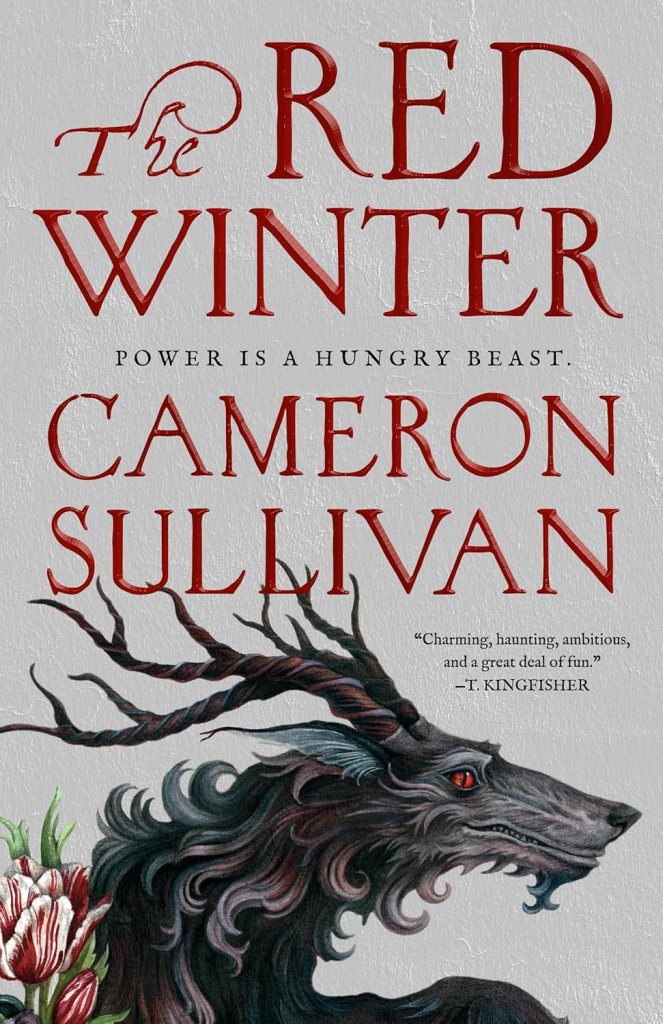
The Premise:
Sebastian was granted immortality when he bonded with Sarmondel, his demonic Guest. This book him reminiscing about his time in France in the 1700s. One storyline follows him joining a large hunt for a monstrous beast ravaging the countryside, falling in love with the young lord Antoine along the way. Another is set 20 years later as he is summoned by Antoine’s son to kill the beast that returned to ravage the countryside. The final storyline is told by Livia, Sebastian’s succubus slave, as she investigates the supernatural oddity that is Joan of Arc. At the center of all three storylines is the Warfather, Ares, Mars, whom Sebastian’s Guest hopes to feast upon.
Read If Looking For: brisk narration, a trail of bloody bodies, snarky footnotes, religious zealotry
Avoid If Looking For: deep characterization, romantasy, impactful female characters
Comparable Media: The Bartimaeus Trilogy, Shigidi and the Brass Head of Obafulon, These Burning Stars
What Worked for Me:
I came to The Red Winter expecting it to be dense and medieval. It’s a big book, but Sullivan’s storytelling is brisk and transparent. I wouldn’t call it ‘windowpane prose’ but its close. There are too many disemboweled bodies to call The Red Winter light reading or an easy popcorn fantasy. There’s a compelling portrait of historical France, but Sullivan doesn’t get caught up in infodumping. Instead, he drips information about how magic and demonic contracts work lightly, allowing the story to flow on the good will that you’re willing to extend our intrepid narrator. When additional information is necessary, Sebastian uses footnotes to flesh things out without interrupting the flow of the main narrative. Frequently, these footnotes were my favorite part of the story, and I’d have liked to see some of the energy present there in the rest of the story. You’ll find grim scenes side by side with dark humor, dramatic reveals right as things start to slow down, and brutal violence that comes as both a creeping menace and a sudden ambush.
Sebastian’s immortality and history made for an intriguing lead character. He and his Guest have the illusion of a deep history without much of it actually making it to print. Sarmondel is constantly hungry for energy (consumed through death, sex, emotionally charged objects, and more) to fuel his great power, but the plot kept him running on empty for most of the book to prevent Sebastian from brushing aside various challenges. Our warlock protagonist has a reputation for great cruelty and ruthlessness – according to him, of course – but he seems to mostly be a big softie with how often he let easy power slip through his fingers. I know that Sullivan has a ‘sequel’ planned, following the same characters in a different time period. I’d very much enjoy reading more of this type of story, and Sebastian alludes frequently enough to his misadventures that Sullivan should have plenty of material to draw on for standalone-style adventures with the same main characters.
I want to take a second to commend Sullivan for how well the pieces in The Red Winter fit together. For a debut novel, he manages pacing between each storyline masterfully. They build upon each other, bouncing back and forth right in time for revelations in one timeline to find a mirror in the future or past. It’s always clear which version of Sebastian’s life we’re in at the time. Thematically, Sullivan doesn’t have a ton of depth. He does take great pleasure in the irony of religious figures preaching miracles while condemning any who perform magic ‘the wrong way.’ Solidly written, and not many significant flaws for people to poke at, assuming you’re someone who’d go in for a bloody werewolf hunt book.
What Didn’t Work For Me:
My biggest complaint about this story is probably nothing more than a pet peeve: Sullivan overuses italics and bold text in his writing. At first, I thought he was solely using these elements for when Sebastion and his Guest talk to each other (or to other spiritual entities). This, I am fine with. It’s a common enough way to denote non-spoken language, and it works well. However, Sullivan also really likes to use italics and bold text to emphasize and weigh certain words. This, I like much less. Like most sins, I’m guilty of this too, but it really annoyed me while reading. If you need to rely on bold text for emphasis, then you aren’t writing your sentences carefully enough.
Throughout my read of The Red Winter, I struggled to identify why I wasn’t falling head over heels in love with it. There’s so much that I like here, but Sullivan never managed to pull me into the hypnotic trance where I forgot that a book was in my hands. Everything was just far enough removed that I couldn’t forget about the act of reading, the number of pages left in a chapter, or that this was all a story. I think part of this distance was that characterization is probably Sullivan’s biggest growth point. Everyone’s voice feels similar (footnotes aside), and I don’t think he drills down into the heart of who these characters are. Sebastian is supposedly obsessed with Antoine, but I never quite believed or understood it. He certainly doesn’t make me feel why he was ready to throw away everything for the sake of this one man. I never got lost in the language and the story, and I almost never read more than 75 pages in one sitting.
Conclusion: a brisk and competent read. Something was missing, but it was hard to figure out what


An intriguing review. I started reading this book, so I can see where your positives and your negatives come from. I haven’t finished reading the book yet, but I do know that this book is now the 1st in a series. Maybe your answers will be revealed in the next book?
LikeLike