
I have been waiting for this sequel for a long time (and waited longer because the Library hold time was so long!). I read To Shape a Dragon’s Breath before I started this blog and loved it for … so many reasons. For those who haven’t read that book, go read it now if you have any interest in a slice of life story interested in exploring indigenous takes on classic fantasy concepts, nuanced and rigorous depictions of racism in many forms, and a rambunctious dragon hatchling with quills!
For those who have read To Shape a Dragon’s Breath, the TLDR of this review is that your feelings about Book 2 will probably be the exact same as Book 1. If you disliked the first, this won’t win you back. If you liked it, you’ll find this book to be a feast.
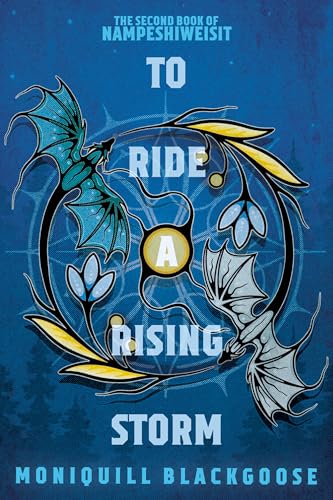
The Premise:
Anequs’s world continues to shift. As she prepares for her second year at Kuiper’s Academy – which she plans to be her last – she begins to come to terms with the impact her fame and position have on her homeland. Her home has far more eyes on it than ever before, she can’t properly talk about her romantic intentions with either Theod or Liberty, and Kasaqua is big enough that she can’t fit in buildings anymore. She also faces rising discontent from the white nationalist political faction, comforting her friends whose struggles she doesn’t understand at all, and a variety of new faces at school.
Read If Looking For: when the leopards came to eat their faces, characters who don’t always get it right but own up to it, tough conversations between characters you love
Avoid If Looking For: lots of dragon riding, easy victories for the main character, one dimensional characters
What Worked for Me:
The thing that Blackgoose is doing better than anyone else in Fantasy at the moment (that I’ve read) is tackling head on well-meaning people who don’t realize they’re being racist. Marta is a great example of this. She’s grown in leaps and bounds, no longer seeing Anequas as someone to ‘fix’ because she doesn’t conform to Anglish standards. She faces her own problems in this book, including a very real threat to her planned future when her father gets engaged. Her struggles to find a path forward in a patriarchal society don’t make sense to Anequas, who doesn’t quite get the social pressures at play, and you find yourself cheering for her even as you continue to rage at the society which created this misogynistic situation. Then, Marta spends that goodwill by treating Liberty absolutely horribly. She has grown, yes, but she is still a product of her society, unable to see the biases in front of her without them being pointed out.
This book also brings us armchair liberal philosophers who don’t want to take action or welcome anyone unlike them into their little club, excited prospective allies who’ve read too many fanciful tales about indigenous people, and adults who don’t take problems seriously until they impact white folks. Yes, the villains of the story are objectively the overt racists who are actively murdering Anequas’s friends and family. The story isn’t really about that struggle though. It’s about Anequas navigating social dynamics with people who see themselves as her allies but who don’t understand at all. The problems in this book can’t be solved by Anequas or her community alone. She finds herself beholden to people who don’t understand how dehumanizing they are. Of course, Anequas isn’t perfect either. She’s stubborn and impatient and delightfully complicated, which make this story ring even more true.
From a plot perspective, this book continues to stubbornly defy expectations. You might expect plenty of scenes riding Kasaqua, but instead you learn about many types of saddles that don’t fit her form, putting off most riding until the end of the book. Classroom scenes are full of theory, free from learning badass chemistry experiments that will help in the brewing civil war. Instead, you learn safety procedures! Yes this is a magic school story, but you’ve got to come at it with the perspective that this story is a slice of life narrative with lots of thematic depth. You’ll reach the halfway point and wonder where the book went, because ‘nothing happened’, but that’s part of the point. Blackgoose’s writing is strong enough to pull it off, and I love love love the slower pacing. We don’t get to see this much in YA, and Blackgoose joins a growing rebellion against what YA is ‘supposed to be’.
What Didn’t Work For Me:
If this series has a weakness, it’s the romance. I truly appreciate Blackgoose ignoring the obvious and overplayed conflict that would be Theod and Liberty hating each other. I like that Anequas has to own up and apologize for times she gets things wrong, instead of always being the one in the right. I like that Blackgoose doesn’t turn her feelings towards her two suitors into something overblown and unrealistic – this even gets called out in text! However, Anequas’s approach to romance feels stilted. There’s lots of frustration about Anequas not having time to talk with either of them properly about courting, but very little indication of why these characters like each other as more than friends (other than Theod, who gets a good amount of development here). The fact that they dance together gets little more than a passing mention! Show me flirting, show me wry smiles, show me inside jokes. You have swung too far Blackgoose, and I demand a better romance arc! This series is too good for it to fall short here.
Otherwise, there’s only some small quibbles. Usually it’s around Anequas getting to have her cake and eat it too. She’ll happily note the virtues in Marta’s Anglish social skills when boys look down on them, but then she turns around and judges Marta for the exact same things that the guys did. To be fair, Anequas is a convincing portrait of a level-headed teenager (yes they do exist), and even the best people are hypocritical at times. For the most part this book was excellence stacked upon excellence.
Conclusion: No middle book slump here. This series is excellent and you should read it (if you want to, no pressure, but maybe a little bit of pressure).


2 thoughts on “To Ride a Rising Storm – No Middle Book Slump Here”