
Words are not enough to describe how nervous I was to suggest my in-person book club read The Spear Cuts Through Water. Was it everything I remembered, or are my memories clouded by the pink haze of nostalgia? Would my friends like it as much as I did? Was the brutality and violence of the book excessive? Would I still think about this as my favorite book of all time? That’s a lot of pressure to put on a book, and expectations are the mother of all disappointment.
Thankfully, it absolutely stood up to the book of my memories. I think I liked it more this time around, and I certainly noticed things that I had missed in my first readthrough. The jury is still out on whether or not my friends will love it like I do. My only regrets are starting this book a little too close to our book club meeting – it’s tomorrow! – which coincided with a bout of brain frog that left Jimenez’s gorgeous pose a bit more difficult than I was equipped to handle after a long day of work. However, I consider it the best book I’ve ever read, and it represents the direction that I wish epic fantasy would start to explore.
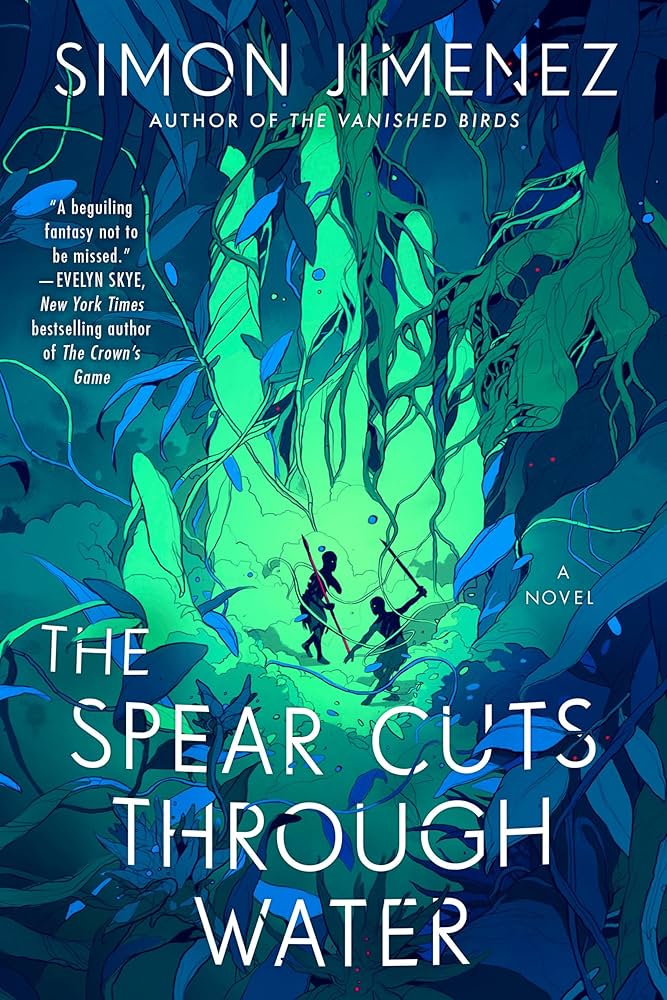
The Premise:
In the inverted theater, the child of Moon and Water performs for you a story of your people’s history. You’d heard this story before. It is the one your Lola told you and that you told your brothers in turn. It follows Keema and Jun, one an outcast with one arm and the other a monster of a man searching for a path towards redemption. They escort the Moon in her desperate bid to escape the empire freeing her from 8 generations of servitude and the people from 8 generations of tyranny. This is a tender story of the journey of two boys, a chronicle of the death of an empire, an exploration of guilt and shame and violence, and it is a story about how our past ripples into our future.
Read If Looking For: a simple story transformed by its format, an ode to the oral history of Fantasy, standalone epic fantasy, a very wise tortoise
Avoid If Looking For: straightforward storytelling, books free from graphic violence or sexual assault, rapid pacing
Comparable Media: Spear (by Nicola Griffith), Hyperion, Princess Mononoke
Why This Book is a Masterpiece:
Let us begin with the elements that will immediately make this book unreadable for many; Jimenez makes a ton of ambitious choices in his writing that readers looking for something simple and mindless will hate. This story is presented in three formats: a relatively standard 3rd person epic fantasy, ‘you’ getting told the story by various relatives, and ‘you’ experiencing the performance of this story while asleep and visiting the Inverted Theater. Jimenez doesn’t shift tenses and perspectives in each section or chapter. No, he shifts from sentence to sentence, slipping between storytelling modes like water flows across boulders. Woven into this fabric are the voices of those who go unheard; you get asides from the man trampled by the First Terror as he slowly dies, from the ghosts that haunt Jun, from the farmer who bemoans the lack of rain. Yes this is a story about Keema and Jun and the Moon. However it is also a story about those who are forgotten, about those who pass a story from generation to generation, allowing it to shift in meaning and tone, still true even as details shift. To your Lola, this is a love story. To your Granjo, it is a story of tactics and political maneuvering. To your father, it is a story of identity and pride. To you … well that’s up to you I suppose.
Jimenez’s use of this technique is recursive, building upon itself as the story collects meaning. I find it challenging to pull a single quote that demonstrates how these elements interact to create something far more meaningful and intense than the sum of its parts. The egg timer your lola twists to time the brewing of her tea ticks as the feet of the dancers tap. It ticks away as The First Terror brings the power of gods to break the Tiger Gate as Jun and Keema try to escape. We float between these three images as they build into a crescendo that culminates with something simple that becomes something unimaginably tense. The audience holds its breath. An egg timer goes off. The tea is brewed. The First Terror has arrived.
It’s hard to overstate how deeply Jimenez’s structure permeates the meaning of the story. This is a story about stories, but I found it more honest than any book about a character getting lost in a magical library (and I have enjoyed many such tales). The performance of this myth as a dance draws strong parallels with how myths were and are told in Filipino culture, and the story’s shifting meaning echoes how myths are taken and manipulated for new purposes and contexts without being any less true. Yes there is destiny and redemption and war, but The Spear Cuts Through Water asks you to consider how storytelling is more, and he does it without ever explicitly asking you to do so.
Another stumbling point for some will be the unfettered violence of this book. You’ll see casual death, brutal torture, and cruelty that makes Game of Thrones look tame. Yes the Three Terrors are evil, but few of our characters escape without blood on their hands. It’s an interesting tension between some elements we consider fairtyale-esque, things coming in threes is a good example of this, and I think the violence of this book is more shocking than its introductory pages and back cover lead you to believe. Is Jimenez gratuitous? I don’t think so, but I think some will disagree. The violent nature of tyranny – and the many forms it comes in – is a core thread of this story. Even the Moon herself, whom our heroes desperately protect, is cruel to those she sees as mere mortals, much like the wealthy businessmen see those who work for them in The Bowl of Heaven. Ultimately it is an optimistic story, but had it read closer to Sanderson’s preferences, I think the story would have lost a lot of its impact. This is where Princess Mononoke comes to mind as a comparison point; it is overly bloody (perhaps comedically bloody at times), but that unvarnished cruelty is essential to acknowledge the nuance of the situations that our characters face. Ironically, this isn’t a nihilistic story at all. If I have any complaint, it’s that the ending was too happy and optimistic when compared to what came before.
If authors making ambitious choices appeals to you, then The Spear Cuts Through Water is absolutely worth a look. Jimenez is a master of honoring the core elements of a genre while creating something unique. I can’t promise you’ll love it, but I think I can promise that even if you dislike it, you’ll probably respect it.
 Marked for Plot
I need to reread this book. I read it before as a judge for an award (it won). Now, I want to read it as a reader.
LikeLike
I’ve never had the chance to judge like that! I imagine it would activate a very different part of my brain though, since there are some very good books that I very much don’t enjoy.
LikeLiked by 1 person
I did struggle with the way this was written, and I listen to books because of a health issue (audiobook for this one), so I think that made it more confusing. But it was clear it was very much a purposeful choice, and I don’t think the book would’ve had the same feeling if it were written differently. So I do respect it! I like how you explain it. And I thought the characters were really fascinating. Even though I didn’t love this like you did, I enjoyed it, and it’s a book that stands out in my mind. And I’m glad you’ve found a book you love so much!
LikeLike
This is one I’d love to get to at some point. I hope your book club friends enjoy it as much as you do!
LikeLike