
Translated Novels tend to be some of the more unique reads. It’s easy to forget how much cultures have self-reinforcing patterns in their writing, even across subgenres. Walking Practice is a great example of how translated fiction can be an engaging experience that confronts your notions of how stories go.
Assuming you’re reading in English and not Korean, I highly recommend reading Victoria Caudle’s translation notes, which will provide key context for what the hell is going on with this book’s typesetting.
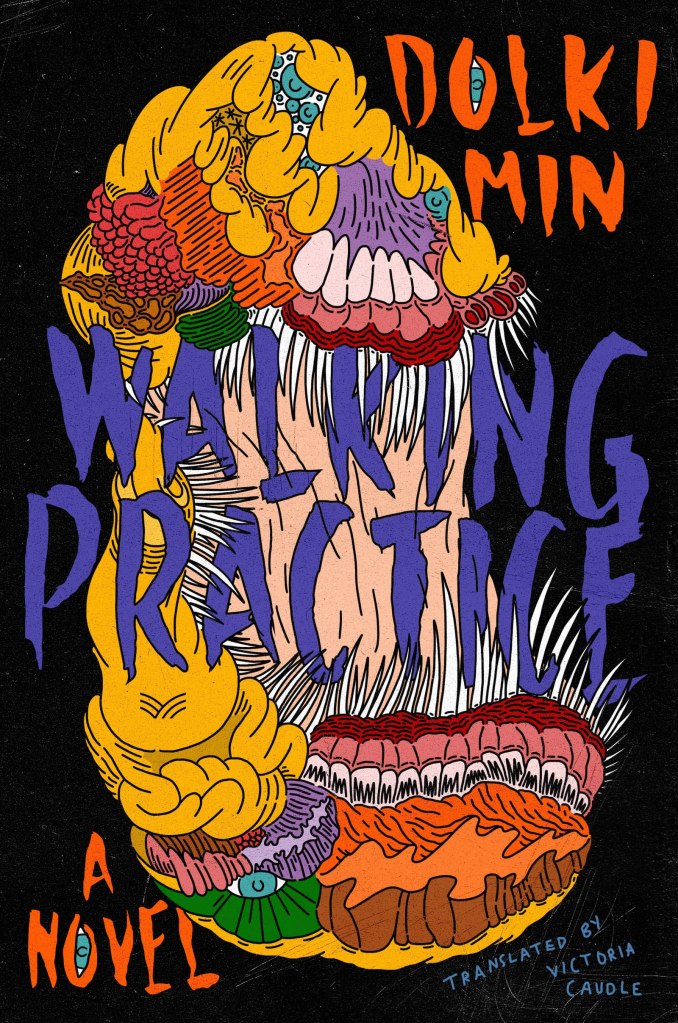
Read If Looking For: horror with deep themes, gruesome depictions of bodies, gore, and sex, utterly alien narrators
Avoid if Looking For: something like what you’ve read before
Elevator Pitch:
An alien is stranded on Earth, at the mercy of the planet’s intense gravity and its own need to eat. Thankfully, Earth is full of delicious, tasty humans! And so this shapeshifting creature laboriously makes its way through the city towards its meals, adapting its appearance on the premise of a fun hookup that turns into mealtime. When things go sideways though, the alien must adjust or starve.
What Worked for Me
Walking practice is a manifesto in how queer literature can push boundaries, play with form, and be brutally visceral without the attached baggage of what people traditionally think of as queer art. It’s a book that I can’t say that I loved at the time, but can’t stop thinking about.
Dolki Min is able to render our lead character’s physicality with a level of detail that is rarely seen. One of the most engaging parts of the book was when it was trying to climb a large flight of stairs. This sounds like an insult, but it’s a testament to the narrative voice and how gravity and physical exertion are more of a threat to this creature than any human could possibly be. I would call this book as one that thematically tackles the topic of disability, but doesn’t map neatly onto disability in a way that we think about it. A body is a meat sack, and the narrative treats all bodies as such, even when in the midst of sex described in ways that are repulsive and disgusting because it focuses on the physical mechanics of it in ways that are utterly repulsive. And then there’s the kimchi intestines and pickled eyeballs and the general feasting that occurs at mealtime in this book.
If you asked me whether an alien serial killer novella was going to be a thematic tour de-force, I would have laughed at you. But the book was deeply insightful about how human culture sees gender, and how many people refuse to treat people as people until they can identify a gender. For all the alien is brutal and awful, its insights into the human condition are really quite profound. Dolki Min did a great job of using this story as a vessel to challenge people to think deeply about gender, and how they interact with gender on a daily basis.
What Didn’t Work for Me
If I’m being honest, my enjoyment was tamped by my own squeamishness and the amount of body horror going on in this book. I can acknowledge how it was leveraged in meaningful ways, but still found myself vaguely repulsed the whole time I was reading.
In Conclusion: An ambitious novella about a serial killer alien with many musings on bodies and gender.
- Characters – 5
- Worldbuilding – 3
- Craft – 4
- Themes – 5
- Enjoyment – 3 (in the moment), 5 (in hindsight)
 Marked for Plot