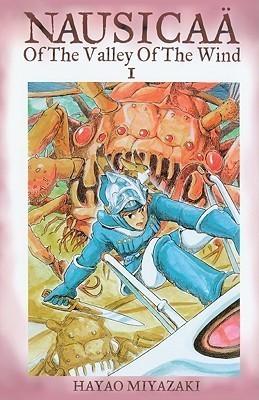
I’ve been a fan of Studio Ghibli movies since I watched Howl’s Moving Castle as a kid. However, I’d never seen Nausicaä on screen before. Miyazaki’s manga has a sterling reputation as one of the great classics, so I nabbed a copy to try out. Turns out Miyazaki is just as competent with sequential art as he is with animation. Nausica is a love letter to classic epic storytelling, mixed with a fleshed out condemnation of war. For fans of his other work, Nausicaä is a must-read. For fans of epic fantasy, Nausicaä is a must-read. For fans of fantasy manga, Nausicaä is a must-read.
Maybe Nausicaä is just a must-read in general.
This review comprises my thoughts about Volume 1 (~130 pages). I hope to return when I’ve finished the series!
The Premise:
The world has been consumed by a corrupted forest, one filled with deadly spores, monsters the size of buildings, and secrets beyond belief. Nausicaä is the princess of a small nation-town bordering said forest. Nausicaä’s home – and by extension Nausicaä herself – gets dragged into a war of their more-powerful ally’s making. She’s also able to speak to the insects and the forest in a way that others cannot, and some feel that she is the one destined to end the cycle of violence and death.
Read if You Like: environmental themes, chosen ones, entrancing characters, aerial dogfighting
Avoid if You Dislike: classic fantasy vibes, action scenes getting deprioritized, ‘perfect’ main characters
What Worked For Me:
Nausicaä is everything that an a classic epic fantasy book should be. Authors of the 80s and 90s had a special feel to their worlds and plots. It’s not a particularly popular style, and one I have little patience with if done poorly. Nausicaä is not done poorly at all. Nausicaä herself is a princess, one who has defied odds, has the good of the world in her mind, able to heal a broken land. Yet she also feels like a real person, someone beyond the character traits and grand destinies. There’s a healthy condemnation of war, and there are massive creatures. There’s fight scenes and political intrigue. The heroes succeed because of their internal goodness. There’s an animal companion. Nausicaä of the Valley of the Wind is the distilled essence of that era’s epic fantasy, but the trappings help Nausicaä stand out from the crowd, and even 50 years later I the story doesn’t feel like newer work has iterated the idea in any way that surpasses the original.
Nausicaä is, I think, very indicative of just how great the looming shadow the United States’ bombing of Hiroshima and Nagasaki. Humanity has poisoned the world with their war and machines. Nature itself has mutated, and those who breath the air of the corrupted forest grow sick and die. There’s even a bit o invoking Godzilla elements, which is an even more blatant story with the atomic bombs at their core. Miyazaki stakes a clear moral ground in this book, about the sanctity of nature, about how suffering continues long after the war has concluded. It’s the type of Fantasy I think Tolkien would have loved to read.
What Didn’t Work for Me:
This manga has a reputation for being wordy and verbose, so I was pleasantly surprised when I enjoyed the dialogue and thought everything flowed nicely.
I know that in the modern era, we are spoiled for good art. That the tools to create evocative detail (and meticulously replicate them) are better now than ever before. Still, I thought Miyazaki’s art sometimes lacked clarity. Details that I wouldn’t have been able to realize without dialogue providing context. Everything just felt a little fuzzy. Not the actual linework of course, but the compositions left something to be desired in the visual clarity department.
Conclusion: A classic and beloved manga finds another fan
- Characters: 3
- Setting: 5
- Craft: 4 (Story) 3 (Art)
- Themes: 4
- Enjoyment: 4


I didn’t know that Nausicaä was a manga also! I’ll have to look for that one. I’ve seen and enjoyed the movie (but only once… need to rewatch it) so maybe that would help with the fuzzier parts of the art.
LikeLike
I didn’t either until recently! Once I read the whole manga, I plan on doing a movie night with friends
LikeLike
That sounds like a good plan. As a bonus, I remember the movie having a wonderful soundtrack.
LikeLike
The manga is absolutely fantastic.
LikeLike
I’m excited to continue it!
LikeLike
I really should give this a try as well!
LikeLiked by 1 person