
There are only 2 novellas that I hadn’t yet read from the 2026 Hugo Nomination slate. I know I’m not interested in Vernon’s offering (though part of that might simply be exhaustion at her getting nominated every year), but had wanted to read Automatic Noodle before the awards were announced. In the end, this was a fairly disappointing slate of Novellas. My pick was Cinder House, which I authentically enjoyed. I was happy to see it on the shortlist, but am still not sure if I consider it Award-Winner material. Automatic Noodle, like the rest of the lot, has some areas I see as significant flaws. However, it’s not the style of book that I would have ever put forward as a nominee, so perhaps I’m judging it on criteria that don’t really fit. It’s great chill pick for someone looking for something quirky, knowing that it isn’t going to be an emotional rollercoaster.
The Premise:
Four robots wake up to find their company has absconded to the United States (California is its own country now), threatening their already dubious freedom. They decide to open a a hand-pulled noodle restaurant, despite robot corporate ownership being very illegal.
Read if You Like: allegories for otherness, weird futuristic worlds, stories with personal stakes
Avoid if You Dislike: robots that feel like humans, heavy-handed themes
On Robots and Otherness:
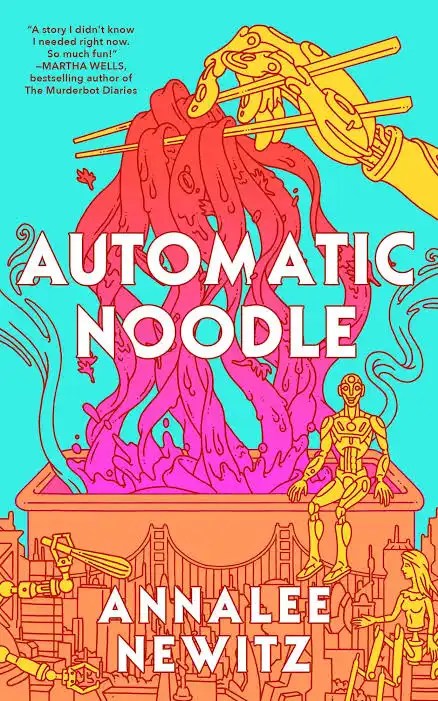
These are the two ideasthat your enjoyment of Automatic Noodle are going to hinge on. Our main cast of characters are four robots, each of whom is a little bit different. Cayanne has tentacles they use to taste, Sweetie has a lifelike human upper body and wheels for legs, Hands is immobile and has a passion for good food, and Staybehind is an ex-military bot who isn’t sure about this whole restaurant thing. Newitz isn’t subtle about using their robot status as an allegory for various oppressed groups. There’s lots of moments that they’ll whack you on the head with a hammer: the cast tries to find robot-centered perspectives in media they consume, the laws giving them ‘freedom’ are almost as insulting and limiting as being literally enslaved, Sweetie struggles with the pressures to ‘pass’ as human for business despite it not reflecting her own desires, etc.
I don’t think that any of the ideas here are bad. I actually like how many different ways Newitz twists the analogy; this is a great example of how to use robots allegorically in a way that works, as opposed to being dehumanizing. However, they’re never subtle about this content. I know some people really enjoy it when authors are explicit about the messages in their story. I’m sometimes one of them. In such a short format, I think it may have even been the smart move for this novella. However, it began to grate on me, and I kept wishing that Newitz would have let the story speak for itself.
The other element that you’ll get varying mileage out of is how much you want your robots to feel inhuman. Obviously a big point of this story – which we are told several times – is that anything which has thoughts and can feel emotions is worthy of dignity, respect, and personhood. However, the robots never quite felt robotic to me. All of their robotic elements felt like surface level details. Hands needs texture receptors to properly pull noodles, and Cayanne’s various tentacles is each adapted to a specific flavor. At their core though, I think this story could have worked as easily if you slotted in any minority group. If, for example, this story were about Asian immigrants opening a noodle shop and hiding the fact that there was no white man who held the money and contracts, I think the characters and themes could have largely remained the same. A good example of this is chats. We frequently get headings of new chats starting, listing the group name or individuals DMing each other. But we rarely see the chat messages themselves in that format, or any distinction from spoken dialogue at all. This leaves the aesthetic of their communication style without any engagement with that idea.
This all loops back a bit to how the allegory is meant to be obvious as a brick wall. We never get the perspective of some of the robots that humanity has denied even limited freedom to (due to their processing not being deemed sentient-enough by humans), despite our POV characters insisting several times that they are people too. You’re getting the vibes of robots without much of the thought that goes into it. It feels a bit like its on the opposite end of the spectrum as Ted Chiang’s The Lifecycle of Software Objects, which also tackles whether robots/AI are worth of being treated with humanity. However, Chiang is much more interested in something fundamentally different than humans, while Automatic Noodle cares for about the visuals. Your mileage will vary depending on what you’re looking for.
Food and Restauranters:
The other major part of this book is that the robots are opening a restaurant (a word that is constantly in spellcheck mode, because I cannot for the life of me remember how to write it correctly). Thankfully, this doesn’t quite slip into the territory of being yet another Legends and Lattes clone, but it does share a similarly cozy outlook. You’ll find no sense of realism about how quickly restaurants go under, or the extraordinarily slim margins they face. It’s mentioned, but never in a way where the author makes you think they’re going to pull the trigger on it. However, each robot specializes in a different part of the business – Sweetie is the Front of House, for example.
They land on making Biang Biang, which isn’t a type of noodle that I’ve ever had, but now definitely want to try. Newitz succeeds in making the food sound delicious and tempting, and I would have been happy for aromatics to form a much bigger portion of the page count than they did. They do give a small lecture on authenticity, and how the robots market their food are reinterpreting a dish, rather than trying to create something ‘authentic’ (and how the word authentic in restaurants is mostly for advertising to white folks anyways). Like the rest of the book, I don’t know that this was the most profound thing in the world, but it was a nice little tidbit. I’m sure hand pulling my own noodles will be a disaster. If Hands can figure it out in a single day though, surely so can I!
In the end though, a nibbling little doubt kept creeping into my mind. Robots opening a restaurant is the premise of the book. However, one of the thematic cores is that robots shouldn’t live their life orbiting humans as an allegory that oppressed people shouldn’t form themselves around the expectations of those in power. However, don’t those two ideas seem at odds? Why are the robots not creating something for themselves, and for other robots? Their whole business model is to make food for humans, not to make products that they would enjoy themselves. There’s this fundamental contradiction of ideas that I had trouble getting away from as I read this book, but I don’t know how to resolve it without radically changing the premise or overarching themes. Newitz seems aware of this, as a robot side-character voices similar thoughts. It’s portrayed in the least charitable way possible, and I think there was a real missed opportunity to explore how, even when you love something that isn’t meant for you, there is still a separation between you and it.
Conclusion: too didactic for me, but a quick little cozy read in the rapidly growing ‘open a restaurant’ subgenre of cozy books
- Characters: 3
- Setting: 4
- Craft: 3
- Themes: 2
- Enjoyment: 3
 Marked for Plot
I read this fairly recently and enjoyed it. The robots were able to get some things for themselves by making a restaurant for humans. Once they had a bit of success and money they had that sense of accomplishment for themself, plus they started the group themes and some of those were robot events. I did feel their emotions about various things which happened to them and were out of their control, as well as their worries and their successes.
Anne – Books of My Heart
LikeLike