
Nine Goblins has been bouncing around my noggin for a while. I have a soft spot for the green little buggers, and thought it would be nice for them to finally get the spotlight. This novella went the way most of Kingfisher’s stories have gone for me: I liked the story well enough but kept wanting it to be something a bit different than it actually was. I don’t think I’ll ever regret reading one of her stories, but I’m never chasing down her newest releases either. This was a fun backlog read that I’m glad I got the excuse to finally get around to!
The Premise:
Despite its title, this book actually follows two separate storylines (which of course intersect). The first involves the titular Nine Goblins, soldiers in the war against human expansion. Interwoven into their tale is of a veterinarian elf who treats a variety of magical critters and has a particular fondness for trolls. When the goblins’ mission goes awry, they must find their way home from enemy territory.
Read If: you’re hankering for a story about goblins (duh), always wanted your teddy bear to come to life as a kid, want to see what a countercultural elf looks like
Avoid If: you don’t want your silly story to get gruesome, you refuse to read comedic fantasy inferior to Discworld
What Worked for Me:
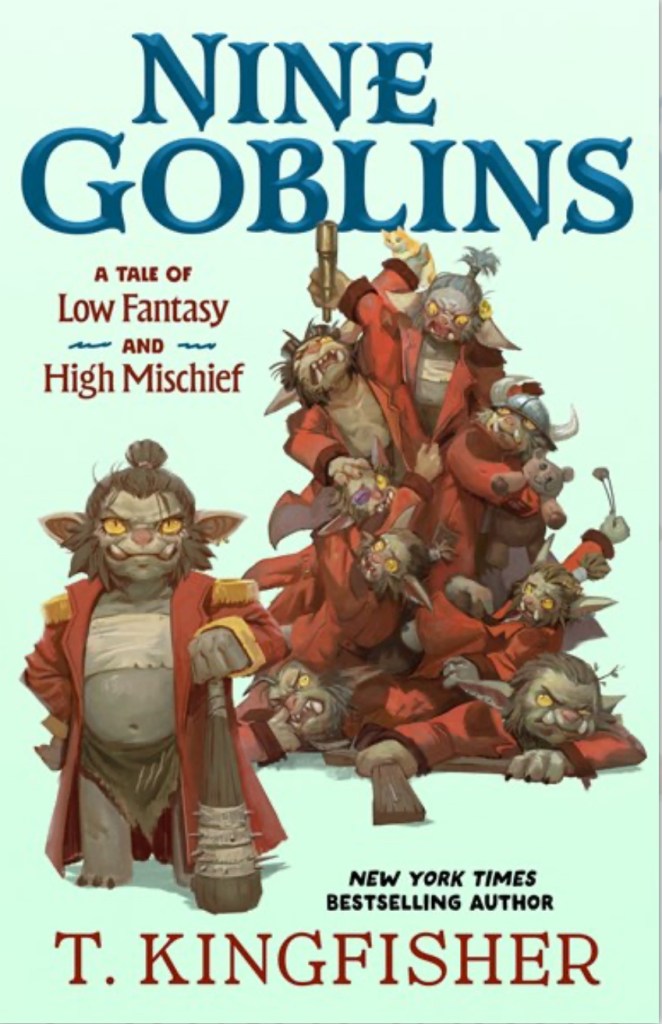
I think it’s clear to anyone who sees the cover of this book that Nine Goblins only works if the goblins themselves steal the show, and Kingfisher does a great job with them. She leans into a lot of the tropes (grubby, stupid, reckless) and builds a culture around these ideas. Sometimes it’s silly: see a pair of identical twins you can’t tell apart? Just punch one in the eye to solve the problem. Other times she simply explores a new cultural norm. Goblins complaining is a sign of affection and compliments. It’s when they don’t even have the energy to speak up about food that you know you did a really bad job cooking. You get to know the crew of lovable scamps who are simply following orders and doing their best to cook some good gruel from a rusty pot. Nobody is particularly deep or nuanced, but you don’t mind it because the whole story (at first) is poking fun at itself.
This book was published 13 years ago. In the time since, retellings and reclamations of villains and monsters as heroes have become so popular as to feel like a worn out trope itself. Despite me reading this book in a rather crowded landscape, Nine Goblins stands out as a story that didn’t fit into the tired trends of other stories of its ilk. In all likelihood, that’s precisely because Kingfisher wrote this before this style of writing became vogue, but it’s worth noting.
What Didn’t Work for Me:
Let’s address the elephant in the room: the first half novella reads a lot like a Terry Prachett novel. It’s got a lot of silly offshoots and one-liners, but ultimately the plot itself takes itself pretty seriously. It uses its comedy as a way to talk about real world issues. Not every comedic fantasy has the stylings of a Discworld story, but this very much does. Unfortunately, Kingfisher’s comedic stylings aren’t as strong as her horror work. I enjoyed Nine Goblins well enough but, as someone who has only read about 5 Discworld novels (and enjoys them, but doesn’t list them amongst his favorite fantasy stories), I kept wishing I’d just read another Discoworld book instead. This vibe lasted for around half the novella.
Then, the story has a rather abrupt tonal shift into something far darker. You get the mangled bodies of humans and animals. The insanity of magic which was a quirky aside becomes something present and tangible. The fun gobliny moments fade back as a more serious plot takes center-stage, separate from the comedic trappings of the first half. This takes us to the climax, whose conclusion promptly sees Kingfisher pivot back to comedy and lighthearted silliness. It was jarring and disjointed. The two halves of the book felt very different, and the first half was (in my mind) significantly stronger.
I’d have liked this novella a lot more if Kingfisher had committed to a more consistent tone. Specifically, I’d have enjoyed seeing something even more absurd and silly than the first half. Something akin to a low-fantasy Minions movie following a goblin military regiment. That clearly wasn’t the book Kingfisher wanted to write, but I think it would have been much more successful.
Conclusion: This novella struggles with odd tonal shifts, but is an enjoyable silly/horrific read that will scratch the goblin protagonist itch
 Marked for Plot