
The Cozy Fantasy/Sci boom seems to have two modes: romance featuring the opening of a small business, and elderly folks solving murders. Unsurprisingly, this is the latter. I liked this book quite a bit, though Mystery aficionados will leave disappointed. The portrait of the generation ship that Dorothy rides on is unrealistic, but an engaging and evocative locale for a series of mysteries to be set in. I’ll read the sequel for sure, as this series feels like a great palette cleanser between longer novels. In terms of Hugo viability? I’d slot this well below Cinder House, probably about equal with Summer War.
The Premise
Dorothy was taking a break from life when the Fairweather’s AI stuck her consciousness in the body of a bank clerk. It turns out the previous host for her new body was tangled up in some shady business, including wiping a shelf of memory archives that included Dorothy’s herself. As she gets used to a new body that she very much hopes to abandon as soon as possible, Dorothy gets pulled back into her Detective work, hoping to solve a mystery that involved several deaths, at least one of which was permanent (not something that’s supposed to happen on this ship).
Read If You: are craving something light and readable, want to follow a stereotypical Auntie solving crimes, enjoy utopian portraits of humanity’s future
Avoid If You: want realistic depictions of space travel or economic models, want the experience of a tightly written mystery
What Worked for Me:
Murder by Memory is exactly what I’m looking for in a cozy mystery. It’s got an interesting narrator who has enough personality to avoid being a self-insert. The prose is light and breezy, the type of book you can chip away at without feeling drained. I enjoyed romping around the ship seeing a bunch of different locations; we got to see a yarn shop! Waite’s writing is great at providing lush sensory details without overwhelming the story with exposition and descriptions. As a Mystery, this book isn’t much. As a cozy Sci Fi with a mystery throughline, I loved it. I finished the book in two sittings and would have happily picked up the sequel if my tower of novellas wasn’t staring me in the face.
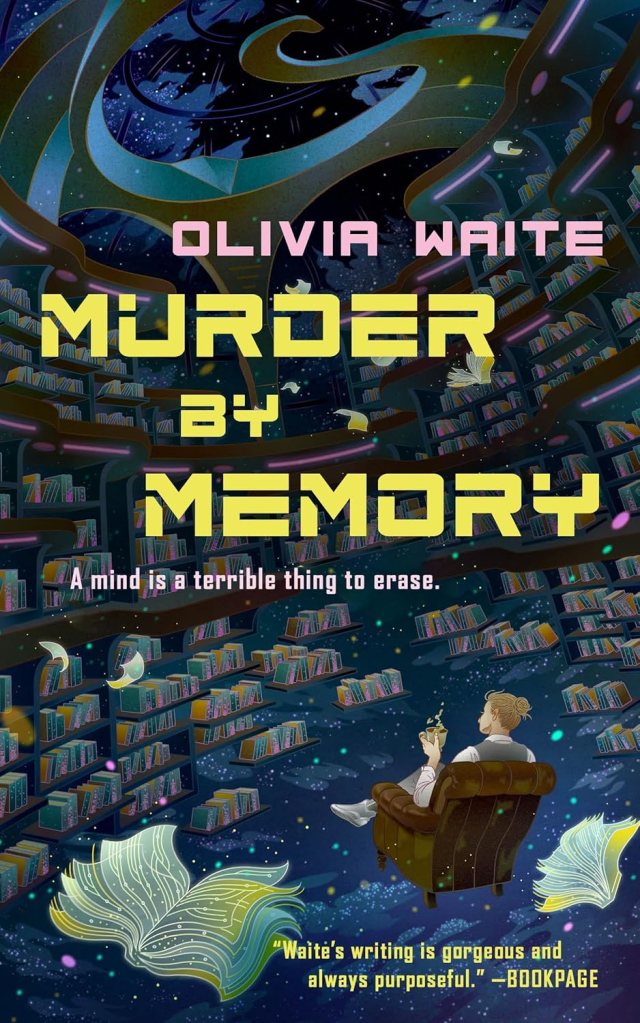
The Fairweather itself is a great setting for a series. The ship is certainly not a realistic portrayal of space travel – they have a bunch of excess housing and aren’t constantly worried about the ship breaking down – but the ship was a more romantic portrait of what an immortal life sailing to humanity’s new home might look like. It’s full of cute little shops, libraries of glass books holding the memories of all voyagers, and gardens to keep people thinking of home. They’ve even got mixologists who specialize in brewing the memories and sensations of Old-Earth in a drink! Just good fun, and a feel-good portrait of the future. There’s been lots of bleak sci fi on my plate recently, so this was nice.
What Didn’t Work for Me:
As I mentioned above, I really like the Fairweather as a setting. The vaguely utopian generation ship was a fun setting, if not a realistic one. However, portions of this self-contained world just didn’t make a bunch of sense. The economy is the big offender here. It’s based on a series of concepts that I generally support (plentiful housing, universal basic income, attempts to prevent billionaires), but within the context of the spaceship setting, these concepts felt brittle. We only see small snippets of this vaguely utopian world. Normally, I’d brush aside how seemingly traditional economies are functioning within such a closed ecosystem with personal automatic fabrication of … anything. However, economics ends up fairly central to the mystery of this book, which drew those questions to the forefront of my mind as I was reading.
The sequel looks like it deals with a mystery baby appearing – reproduction has stopped for this ship on its journey – and I’m curious if I’ll have a similar response to the author’s exploration of that topic. To a certain extent, this has echoed my feelings about a variety of authors entering the Speculative Fiction space who have previously written Contemporary or Historical Fiction; the prose and reading experience are great, but the speculative elements don’t quite hold up to authors who have been immersed in genre writing for longer. Do you really expect me to believe that backups for people’s memories wasn’t a priority? However, this was a fun and short read, and the negatives don’t outweigh the positives for me. For those looking for Science Fiction grounded in logic and scientific principles, this book will likely be a big miss.
Conclusion: a good cozy ‘mystery’ that’s quick, vibe-forward, and light. It falls short on some of the Sci Fi and Mystery genre elements, however.

