
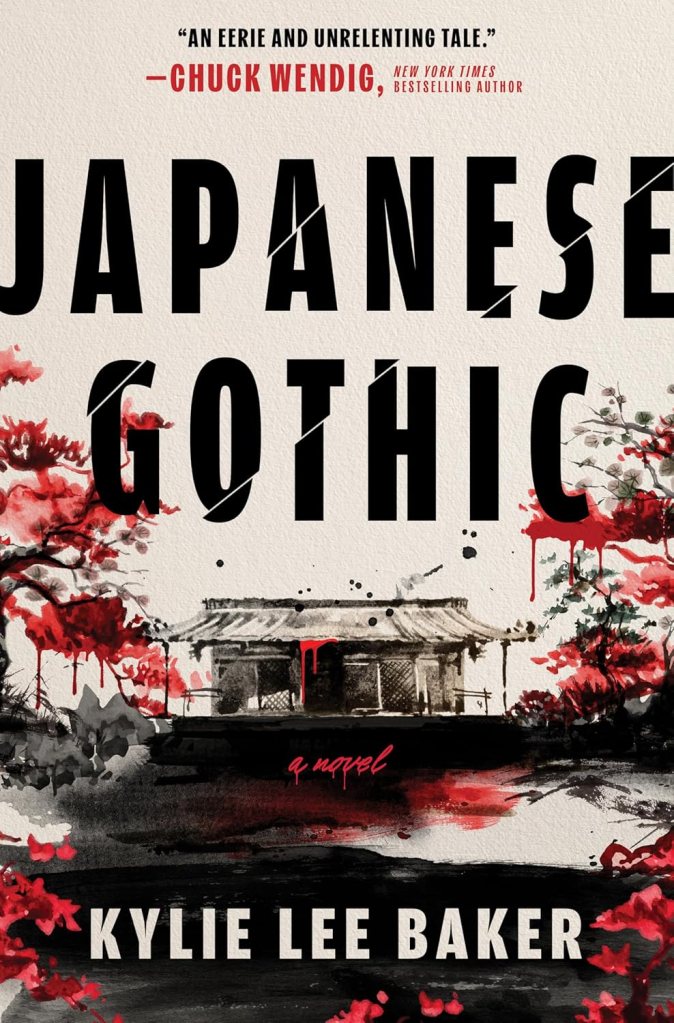
I knew very quickly that this was a new release I wanted to carve out time for. As much as I don’t love derivative naming conventions, I loved Mexican Gothic and had high hopes for Japanese Gothic. Ironically, they are very different types of Gothic fiction, and I don’t think this book references the style of Silvia Moreno-Garcia’s at all. Considering this one is getting a good amount of buzz, I think you can expect to see more [Country] Gothic titles in the future. It’s a shame, because I think Japanese Gothic stands on its own two feet as a really delightful horror story, even if not every element worked for me.
The Premise:
Lee is a college student who fled to Japan after murdering his roommate. His father lives in an old Samurai house with a rotating cast of short-term Japanese girlfriends. Meanwhile, Sen is the son of a disgraced Samurai in the late 1800s, and she desperately wants to live the path of the warrior and live up to her father’s hopes. The world has moved past Samurai, however, and she knows her father’s living breath is a testament to his cowardice, which he takes out on Sen. These two protagonists discover that they can communicate through time. Lee hopes that Sen – obviously a ghost – can give him insight into how he can find the mother who was kidnapped when he was a child. Sen hopes to find details of her family’s fate, for she would do anything to protect them.
Read If You Like: paranormal time travel, historical settings, turtle myths, a creeping sense of unmooring from reality, psychological horror
Avoid If You Dislike: abusive families, unreliable narrators, dead animals, descriptions that feel claustrophobic
What Worked for Me:
Japanese Gothic is a masterclass in slow escalation. The beginning of this story, like the best Gothic tales in my opinion, is slow. Frankly, it’s also not terribly scary. We get some of Lee’s breakdowns around how he killed his roommate, his tragic past concerning his mother’s disappearance, and some portraits of how Sen’s life is one of profound isolation. However, the story slips further and further into the odd. What began as simple time travel shifts into warped visions, the terror of loving (and being) a monster, and a damned red stain that just won’t clean out. Baker tugs at readers, coaxing them with simple prose into an unreality only to release the pressure with a return to everyday life. The story is a constant push and pull of the supernatural and mundane, with the supernatural gaining ground like crashing waves.
I also thought Baker did a great job with abusive fathers. I’ll admit that some current trends in Romance and Progression fantasy have left me a bit burnt out on the asshole parent trope, but it was handled very well here. Lee’s father starts more as a sleazebag than truly abusive; he’s a great portrait of what toxic masculinity can look like in the modern day; hint – it doesn’t mean you’re a shitty gym bro, and the ongoing fetishization of Asian women. Sen’s father is a true masterclass, however. We never truly dip into his head, but Baker captured a powerful character torn by pride and shame. As a girl, Sen will never truly live up to his expectations, and he shows a casual willingness to toss her aside whenever convenient. He will bury her alive, force her to murder animals and humans, and have her maim her own family members, all in the name of hardening her into a true warrior. Sen herself is a reflection of her father, craving the morsels of love and affection he so rarely doles out, internalizing her own brand of toxicity to cope with a hopeless situation. The cast of Japanese Gothic is small but intensely developed, and I think they are the heart of the story, even more than the supernatural horror.
What Didn’t Work For Me:
I do truly wish we’d start putting Author’s notes at the front of a book. I spent the whole book wondering about how accurate of a portrayal Sen and her father were of Samurai. Certainly, large chunks of this book feel closer to Historical Fiction rather than something supernatural. She addresses this (sort of) in her afterward, talking about how he isn’t indicative of all Samurai, but is meant to show a specific type of Samurai’s reaction to their privileged caste being removed. I still have no idea whether it’s accurate or not, but it would have been nice to have this insight near the start. I’m better about checking this with physical books, but I rarely remember for audiobooks or ebooks.
When the book ended, I found myself wishing that we’d either focused on just Lee or Sen. The explanation for how and why Sen and Lee are connected is … fine. However, aside from a few short visions, I thought the strongest parts of the story were Lee and Sen’s stories in isolation, not when they intersected. The twist was clever, interesting even, but was let down by the fact that Lee and Sen’s connection felt so much less meaningful than any of the other relationships in the story. In the end, I wish the book had been a simpler haunted house story with many timelines, rather than something more bespoke. Had I cared more about Sen and Lee’s interactions with each other, I think I’d have liked the ending to this story a lot more. There’s enough great imagery and writing to make the book worth it, but this one just didn’t quite hit the mark with its ending.
Conclusion: two excellent horror stories, though I didn’t care much for how the author connected them together


Im sorry to hear that you weren’t a fan of the ending. I loved how it tied things together and thought it was really cleverly done, but I know not everyone is a fan of this kind of thing. Im glad you enjoyed each of the stories individually though. I couldn’t believe just how steeped in trauma both timelines were.
LikeLiked by 1 person
I think I sometimes get unfairly nitpicky about twists near the end. I can’t say there’s anything objectively wrong with how Baker chose to tie things together (it makes sense, especially for Lee’s storyline). When I look at most people’s thoughts about the book, I think overall consensus is that the connective tissue was a plus for the book.
I definitely did not expect trauma to feature as much in this story as it did. Sen’s storyline I caught on fairly quickly, but Lee’s snuck up on me. It was super visceral, and a really powerful bit of storytelling
LikeLiked by 1 person