This book was a pressure cooker, and I’m so happy I read it. I’m slowly realizing that the romances that I love are the ones that take things seriously, instead of going on autopilot. Whimsical and campy romance is great, but I don’t typically have very much interesting to say about them, whereas this might be my longest review of 2026. There was so much that delighted me here, that pushed me to rethink what romance books could accomplish. It also fell into some really basic pitfalls that annoy me, and the ending was sloppy. I think its absolutely worth a look for anyone interested in a serious take on interspecies romance, but if solving systemic issues with a single conversation annoys you, be on guard.
The Premise:
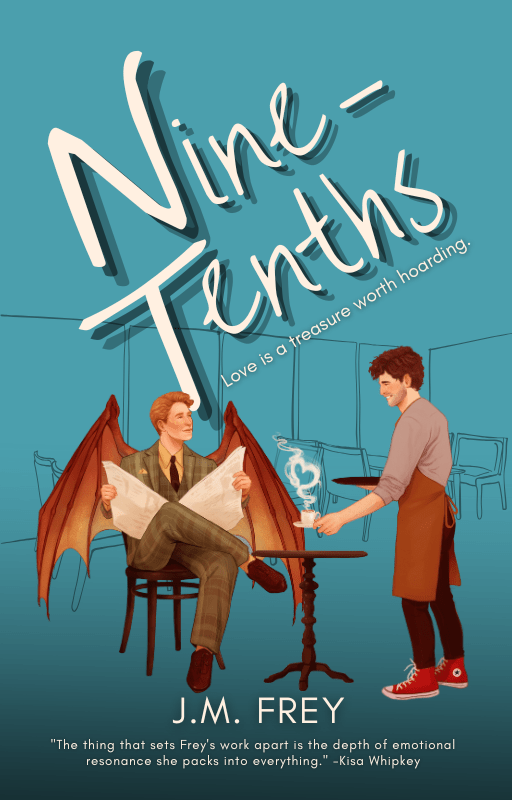
Colin is a barista who is listlessly wandering through life and depression. One of the only perks is the hot and slightly creepy guy who has watched him while drinking coffee for the last two years – Colin has reciprocated those looks. When it turns out that Dav is actually a dragon, the coffee roaster gets melted with dragonife, and Dav volunteers to help out after paying for a new roaster to be shipped in, their romance kicks into high gear. However, relationships to dragons mean something very different than to humans, and that means the duo has a lot to work through.
Read If Looking For: protagonists to have tough conversations and return to them, a peek into draconic psychology, defeating the brain weasels, badass Lesbian aunts
Avoid If you Dislike: miscommunication, unscientific evolutionary biology, easy endings, coffeeshop romances, stuffy British formalities
Comparable Media: Dawn, Looking for Group, Heart of Stone
Content Warning: despite the cosy cover and blurb, this book has a lot of situations that are analogous to abuse and slavery as Frey explores what a dragon/human romance might look like when it isn’t all sunshine and roses. Dav physically harms Colin at one point in the book. I think readers will be split on whether or not Frey handles this well. There’s also plenty of focus on mental health challenges for both characters, and it’s heavily implied that Dav struggles with suicidal ideation.
What Worked for Me:
The back cover of this book will try to convince you that this Romance has a focus on Colin and Dav exposing the secret medicinal properties of dragonfire to the world. This is unfortunate, because that little plotline is probably the least interesting part of the book. It’s not bad, but it’s kind of a bog-standard Romance B-Plot. What makes Nine Tenths special is the way it dives into romance between two species that are hardwired in fundamentally different ways. Full disclosure: human x nonhuman romance isn’t something I’ve read a ton of; it is entirely possible that everything in this book is a well-written rehash of tropes that have already been explored. However, in most books of this type I’ve read, the monster ends up feeling a bit too human for my taste, and the relationship challenges could easily be mapped onto human/human pairings. Dav may look like a human for pretty much the entire book, but it’s very difficult to forget that he’s a dragon, because Frey doesn’t let you forget how differently he sees relationships than humans.
Frey builds the book around the idea of dragons loving to hoard things. What if they hoarded humans? What would society look like if a significantly more powerful (but less numerous) species saw humans as part of their hoard? Dragons care for their hoard, usually meticulously, so it would make sense that they would try to prioritize the wellbeing of their communities, just like they make sure their coins are shiny. How does this translate to their relationships with humans, who have a very different understanding of what freedom means than dragons? And what if, despite all this, romance could still happen?
These are not lightly brushed over issues: Colin and Dav get into frequent arguments about their lack of understanding of how the other shows love. It takes Colin setting frequent boundaries around language and why Dav’s words make him uncomfortable before Dav gets the message. Dav struggles to articulate how his relationship with Colin is based on love and not a desire for power over another person. They struggle to figure out how to bring Dav into Colin’s life and find a way for Colin to enter draconic society on his own terms. It truly felt like Frey managed to capture a different type of brain, and pushed those characters to very publicly (to the reader, not the world) work their way through the types of challenges inter-species relationships would likely face. Relationships are work, and by the end of the book, nobody can claim that Dav and Colin haven’t worked at it. I, and most readers, are probably going to spend the vast majority of time agreeing with Colin: not only does his understanding of romance match with ours, but we’re also in his head and not Dav’s. Frey dances on some very fine lines, and plenty of readers will dislike everything about this story. The title is a fun wink at ‘Possession is Nine-Tenths of the Law’, so imagine that idea injected into Romance books. I appreciated that she was dedicated to actually exploring this idea seriously instead of treating it as a fun aside to the main plot of falling in love. Dav is a bit unknowable, kind of infuriating, and frustratingly non-human. It’s great.
I think the romance only works because I believe the two are in love. Colin and Dav both have shit they’re going through, namely depression (though Dav is largely in denial and undiagnosed). This is one of many complicating factors in their relationship, but it became clear that they both had lives outside of each other, something I always look for. The pair consistently makes the choice to try and prioritize each other and keep their partner’s best interests at heart, even when they’re fucking things up spectacularly. The beginning of the book was a bit instalove for me: I would have loved a montage of the two years Dav was hanging around the coffee shop! The classic romance plot beats get mixed in with more serious elements, but the constant grins and flirting are written oh-so well. They have so many good reasons to walk away from each other but keep renewing their commitment. I could have used a few less comments about erections, which were nonstop. Other than that I really bought what Frey was selling. Good chemistry, not too syrupy, just the right amount of focus on tropes vs trying out new things. Plus this whole book was so gorgeous and beautifully readable!
Final notes, otherwise I’ll rave about this one for a long time. I love how Frey handled the worldbuilding. There were a few times early where I cocked my head to the side because something felt off. Are we in Canada or America? What’s going on with these dragons, who seem to be mysterious (and rich) shepherds of humankind’s growth? Also the dragons mirror human ethnicities? Turns out history plays out differently, America is mostly just the south, and much of what we consider the northern US is Canada. Britain is still the main colonial power, and their history of exploiting indigenous people (and dragons) hasn’t changed much. The book engages lightly with indigenous agriculture and Land Back movements. All of this, plus plenty of details about how many different versions of draconic culture function in relationship with humanity, is drip fed to us. I love withholding the infodumps and letting the reader put together pieces until a more appropriate time to give more direct exposition.
What Didn’t Work For Me:
Do you hate it when books rely on withheld information and miscommunication to ratchet up tension? I sure do! And it was everywhere in Nine Tenths. Colin frequently takes actions that lead to bad results for him and Dav because he doesn’t understand some really fundamental elements of draconic culture. This is great; see my earlier paragraphs on how the navigation of fundamental cultural and biological differences is one of the things that makes this book really stand out. However, usually this is a result of Dav not laying out some really basic ideas to Colin. It’s waved aside as Dav growing up in a society where all humans were raised in draconic culture and understood the norms. However, Dav will frequently share things at the last minute, like when they’re walking into a ball and Dav is giving impromptu lessons about etiquette at a draconic ball. Just have the conversation at home dimwits. There are a few times where Colin lacking information was smartly done and made sense, but typically it just made me want to throw my book at the wall. There were some very lazily written conflicts in a book that had set the groundwork for so many better options to get at the same tension.
I’ll also admit that this book had a host of small annoyances that bugged me. It featured the oh-so common anxious bottom POV character paired with a hunky top – though I appreciate both Colin and Dav got actually fleshed out personality wise – which was the first of a few red flags that went up in how gay characters get written. This is the type of m/m romance that I’ll consume greedily, but it didn’t ring as inherently, fundamentally queer. That’s okay: most m/m romances aren’t. But I always get a pang of disappointment when a book that is otherwise thoughtful and intense doesn’t give that same level of care to the identities of our protagonists The author includes some meta-narrative stuff where Colin comments on the different beats of storytelling, such as teaching the reader what an inciting incident is. I’ve seen this type of metatextual awareness work well – A Fractured Infinity by Nathan Tavares comes to mind. Here, it felt mostly slapped onto the start of a few chapters as a pressure release valve that sucked the energy out of the story right when it hit the good bits. There’s also a weird minor plotline about how dragons and humans descended from a common ancestor (one towards reptiles and the other towards mammals), that makes zero sense with how evolution works. Just slap magic on as an explanation, and it would’ve been fine.
Finally, the ending. Up until the final 50 pages, I was convinced this was going to go on my favorites list despite having some qualms. However, the quality took a sharp nosedive in comparison to the rest of the book. Some of this was just disappointing: once we enter the climax the tone shifts to a light more campy romance book, replete with extended monologues from hero and villain alike. It lost all sense of nuance, provided easy answers to some thorny systemic questions, and just felt so much less interesting than everything else that had happened. Our villain went from a skilled political schemer to one of the dumbest characters I’ve had the misfortune of meeting, I also took pretty major issue with the villain’s ending. Without spoiling too much, he gains visible disabilities and scarring to match how everyone sees how rotten he is on the inside, which even gets acknowledged (and celebrated) by the narrative. I always hope we’re past assigning these visible traits to villains, especially since draconic healing works great on Dav but not the villain? It was in very poor taste. The ending also falls into the classic fantasy trap of ‘monarchies are fine as long as the monarchs are good people’, which is frustrating considering how engaged this book is on other issues.
Conclusion: A potentially thorny romance, but Frey captured me by embracing a challenging topic instead of running from it.


One thought on “Nine-Tenths – Exploring the Complexity of Draconic Love”