
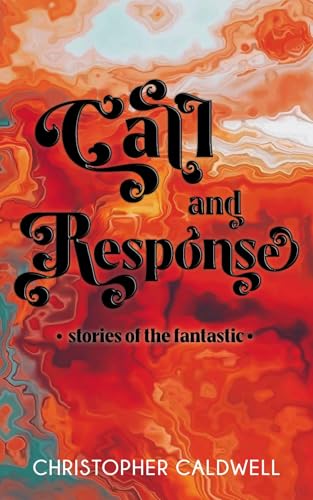
Call and Response is a fairly new anthology of short stories by Christopher Caldwell built around a delightful premise: what if each story comes in a pair? In Call, Caldwell introduces characters and worlds, only to return to them in Response. Sometimes these appearances are small cameos, other times they are directs sequels. Call and Response is unapologetically black and queer, with several stories sneaking semi-autobiographical details into the fantastic. This collection won’t satisfy those seeking the tight research of Ted Chiang or the experimental forms of Isabel Kim. However, Caldwell’s stories are candid, intense, and thoughtful. I’d love to see what he can do with a full novel.
Read If Looking For: stories of black resilience and rebellion, diverse representations of queerness, aquatic motifs
Avoid If Looking For: experiments in form or structure, answers to broken systems, unambiguous endings
Comparable Media: Convergence Problems, The Fox Roads, Ivy Angelica Bay
Reflections on the Collection as a Whole:
There were a few throughlines in this collection. Oceans and water certainly make more appearances than I’d have expected for a collection that isn’t explicitly set up around that theme. However, I think the real through line of these stories is what we owe each other. Sometimes the stakes are personal, actions taken with close relationships driving characters to take radical action. At other times, Caldwell explores how you don’t owe those who abuse you kindness or understanding. But these stories always remain deeply personal, and the characters Caldwell writes rise to the needs when the stakes are so individual to a person’s situation.
You’ll find vengeance more than forgiveness in Call and Response, and that vengeance can’t be separated from Caldwell’s explicit focus on the experiences of Black (and often Queer) Americans. The first story, Femme and Sundance, opens with our protagonist walking into a rural midwest diner where bigotry hung thick in the air. It was a portrait of how hostile ‘midwest nice’ can be to those who are deemed Other. As a rural Kansas boy, Caldwell nailed the atmosphere in a way few authors capture. Other stories tackle slavery, the degrading of black hair, and the family pressures for a young boy to be properly masculine. Call and Response doesn’t focus on the characters making system-level change. Instead it focuses its spotlight on characters fighting for their place in the world and refusing to accept dehumanization.
While Caldwell did a great job of differentiating voice between narrators- something I always look for in anthologies – the collection kept to a very consistent form. The stories are straightforward: the most complexities you’ll find are bouncing back in time or writing in dialect. Anthologies don’t always need stories that take huge structural risks, but I like reading those stories (if you don’t like it, its short!) and wished Caldwell had taken one or two of the stories in stranger directions.
The Short Stories (Presented as their Pairs)
Femme and Sundance: a couple goes on a wild-west style crime spree with the help of some magical artifacts. A story full of life, without feeling the need to make our protagonists ‘good’ all the time.
Miz Bourdeaux’s Last Ride: one of two stories that is more or less a direct sequel: we follow the couple from Femme many decades later, dealing with their unnaturally aging bodies. It was a great epilogue to a really sweet couple.
The Lonesome Sea: a young slave is turned into a cabin boy, learning how to handle himself at sea while maintaining relationships with his people’s god of the deep ocean. This was my favorite story from Call, and it all clicked for me.
Canst Thou Draw Out The Leviathan: a whaler and a carpenter keep their relationship secret while their vessel goes out to sea. It features sea gods and whales and the hero from The Lonesome Sea.
The Beekeeper’s Garden: a young black girl is trapped in the home of a woman with magic bees. How white folks – especially those with authority – police black hair and degrade natural hair textures is a core part of this story, also featuring lots of talking to plants. I thought things fell off a bit at the ending, but enjoyed most of it.
Counting Her Petals: this is the other direct sequel we get. We follow the girl, now an adult, navigating a relationship with a trans woman who is retreating from the world into a virtual one. It bounced between three timelines, including a retelling of The Beekeper’s Garden. I kind of wish it had been more laser focused, and I don’t think the retelling was necessary when presented in tandem with the original story.
Serving Fish: a take on The Fisherman and His Wife where the protagonist fills both human roles- we love a drag queen. A good take on a classic ‘make a wish’ format.
Deep Like the Rivers: a mother struggles to parent a child obsessed with the ocean (and gay). A heartfelt story following a character who doesn’t get it right, while still acknowledging her humanity. I cried. No notes.
If Salt Lose It Savor: This should have been my favorite in the first half: it focuses on a character who processes magical ingredients used for war spells, only for her to realize her part in creating magical nukes. I thought the setup and conclusion were both strong, but I wish there had been more intensity in the ‘realizes what I’m a part of’ portion of the story. I was so close to adoring this one.
The Calcified Heart of Saint Ignace Battiste – An acolyte spies on one of the most sacred rituals of his cult’s order, revealing a secret that shifts his view of his religion. As with If Salt, I found this one a bit lackluster in the moments that were supposed to be the most intense/emotional. They’re also the most ‘high fantasy’, which should be my jam, but I also don’t experience much high fantasy in short format.
Conclusion: a straightforward collection about what we demand from our world. Also featuring lots of water.


One thought on “Call And Response – An Anthology of Duets”