
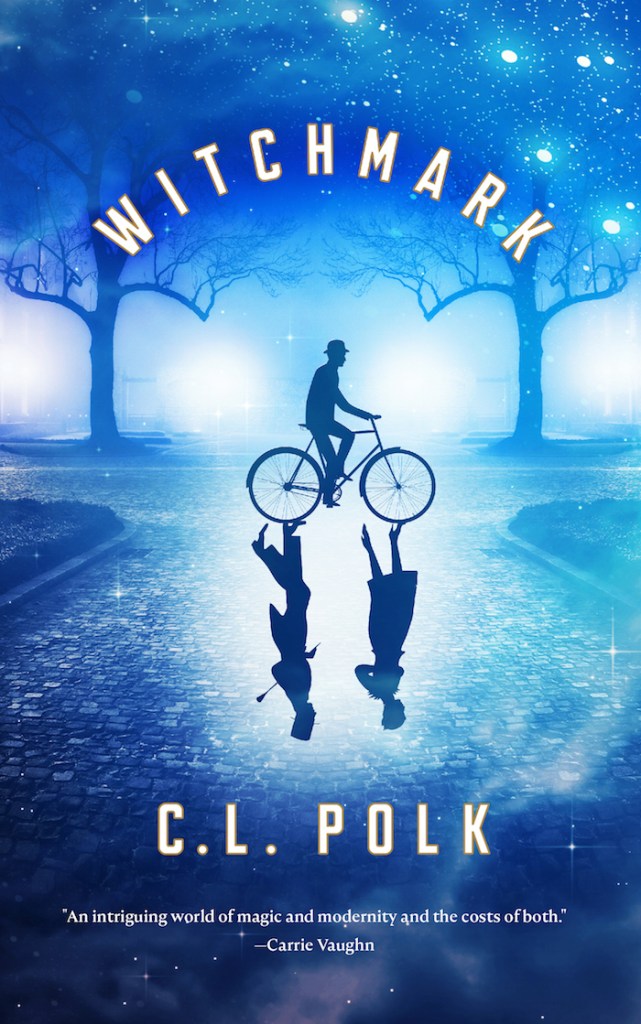
I’m not sure why Witchmark languished on my shelf for years. I already know that I love Polk’s writing, and Witchmark was on the forefront of queer content from Tor and Orbit releases right as it was starting to become more commercially acceptable for traditional publishers to put out queer books. It was one of 12 books I committed to read in 2026, and I’m glad I did! It sits in a setting I’ve not read much of (World War I adjacent, time period wise, though not set on Earth), but I think I need more bicycles in my fantasy. I don’t think I loved it quite as much as most others, but I had a great time and will be chasing down the sequels for sure.
The Premise:
Miles has a gift for healing. Unfortunately, his magic doesn’t involve controlling the weather, which means he had to run away from his aristocratic family and fake his own death to prevent his father from turning him into a glorified magical battery for the Storm Singers. He’s now a Doctor who focuses on mental health in a veteran’s hospital. He gets yanked back into his old life when a dying man is brought to him, a man who knows that Miles has magic. And the gentleman who brought that dying man also seems intent on the secrets that Miles has so desperately kept. He needs to solve the man’s murder, lay low, and prevent his sister from binding his freedom to her whims.
Read If Looking For: a story set after the war has ended, an oppressive oligarchy that hits a bit too close to home, grounded and messy sibling dynamics
Avoid If Looking For: a mystery where you put the clues together, deep explorations of PTSD, developed romance arcs
Comparable Media: Howl’s Moving Castle, A Marvellous Light, Full Metal Alchemist
What Worked for Me:
Polk has always had a gift for prose that is clear, grounded, and evocative. This story has many significant elements that could have felt very dramatic: soldiers returning home from war with PTSD, magical enslavement, a creature whose very appearance is dangerous to look upon. Polk takes these and makes them feel serious and weighty. It doesn’t feel like Miles’ quest to keep his independence is a mere plot point, but rather something woven into his identity so deeply that he can’t find a way to disentangle himself from it. Polk does not carry a hammer in their writing toolkit, but rather a screwdriver. The pieces of Witchmark fall neatly into place at their own pace, untangling a single plot point and setting detail at a time. Relationships – especially the sibling relationship that’s so key to the second half of the book – feel messy and tangled and full of history. Polk doesn’t pontificate on the ethical failings of the world to make a thematic point in ours; instead, they simply present situations and conversations, allowing the reader to see the connective tissue that makes Witchmark very much a commentary on our own world.
Another highlight of Witchmark is the setting. I’m not sure how much my enjoyment of the post-WWI setting is Polk’s writing vs standing out by virtue of me rarely seeing it. You get a decent amount of time following Miles around on his bicycle (including a chase scene!), a newspaper industry that’s completely faded from existence in our age, and a sense of urban pastorality. It’s this weird blend of idyllic and dystopian, and I really vibed with it. Despite Miles’ life falling to pieces and the world being objectively stark, it was calming. This blend of mellow writing with high stakes and interesting character dynamics made Witchmark stand out in a really fun way, and it feels like it has much more in common with pre-2000s novels than ones written in the 2010s.
What Didn’t Work For Me:
While I think there are a lot of things that Witchmark’s light touch gets right, I’m not entirely sold on its depiction of trauma. There’s a lot going on here, and I very much appreciate the focus on how war impacts soldiers’ mental health, but when it came to Miles himself, the character whose brain we sit inside, it didn’t feel like the pieces fit together in a way that made sense. Part of Miles’ tragic backstory (and there’s a lot of tragic backstory to Miles) is that he spent time as a prisoner of war. While there, he was forced to repeatedly heal torture victims so they could undergo more torture. This more or less felt like a throwaway plot point and motivator for Miles, but he doesn’t particularly read like someone who is still processing trauma. To be clear, trauma affects everyone differently and representation shouldn’t be a monolith, but I would have liked to see more engagement with Miles’ own relationship with trauma considering how prominently his role in helping others work through their own trauma is to some early plot points.
In the romance department … Witchmark was fine. Thankfully not the main focus of the book, otherwise my ambivalence about our main couple would be a lot bigger of an issue. I will credit Polk for featuring flirting instead of springing for instant love, but I never quite felt the tension of desire and restraint that it seemed like they were going for between Miles and Tristan. It looks like sequels follow different characters, which I think I’m happy about. I enjoyed my time with Miles, but I’m happy to move on!
Conclusion: Enjoyable with a fun setting, but perhaps didn’t blow me away

