
Robert Jackson Bennett is currently getting laude for his Shadow of the Leviathan series (which are quite good on the whole). However, I think his Divine Cities Trilogy is by far the superior work, even if it’s taken me about four years to read the entire thing (I wrote in my review of book 2 that the finale would be ‘a priority for 2024’ yet I’m only getting around to it in 2026). These books are unlike anything I’ve read. The prose is straightforward enough, Bennett’s thematic work is ambitious and so very different from the examinations of imperialism we see in the 2020s, including his current series. It’s the type of mind bending and ambitious fantasy I love to read, and it safely sits as some of my favorite books in the genre.
Read if Looking For: spycraft/action hybrids, competent protagonists, weird gods, thorny questions without easy answers
Avoid if Looking For: direct sequels, purely happy endings, John le Carre style bureaucracy spycraft, straightforward morality
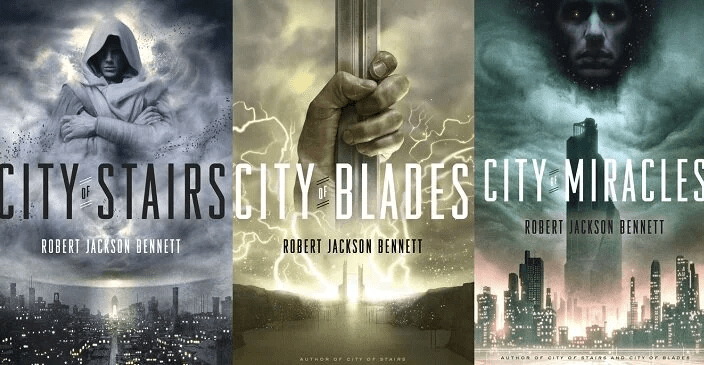
Elevator Pitch:
This trilogy is set in a world where Saypur’s Empire controls much of the world, including ruling over The Continent. This is ironic considering The Continent used to subjugate Saypur just as badly when its Gods still lived (or was more cruel, depending on whom you ask). When Saypur’s mythic hero killed the Gods however, their miracles failed, causing a cascade of unintended and inconsistent consequences. What’s left is a tangled mess of anger and frustration on all sides, and a lot of power available for those clever and sneaky enough to grab it.
Book 1 focuses on Bulikov, a broken city visited by a Saypurian intelligence agent investigating a murder. Book 2 travels to another city on the Continent and mostly focuses on a side-character from book 1 several years after. In that book it follows simmering tension and rebellion in that city. Book 3 follows yet another side character from book 1 over a decade later on a revenge mission. While not necessarily ‘direct’ sequels picking up the story where the previous left off, they do form a cohesive narrative when viewed as a whole. Ironically, this structure made the books ideal for me to read in such a disjointed manner as I did.
What Worked for Me
It’s tough for me to ignore just how compelling I find Bennett’s take on colonialism and imperialism. I feel like we’re in a bit of an Anti-Imperialist streak with lots of fantasy right now, which I love. Plenty of those books explore the many and nuanced ways that empires can oppress on systemic, individual, and generational levels. This book complicates that, by weaving into its history an inversion of roles: the conquered become the conquerors, and they haven’t forgotten what was done to them. Are they any better than their predecessors, however? It’s tough to say that they are. This allows Bennett to say things about power more broadly than many of the more recently published novels, and I’m admittedly vulnerable to the idea of the corrosive nature of power on a person’s (or society’s) ethics and morality. These books typically reject the idea that any culture or government can be wholly right or wrong, instead invoking the messiness of war and retribution alongside the difficulty of achieving lasting peace or healing.
I also love how fucking weird this world is. The Gods in Bennett’s world range from interesting takes on traditional concepts (an ultra-orthodox god of law and justice) to the bizarre (a gender bending sparrow god), and their miracles go far beyond what one might immediately expect. The entire continent is warped by their influence, and you never quite know what the characters are going to encounter, even though the gods have been killed. Yet those miracles which survive are both strictly regulated by the Saypur government while also abused and weaponized by them when convenient. You’ll encounter plenty of oddities while exploring these books, and they do a phenomenal job of imagining a world where all-powerful gods aren’t interested in playing by the laws of physics.
Story-wise, I’d probably classify each of these books as Fantasy/Thriller hybrid books with spycraft elements. It’s a more sensationalized view of intelligence agents than would likely actually happen, but each book centers itself around unpicking Divine Mysteries that go far deeper than they originally seem. There will be plenty of near death experiences, and Bennett does a good job of interspersing brutal violence with a slower paced unpacking of the unknown. Our three protagonists are all competent in their own ways, all professionals who bring a unique and diverse skillset to their books. They’ve also got their own blinders and biases that keep them from making connections too soon. While I sometimes connected dots before our characters did, the payoff was always worth the build.
What Didn’t Work for Me:
It’s perhaps telling that this series took me almost half a decade to read. While I liked or loved each individual entry, I clearly didn’t feel a compelling need to pick up the sequel and see what happened next. This can partially be attributed to how few sequels I read these days, a large change from the COVID years when I obsessively consumed Brandon Sanderson’s entire catalog. Looking back at my thoughts on book 1, it fell into ‘good not great’, which may have affected my lack of urgency. And when I place this book in conversation with my other favorites, there’s a slight spark missing. It’s more thematically complex and compelling than a lot of other work on that list, but it didn’t consume me the way that authors like Simon Jimenez, Alexandra Rowland, Fonda Lee, and Nathan Tavares have. In the same breath however, I can freely admit that the game I’m running for my regular role playing group is heavily influenced by both this series and The City that Would Eat the World.
I think the only thing I might hope for in hindsight is one of the books to focus on a character raised on The Continent. As it stands, two of our three protagonists hail from Saypur, while the third is a Dreyling (vaguely Nordic coded, and a society typically a spectator to the great powers, but less directly subjugated). I think the books are good about providing the perspectives of people from the Continent – that’s why I like Bennet’s thematic work so much – but it would have been nice for the sake of symmetry to get some POV representation from those who currently live under the thumb of another.
Conclusion: Ambitious and daring, with phenomenal worldbuilding. It is absolutely worth the time to set aside for a complete trilogy


I’ve never gotten around to reading the third book, but this may be the kick up the arse I needed! Though I agree, the lack of an overarching arc is a downer. He’s done that again with the Leviathan trilogy, which was so disappointing (to me). I guess it’s clearly his preference though, at this point he’s written however many standalones and two trilogies of standalones? The Order of Founders trilogy is the only thing he’s written with a noverarching plot, I think. So maybe it’s just his preferred style of storytelling?
I remember there was such an uproar about the Kill Your Gays in book one, but with both his series since then featuring queer protagonists it seems like he heard the critique and course-corrected, which I massively appreciate.
I loved the Leviathan setting in book one, but I think now that it was the newness factor, because it’s not a setting I have any urge to revisit. The feeling of ‘this is so cool!’ didn’t last, for me. Whereas I still adore the Divine Cities setting so much. And you make a really good point that that trilogy stands out amongst all the anti-imperialist stories we’ve had the last decade or so. It would be really interesting to pit them in conversation against, I don’t know, Broken Earth and Stormbringer Saga and whatever else, compare them all and see what comes of that!
LikeLike