
Watchmen has been touted as one of the best comics to come out of all time. Historically, many such novels lauded as ‘all time bests’ in the fantasy and science fiction genres have not lived up to the hype for me. Watchmen however, feels like the real deal. It’s dark and gritty, a take on superheroes that feels more nuanced than other deconstructions of superhero stories I’ve seen (such as Hench, Steelheart, or The Boys, all of which I very much enjoyed). It’s tough to read in a lot of places, and not a story I was interested in binge-reading. However, the juice was absolutely worth the squeeze, and I think it has a lot of important things to say about America and its fascination with superheroes.
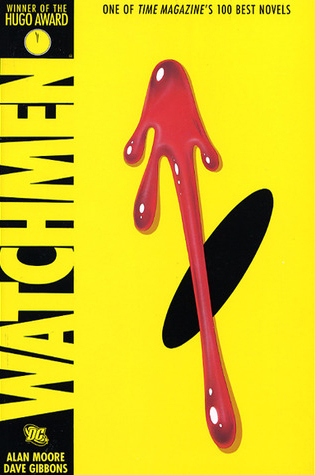
Read if Looking For: layers of theme, episodic chapters, cold war stories, low powered supers (mostly), comics that get studied at colleges, epistolary comics
Avoid if Looking For: mindless fun, protagonists who are good people, books free of sexism and homophobia, diverse protagonists
Elevator Pitch:
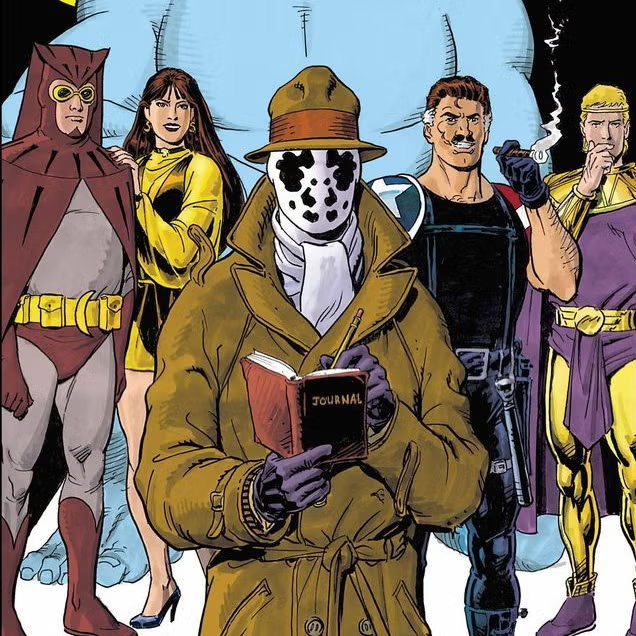
This story bounces back and forth in time, but mostly sticks in an alternate version of the 1980s. It follows the lives of superheroes far past their prime, and after the practice has fallen out of style. Woven in between their individual stories (including plenty of flashbacks to the not-so-good old days) is an investigation/conspiracy theory that these former-supers are being targeted , a brewing nuclear war between the US and Russia, and in-universe texts ranging from memoirs to news articles to pirate comics. The key players are
- Rorschach: a still-active super with serial-killer tendencies)
- Jon/Doctor Manhattan: the only one with actual powers, an inhuman force leveraged by the US government as a pseudo-atomic bomb
- Laurie/Silk Spectre II: former super, but now Jon’s significant other, trapped in the relationship by the US government to help control Jon)
- Dan/Nite Owl II: a batman esque figure who relies on elaborate gadgets Also retired
- The Comedian: a nihilist superhero who did anything the government asked him to, whose death kicks off the comic
- Veidt/Ozymandias: a retired superhero who used his genius to turn himself into a billionaire businessman
What Worked for Me:
This book was a phenomenal take on superheroes. At its most basic level, Watchmen posits that well-adjusted people aren’t going to put on spandex and fight crime. There’s a few likeable/good people, but the core cast includes attempted rapists (which assumes they succeed at some point), homophobes, extraordinarily violent individuals, men who leave their partners to start dating 16 year olds, etc. The best of the bunch was pushed into this life by her superhero mother and doesn’t have an identity outside of that world. Moore doesn’t get preachy about how horrible these characters are; he just lets them exist as the type of human beings who would probably end up taking on the superhero lifestyle. After all, how many of you are fighting crime at night wearing an Owl costume?
Probably my favorite character was Jon, the only person in the world who ended up with real powers – given through a pretty typical lab accident gone wrong origin story. He’s rendered wonderfully alien, including a phenomenal chapter entirely from his perspective that did a great job fucking with my perception of time (fans of Story of Your Life by Ted Chiang will enjoy Jon a lot I think). Jon is leveraged by the US government as a deterrent for Russia, and is more or less turned into a chess piece devoid of much independent drive to better the world. His sense of ethics and morality is so contrary to ours, and I found his perspective to be a refreshing slice through the graininess of the rest of the world.

I think it’s important to place Watchmen in the context of American comic book history. The Comics Code Authority had a stranglehold on comics for decades, allowing only sanitized and happy comics – and centralizing superhero stories over previously dominant genres of comics like horror. Protagonists weren’t allowed to engage in crime or overly violent behavior. You couldn’t show the humanity of people breaking the law. You couldn’t show the government, police, judges, or often parents in a negative light. That left us with a version of superheroes that was fun and meaningful and wonderful, but ultimately consistent in tone and style. By the time Watchmen came out in the mid 80s, the Comics Code Authority’s power had begun to wane, allowing Watchmen to be published. It is more or less a direct rebuke, deconstruction, and alternative to what came before. It was interested in deep explorations of power, contemporary US politics, and morality unbound by the constraints that had a stranglehold on the industry for decades. It succeeded masterfully.
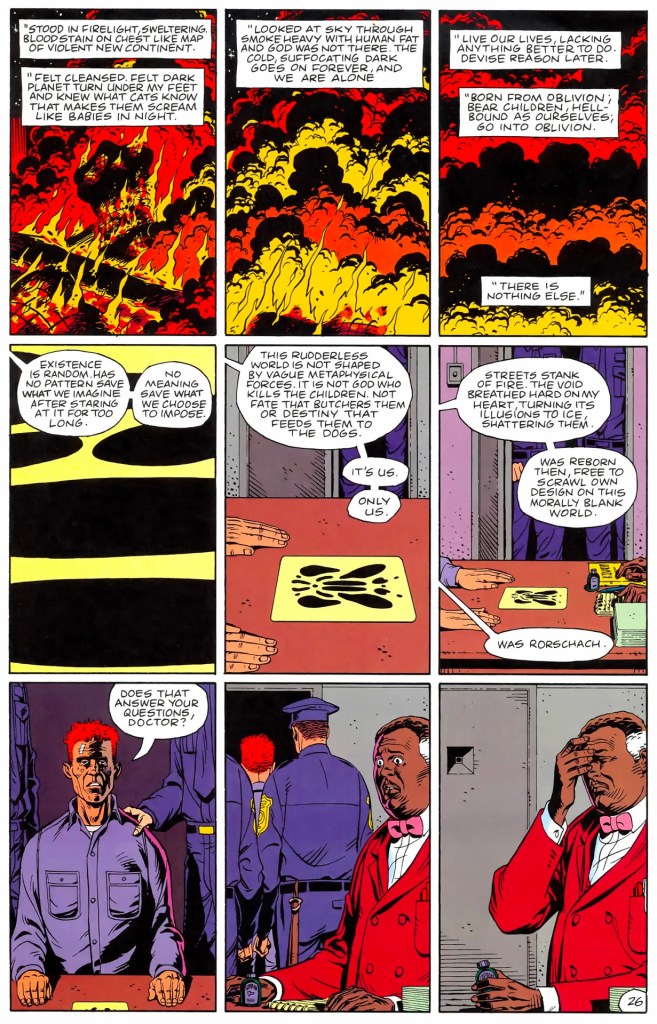
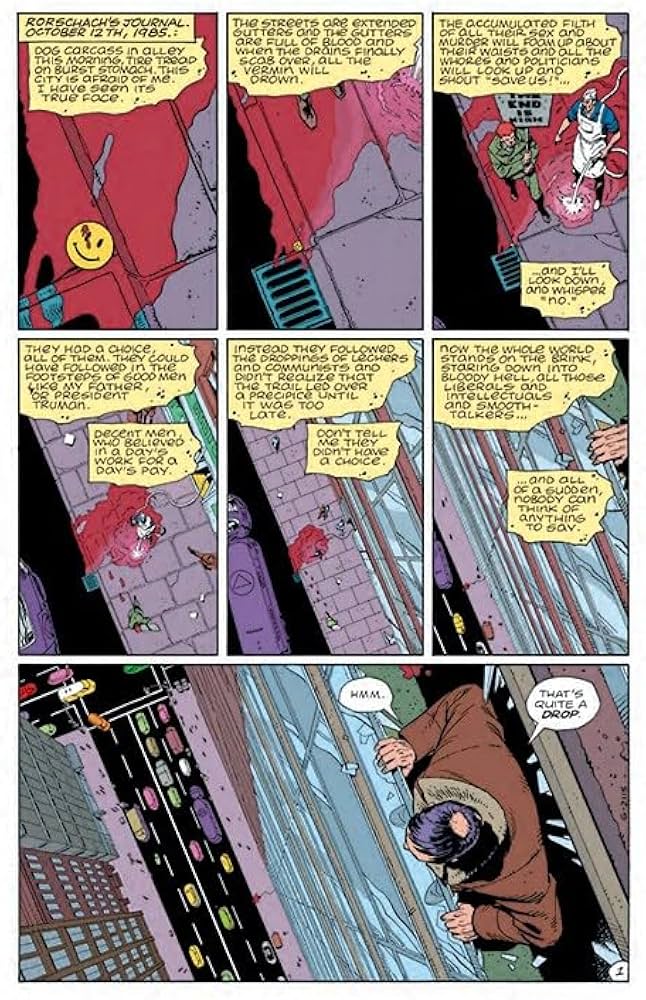
The art of Watchmen was a triumph as well. I tend to dislike comics that use simple panel layouts. This showed me that basic layouts can work really, really well. Almost every page is an identical layout of 9 equally sized rectangular panels. However, Dave Gibbon’s artistic choices are captivating. This is not a comic where the art is simply illustrating what happens between dialogue. Instead, it is just as much a driver of the story and theme as the text. It feels as if every panel got vetted: how could color or perspective be used to enhance the mood of this panel compared to the previous? What visual symbols can we weave into this chapter, enhancing the thematic heft of the story? How could art be used to tell a story in ways that words can’t? There’s no part of me that wants to ever watch the TV show or movie adaptations. I can’t imagine this story as anything other than a comic, and ripping away Gibbons’ work would take away a core part of Watchmen’s identity.
What Didn’t Work for Me:
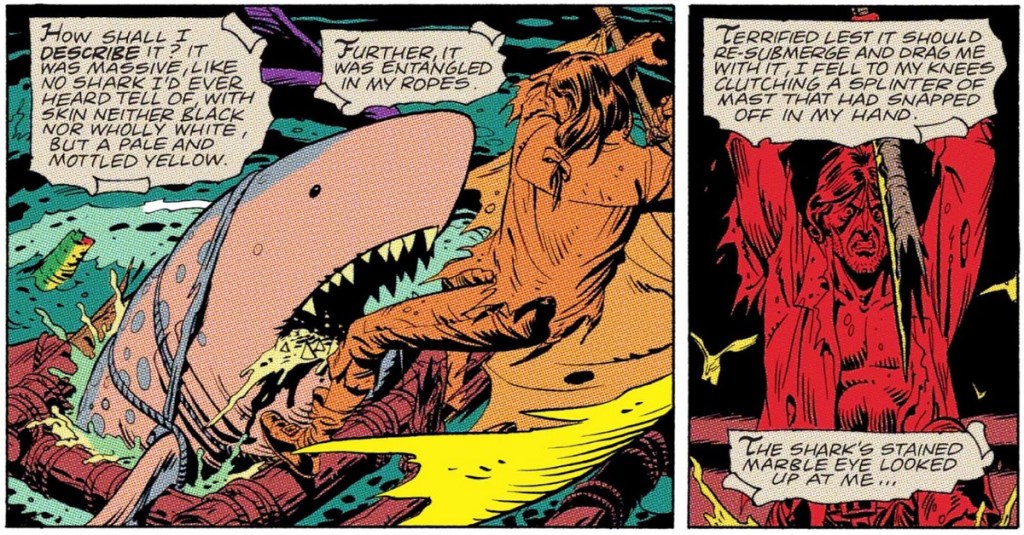
I don’t know that I can firmly put this in the negative column, but I had mixed feelings about the inclusion of in-universe pirate comics. It was interesting to see a reimagining on what the history of comics might have looked like if a genre other than superheroes had taken root, and the stories had many moments where they enhanced the themes of the main storyline. However, I also felt like the parallel storytelling got a little too wordy. There were many panels where both main panel storylines and pirate-comic storylines were getting dense narration. I wish the author had either simplified things a bit, or separated them out more to avoid me zoning out of one of the two.
An aspect that didn’t put me off, but which likely will for many is the rampant homophobia and sexism in the world. Moore doesn’t shy away from blunt depictions of how women and queer folks were treated. I think it was done with respect, as a real acknowledgement of the types of challenges these characters face. It isn’t always successful, but I think the attempt was honest. Still, you’re going to see adult men dating 16 year olds, lesbians being outed and then murdered by upset ‘fans’, and female supers overly sexualized. I think the author had a bit more of a blind spot where race was concerned (partly in that there were almost no non-white characters, and the ones present didn’t engage in the same stark acknowledgement of the state of racism in America). I can’t laud this book as a great example of diversity and inclusion, but it was humanizing and acknowledging the challenges of gay and lesbian women long before it was socially acceptable to do so. Like most of the book, expect things to start dark, and only get darker. You’ve got leading characters who are homophobic, sexist, and rapists. This connects back to the core theme that people taking on the superhero life probably aren’t good people, but I think it will be a deal breaker for some.
In Conclusion: really, this is a masterpiece. For those interested in a grim deconstruction of golden era superheroes, this is the gold standard for a reason. Really phenomenal, and a great example of how comics can be just as deep as novels.
 Marked for Plot
One thought on “Watchmen”