
For someone who reads as much as I do, the fact that I’ve gotten so far through life without reading a single Tchaikovsky novel is astounding. I blame my father in part: he stole Children of Time from me while visiting and never returned it. Alien Clay arrived as part of my never ending processional of Libby Audiobook holds, most of which get shunted back another few months until I have time for it. And I see why Tchaikovsky is so popular. I understand why it was nominated for a Hugo, and why it didn’t win. I liked it, but didn’t love it, and suspect that if I read Tchaikovsky he’ll be a reliably good author when I need a solid page-turner to get me off a reading slump.
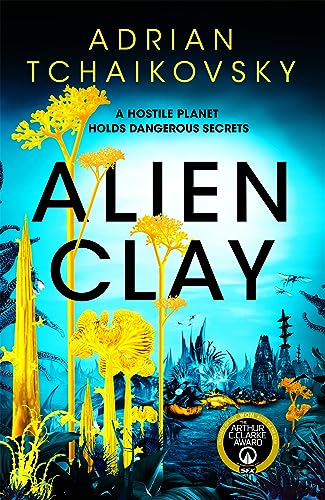
Read if Looking For: delightful alien ecology, characters with realistic skillsets, hopeless situations, readable prose
Avoid if Looking For: something new to say about fighting hegemony and fascism, books without bloat
Elevator Pitch:
Mildly rebellious Xenobiology professor Arton Daghdev has been caught by the Hegemony. As punishment, he is sent to Kiln, a extrasolar planet with the most advanced forms of life yet discovered. While there, he falls in with former rebel contacts, grows fascinated with the interchangable nature of Kilnish biology, and wonders what the point of life is when he’ll never be able to return home.
What Worked for Me:
The ideas in this book were simply delicious. I know that Tchaikovsky is known – at least in part – for his creative imagining of alien life. Kiln was very evocative, especially against the bog-standard (and ill defined/thought out) hegemonic empire we see in so many science fiction stories. Parasitic in the extreme, Kilnish life is always on the lookout for new ways to recombine parts to create new macrospecies. An eyeball isn’t part of an organism, it is an organism, able to slot into any number of different other parts or pieces to live in symbiosis, all of which are relatively compatible with each other. I loved this idea, and thought that Tchaikovsky really brought it to life. He struck a lovely balance of horror and wonder. The thrill of discovery mixed with the horrors of what happens when you let this alien life inside you (execution for traitorous behavior is usually very public displays of being injected with alien biomass and letting the labor force see what happens). It was creative, and unlike anything I’d seen before.
Daghdev himself was competently written as well. He does have some main character energy: the chief of the camp is a wannabe scientist who sees Daghdev as a kindred spirit despite is rebellious philosophies. This connection opens and closes a variety of doors that singles Daghdev out both with the command structure and with other laborers. However, he isn’t universally competent. He’s not a good fighter, and he can magically use the biomass printing machines when the need arises. He’s human. A remarkably smart human with a very specialized skillset. And most characters were like this, tangibly real in juxtoposition to the wildly imagined lifeforms outside their airlock.
What Didn’t Work for Me:
Ultimately, this book felt joyful and immersive, but not terribly deep. It’s the type of story I found myself sucked into, and certainly some elements will stick with me (the aliens, to nobody’s surprise). However, this book isn’t going to sit with me, isn’t going to nag me to recommend it as many times as I can. It didn’t push me as a reader. It was pleasant, enjoyable, and without any concrete or overt flaws that would give me pause in bringing it up as a recommendation. But there was a piece of soul missing. The story ended, and I thought ‘so what?’. I couldn’t find the analogy to our lives, or any purpose beyond showcasing the extraordinary experiences of a single man in a very cool world. To be clear, that’s enough in it’s own right, and not every book has to push on what it means to be human. I couldn’t help but feel like this book should be pushing though, and that it wanted to push, but never really took that idea anywhere as interesting or novel as the world itself. There were times where I saw Tchaikovsky trying to thematically connect Kilnish life with resistance movements against oppression. Thematically a good comparison, but unremarkable because of how little we actually saw of resistance movements at a large scale in this universe. Even more unremarkable because the Hegemony was as vividly imagined as a peanut. When one half of a thematic connection is blowing your mind and the other half feels more generic and uninspired than a ChatGPT response, that link becomes deeply unremarkable.
A slightly less essential complaint I have was the repetition we saw in describing how Kilnish ecosystems worked. The vivid details of new species never grew old, but the long extended metaphors began to grate with how often they arrived and how similar they felt. How often do we need to hear Daghdev ruminate about the wonders of an ecology that functions, in my mind, like Lego bricks? There came a point about 3/4 of the way through the book where I skipped forward because I didn’t need yet another explanation of how wonderous and different this life was from the way that humankind exists.
One of two things needed to happen to this book for me to give it 5 stars. Trim the fat, and remove enough plot points to turn it into a novella that ruthlessly focuses on the alien ecoystems with a small hint of systemic opression against a generic fascist society. Alternative, blow it up into a trilogy and make the first book an engaging portrait of Arton’s fall from academia and life on the run, with a lot of editing to make The Hegemony something compelling and realistic. Then perhaps the deeper themes about resistance against oppressive forces would shine through.
Conclusion: an addictive read, but one without the thematic depth to match the imaginative worldbuilding
- Characters: 4
- Worldbuilding: 5 (Kiln), 1 (Hegemony)
- Craft: 4
- Themes: 2
- Enjoyment: 4
 Marked for Plot
I have been repeatedly told that Tchaikovsky is the author who will get me properly into scifi (so far I’ve only read some of his fantasies, which I did think were excellent) and this review is only re-affirming that!
Do you have your eye on any of his other books? (There’s so many to choose from…!)
LikeLike
Children of Time was my planned entry point into his work! I still want to get around to it, but it’s popular enough that I want to try the audiobook. Turns out home ownership means less money to drop on physical books, and the self pub/indie stuff (or even just the less popular traditionally published spec fic) isn’t available through my local library, and thus gets the majority of my limited budget!
LikeLike