
This was one of the books I most wanted to read in 2026, and I can’t believe I almost reached the end of the year without picking it up. Truly, Sunward was a delight: the type of story I read in two sittings. It didn’t push my boundaries, but it was an uplifting story that was difficult to put down. Honestly, I like it than most of the other space/cozy adjacent I’ve read recently, and I don’t think it’s a particularly close call. I’m going to read more Alexander in the future, and this was an excellent read for the onset of winter.
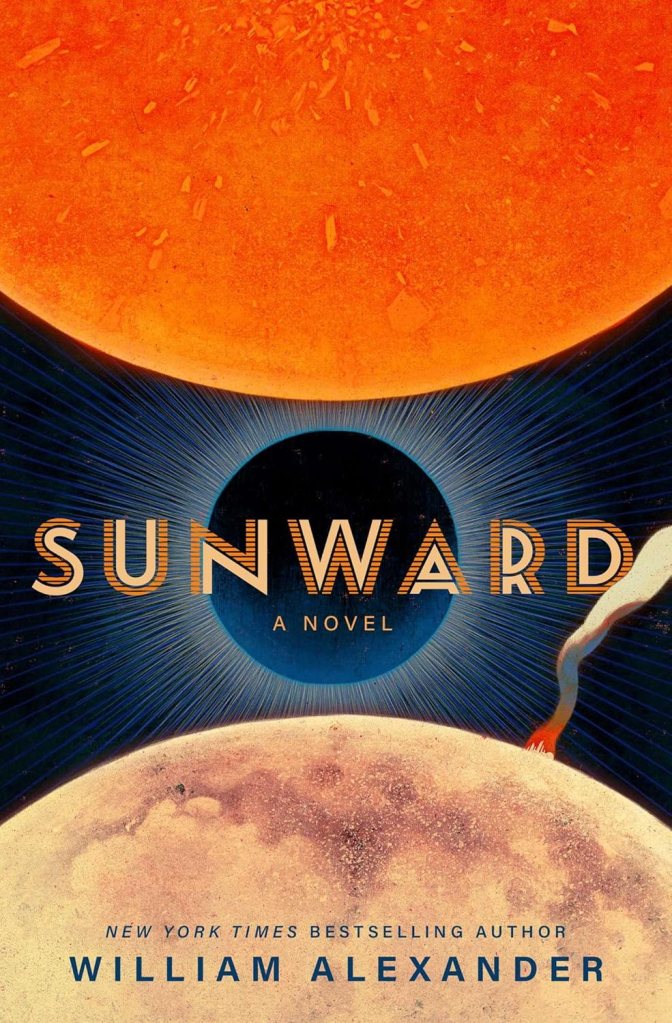
The Premise:
Tova Lir is a courier. She delivers mail (actual physical mail) while fostering her robotic children. When she stumbles into an assassination plot, her most recent child is placed in a coma-like state, bots everywhere are imperiled, and her ship gets marked as a pirate vessel. To get out of this mess, Tova must find her adult children, who are scattered across the solar sytem.
Read if You Like: cozy vibes meet serious tension, parents reuniting with adult children, sun cults, a happily trapped assassin
Avoid if You Dislike: robots as analogies for otherness, unresolved endings, generic science fiction worldbuliding
What Worked For Me:
I think I should have disliked this book more than I did. By all rights, I should feel the same way I did about Moss’d in Space (fine, but unmemorable). I don’t know that Sunward is too terribly different in concept, and I can’t think of much that truly differentiates it from other cozy-ish sci fi with AI copilots (of which there are many such novels). Hell, this book features a ‘go here, do this, repeat’ structure which typically drives me crazy. There’s not much here that’s novel or original – using robots as an analogy for the oppressed isn’t exactly a new idea. Alexander’s easy prose and gift of characterization bring the story to life, however.
Lir is a proud and fierce mother, and the love she holds for her children shine through on every page. That, by extension, makes me care about them. Each section of the book introduces us to a new location in the solar system and a new member of Lir’s family (including some human ones). It’s a nice pairing: a space station near the sun – possibly to be purchased by a sun cult – is where her scientifically minded son lives. Things happen, their bonds are fleshed out, and the Lir & company flee because the plot catches up to them. On to the next locale, and with it the next family member. My personal favorite was an actor in an all-robot rendition of Twelfth Night, who travels the solar system in a ship called The Green Room. However, there isn’t really a location or major character I dislike. Hell, even the parrot won me over by the end. I think Alexander succeeded in creating immediate stakes by putting pressure on Lir’s family bonds, which provided a necessary through-line to keep me invested in our meandering journey. I definitely bought into the idea that one (or more) of her children may perish in this book, which is why I can’t comfortably call Sunward fully cozy. It has the stylings of that subgenre, but there’s enough serious things going wrong at personal and societal levels that I think it can’t really be cozy. Very optimistic, however.
While the broad strokes of Sunward don’t break new ground, I think a lot of the details help breathe life into the story. I do appreciate the casual and unremarked queernormative setting which also didn’t feel belabored, a rare combination. A decent amount of attention is paid to an original sign language developed by the children of space; it gets a level of detail (again, without overdoing it) that had me convinced it would be a logical inclusion in every spacefaring human civilization. The robots in the theatrical production play multiple roles at the same time, and AI consciousness is presented as swimming through an ocean of data (probably not realistic, but fun) trying to avoid getting lost in the tides. Everything is familiar enough that Sunward isn’t really asking you to engage in anything new, but Alexander’s rendition of well-trod ideas is exemplary.
What Didn’t Work for Me:
Other than the fact that this book wasn’t doing much original, my only real complaint is that the ending petered off into nothing. Only five pages from the end of the story, I was convinced that this was kicking off a series. Nope! It wraps things up with very little attempt to tie up any lose ends. More than loose ends, really. If we continue the fabric analogy, the warp that held the story together got abandoned, and the reader has to finish weaving the finished piece on their own.
So many things were left unresolved, and it didn’t seem that Alexander wrapped things up abruptly to make a point. Instead, it felt like a word count had been reached, a deadline approached, and Alexander just decided that this would be the stopping point. There is a button he pushes at the end that wraps up one thing (kind of) but I was left feeling like the story needed an epilogue, if not another 200 pages.
Conclusion: a quick read with lots to love. It’s not the most original story in the world, but it’s well-realized and engaging
- Characters: 5
- Setting: 4
- Craft: 4
- Themes: 3
- Enjoyment: 4


I really liked this one, too! Something about the writing style and characters just made this one work where other books didn’t.
LikeLike
Did you review it in the past few months? Seeing it pop up on some people’s blogs definitely pushed it back to the top of my mind
LikeLike
I did review it, but it’s been about a year. I may have included it in a recent TTT post or something, though.
LikeLiked by 1 person