
Sofia Samatar has been on my reading list for a long time. I always figured I’d start with The Winged Histories, but this novella kept getting rave reviews, and I love a school/academia setting. I knew this story dealt with class displacement from the chatter, but I wasn’t prepared for how sharply Samatar wields the pen … or perhaps keyboard. This is yet another author that I have now committed to reading more of; I wanted this project to lessen my TBR, but it has in fact done the exact opposite.
The Premise
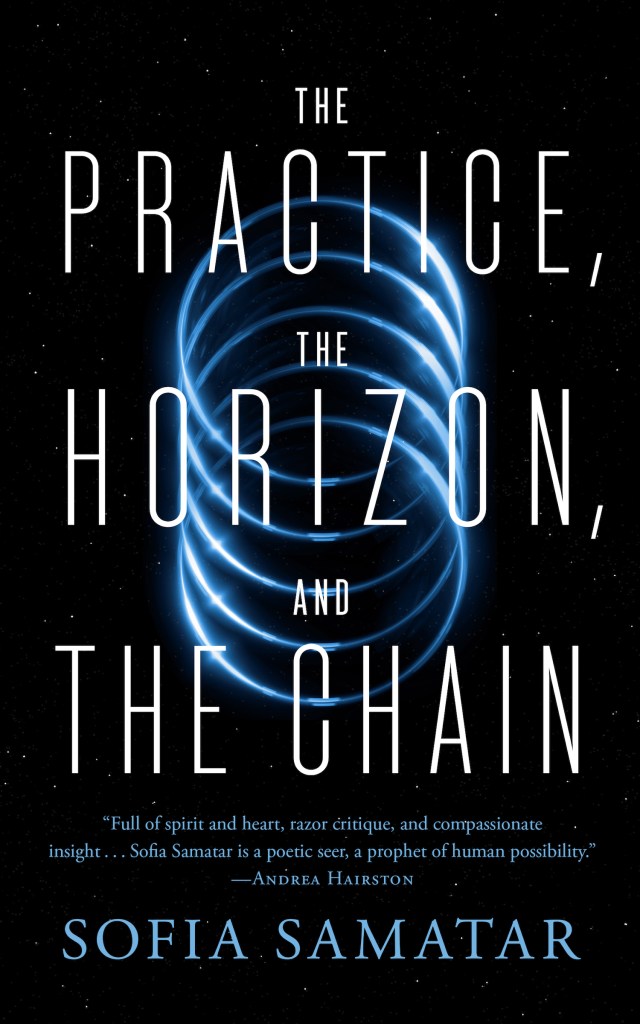
The Fleet travels from mining site to mining site, remaining for generations before making a long journey to a new source of resources. The boy is one of the Chained, laboring in the darkness beneath, and the professor is one of the ankleted, a sort of middle working class. Some of her friends don’t bear any fetters at all. The professor brings the boy out of the darkness, ‘liberating’ him to her class and installing him as a student at her university. It does not go as smoothly as she’d like. As the two grapple with the chains they bear, they both realize they have much more to learn.
Read If Looking For: thematically dense stories, nuanced yet archetypical characters, the pointlessness of meetings and committees
Avoid If Looking For: plot heavy books, tidy endings, school settings featuring classroom scenes, happy vibes
What Worked for Me
This novella is not subtle about its themes, but neither is it preachy or didactic. I think Samatar does a great job of layering meaning into the story, asking the reader to consider the situations of the characters, but she never quite steps out of the story to speak directly to the reader. At its most obvious is the focus on class differences. Notably, the professor sees herself as having saved the boy. He perceives himself as having lost all connections to his culture and his people, even though his physical situation is better than as a slave-laborer below. He is expected to be grateful, but he finds himself unmoored because the Chained built a cultural identity and community; the boy has become an island. Meanwhile the professor ends up reckoning with her own place in the system, passed over for papers and promotions and fighting for any scraps of recognition from the unfettered elite. However, her position of power over another group gives her a sense of artificial freedom. This freedom becomes threatened as she realizes the inadequacy of her own ‘help,’ but pushing further goes beyond the bounds of what has been deemed acceptable by those above her in the hierarchy. There are some layers introduced early that get peeled back beautifully during the second half of the novella, a really excellent use of foreshadowing.
The earliest, and most obvious, tell to get the reader thinking, is that the Chained and those with indigo anklets never get named. Only those without any fetters at all receive names in this book, a not-so-subtle nod to whom society sees as human, and who is a faceless cog in the machine. This comes to a head beautifully when Gil, the professor’s coworker, who considers her a dear friend, unleashes an angry tirade that shows that even his own support and bonding with the professor end when she does not act in accordance with his wishes. It is only in this moment that the professor’s relationship with the boy begins to truly shift to something akin to equals. Until she acknowledges her own enslavement, she cannot see how she enslaves others.
In a really phenomenal interview (you should go read it alongside this Novella. I sort of wish I’d read it before, to be honest), Samatar talks about how this book was born from the murder of George Flyod at the hands of Minneapolis Police, and the sudden flowering of DEI work at colleges. She says “I was interested in this sort of central contradiction of diversity work, which is something that is almost posed against itself, to the extent that the formation of the committee is the work.” I hadn’t made this overt connection while reading the book, but it’s the type of really successful allegory that only speculative fiction can execute. By divorcing an idea so much from its realistic particulars, you’re able to strike at the heart of a topic in interesting and novel ways. It’s part of the beauty of this genre, and few authors succeed at bridging two worlds as successfully as Samatar did.
This book is going to resonate most with readers who like to engage with these deeper meanings. The worldbuilding and characters and plot are all skillfully executed, but ultimately in service to getting you to contemplate and reflect. While the chains and anklets are objectively horrific, they also become ingrained cultural elements for the community, symbols built from their communal experiences. Samatar seeks to go beyond ‘chain bad’ and push the reader to go deeper than the surface level understanding of oppression that is more common in speculative fiction. It’s a much more nuanced take than most Dystopian explorations of classism manage to achieve.
What Didn’t Work for Me
There’s nothing about this novella that I can say is bad or poorly done. I truly think that it executed vision flawlessly, down to an ambiguous ending that is likely the bright spot before something truly horrible happens. The worst I can say about it is that I think it’s going to fade from my memory, whereas my favorites tend to linger in my brain. There aren’t any substantive or meaningful complaints from me though, and I thought this is the type of novella I’d like to continue to see get Hugo nominations.
Conclusion: a theme heavy exploration of classism in academic institutions, melded with a science fiction slave narrative
 Marked for Plot
One thought on “Novella Readathon #21: The Practice, The Horizon, and The Chain”